Special-Product Factorization
Perfect-square trinomials factor into squared binomials when the middle term matches twice the product of the end-term roots. Differences of two squares factor into a sum times a difference. This lesson explains both patterns, the checks that prevent common errors, and how factoring a square garden’s area leads to its side length and perimeter.
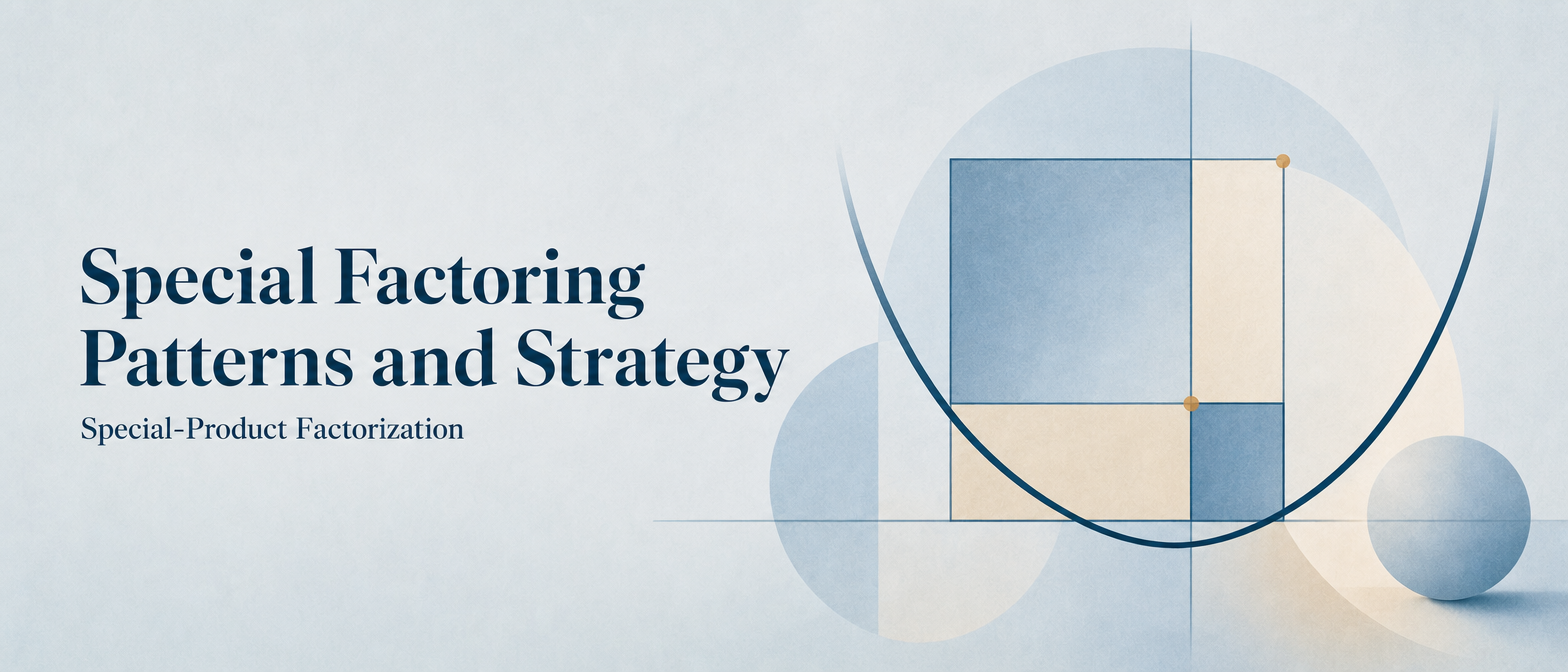
The Garden Mystery
A square garden has an area of 16x^2 + 40x + 25 square feet, but its side length is unknown. For a square, area = side × side = side^2. The question is therefore: which expression, squared, gives 16x^2 + 40x + 25?
Special-product patterns connect certain expanded polynomials with their factored forms. Multiplying a binomial by itself reveals the first pattern; reading that multiplication in reverse lets us factor a perfect-square trinomial. We will return to the garden after developing the pattern and its required checks
Perfect-Square Trinomials
Where the middle term comes from
Expanding (x + 3)(x + 3) gives x·x + x·3 + 3·x + 3·3 = x^2 + 3x + 3x + 9 = x^2 + 6x + 9. The middle term is 6x = 2(x)(3): twice the product of the expressions whose squares are the first and last terms
The two perfect-square identities are a^2 + 2ab + b^2 = (a + b)^2 and a^2 - 2ab + b^2 = (a - b)^2. In these forms, the sign of the middle term matches the sign inside the squared binomial
Example: x^2 + 10x + 25
Factor x^2 + 10x + 25. The first term is x·x, so take a = x. The last term is 5·5, so take b = 5. The required middle term is 2ab = 2(x)(5) = 10x, which matches the actual middle term. Therefore, x^2 + 10x + 25 = (x + 5)^2
Example: 4y^2 - 12y + 9
Factor 4y^2 - 12y + 9. Since (2y)(2y) = 4y^2, take a = 2y, not 4y. Since 3·3 = 9, take b = 3. Now 2ab = 2(2y)(3) = 12y. The actual middle term is -12y, so the minus form applies: 4y^2 - 12y + 9 = (2y - 3)^2
Practice: complete the squared binomial
Complete the factored form of 9x^2 + 24x + 16: 9x^2 + 24x + 16 = (a + b)^2. The first blank represents a square root of the first term, and the second represents a square root of the last term. The original choices are 3x, 9x, 4, 8, and 12x
The correct entries are a = 3x and b = 4: (3x)^2 = 9x^2, 4^2 = 16, and 2(3x)(4) = 24x. Thus 9x^2 + 24x + 16 = (3x + 4)^2. Using 9x would fail because (9x)^2 = 81x^2, not 9x^2
The Middle-Term Trap
Is x^2 + 16x + 36 a perfect-square trinomial? Its end terms look promising: x^2 = x·x and 36 = 6·6. But with a = x and b = 6, the required middle term is 2ab = 2(x)(6) = 12x. The actual middle term is 16x
Since 12x ≠ 16x, x^2 + 16x + 36 is not a perfect-square trinomial. This conclusion rejects the squared-binomial pattern; it is not a claim that no other factoring method could apply
Difference of Two Squares
The general identity is a^2 - b^2 = (a + b)(a - b). One factor adds and the other subtracts, so the middle products cancel when the factors are multiplied
Example: x^2 - 64
Factor x^2 - 64. It has two terms separated by subtraction. Also, x^2 = x·x and 64 = 8·8, so both terms pass the square check. Therefore, x^2 - 64 = (x + 8)(x - 8)
Verify by multiplying back: (x + 8)(x - 8) = x^2 - 8x + 8x - 64 = x^2 - 64. The middle terms cancel exactly
Example: 9m^2 - 25n^4
Factor 9m^2 - 25n^4. Take account of both the coefficients and the variable powers: 9m^2 = (3m)^2 and 25n^4 = (5n^2)^2. Using a = 3m and b = 5n^2 gives 9m^2 - 25n^4 = (3m + 5n^2)(3m - 5n^2)
The second expression inside the factors is 5n^2, not 25n^2. Squaring 25n^2 would give 625n^4 because 25^2 = 625. Squaring 5n^2 gives the required 25n^4
Practice: complete the two factors
Complete the factored form of 49k^2 - 36: 49k^2 - 36 = (a + b)(a - b). The value of a fills the first position in both factors, and b fills the second position in both factors. The original choices are 7k, 49k, 6, 36, and 18
The correct entries are a = 7k and b = 6, since (7k)^2 = 49k^2 and 6^2 = 36. Therefore, 49k^2 - 36 = (7k + 6)(7k - 6). Each entry must square back to its entire term; retaining 49 as the coefficient inside the factors would fail that check
When a check fails
Can p^6 - 12q^4 be factored as a difference of squares using the lesson’s whole-number coefficient roots? It has two terms and subtraction. The first term passes because p^6 = p^3·p^3. However, 3^2 = 9 and 4^2 = 16, so no whole number squares to 12. The term 12q^4 therefore fails this perfect-square check, and this pattern does not apply in the form being practiced
Practice: decide whether the pattern applies
Does the difference-of-squares pattern apply? Classify t^4 - 81, c^2 + 100, and 18y^2 - 49 as “Pattern applies” or “Pattern does not apply,” using the same three checks
For t^4 - 81, the pattern applies: there are two terms separated by subtraction, with t^4 = (t^2)^2 and 81 = 9^2. For c^2 + 100, the pattern does not apply because the terms are added, not subtracted. For 18y^2 - 49, the pattern does not apply under the lesson’s whole-number coefficient check because 18 is not a perfect-square coefficient
Back to the Garden
Find the side length from the area
The square garden’s area is 16x^2 + 40x + 25 square feet. To factor it, use 16x^2 = (4x)^2 and 25 = 5^2. The middle-term check gives 2(4x)(5) = 40x, exactly matching the given middle term
Thus 16x^2 + 40x + 25 = (4x)^2 + 2(4x)(5) + 5^2 = (4x + 5)^2. Since a square’s area is its side length squared, the garden’s side length in this application is 4x + 5 feet
Find the fencing needed
How much fence is needed when x = 5? A square has four equal sides, so its perimeter is P = 4s. Substituting the side expression gives P = 4(4x + 5) = 16x + 20 feet. The 4 multiplies both terms inside the parentheses
At x = 5, P = 16(5) + 20 = 80 + 20 = 100 feet. The gardener needs 100 feet of fencing. Area is measured in square feet; side length and perimeter are measured in feet
Summary
Perfect-square trinomials: a^2 + 2ab + b^2 = (a + b)^2 and a^2 - 2ab + b^2 = (a - b)^2. The middle-term sign matches the sign inside the squared binomial
Middle-term check: after identifying a and b from the end terms, calculate 2ab. The actual middle term must match +2ab or -2ab as appropriate. If it does not, the perfect-square pattern fails
Difference of two squares: a^2 - b^2 = (a + b)(a - b). Check for two terms, subtraction, and two perfect squares, using the lesson’s whole-number coefficient checks
Square-root coefficients as well as variable powers when identifying the expressions to put into the factors: 9m^2 = (3m)^2 and 25n^4 = (5n^2)^2. The second expression is 5n^2, never 25n^2
Verify by multiplying back. In a squared binomial, the middle products combine to produce the required middle term. In a sum-times-difference product, they cancel exactly
Quiz
A square patio has an area of 4x^2 + 28x + 49 square feet. Its side length has the form cx + d feet, where c and d are whole numbers. Use this information for the perimeter question below