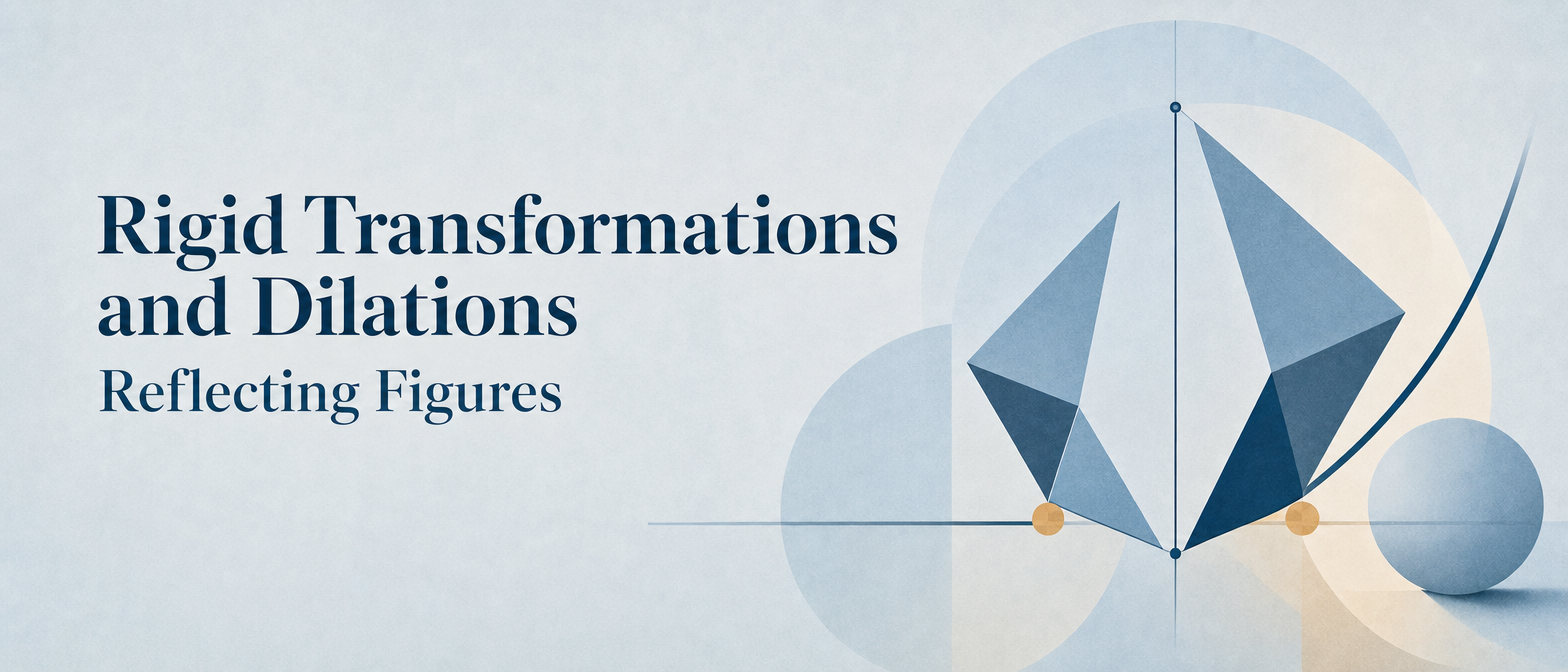
Reflecting Figures
A reflection pairs points at equal perpendicular distances on opposite sides of a mirror line and leaves points on the line fixed. This guide develops that rule into tests for mirror images, exact polygon constructions, a shortest-path argument, and coordinate rules for the x-axis, y-axis, and y = x.
A Mirror Made of Math
On a perfectly still mountain lake, the peaks appear again in the water, flipped upside down. Every point of the mountain has a mirror partner. The question is: where, exactly, does each partner land?
Treat the horizontal waterline as a mirror line. Call the highest peak P and its watery twin P'. The points are vertically aligned. The segment PP' crosses the waterline at a right angle, and the distance from P to the waterline equals the distance from the waterline to P'

The Reflection Rule
The line of reflection is the mirror line. Double arrowheads indicate that the line extends forever. The original figure is the preimage; the reflected figure is the image. Prime marks identify corresponding image points: triangle ABC reflects to triangle A'B'C', with A corresponding to A', B to B', and C to C'
In the course's triangle example, ABC lies to the left of vertical line m and A'B'C' lies to its right. The segment AA' is perpendicular to m, and its two halves have equal lengths. A is the vertex nearest m, and A' remains the nearest vertex on the other side
A reflection is an isometry: size and shape do not change, so the preimage and image are congruent. The figure's orientation is reversed. A point N exactly on the mirror line has zero distance to travel and stays fixed: N' = N

Worked example: Check a mirror pair
Point K sits 3 units from line m. Point T lies on the perpendicular through K, 3 units from m on the opposite side. Decide: is T the reflection K'?
First check direction: K and T lie on a line perpendicular to m. Next check distance: K is 3 units from m and T is 3 units from m, so 3 = 3. Finally check sides: the points are on opposite sides of m. All three checks pass, so T is the reflection of K and can be renamed K'

Spotting True Mirror Images
Not every line between two congruent shapes is a mirror line. The course gives two tests. Test 1 is orientation: the reflection must flip the figure. Test 2 is equidistance: every pair of matching points must be the same perpendicular distance from the line, on opposite sides
In Case 1, two congruent flags face opposite directions across a diagonal line running from lower left to upper right. Matching corners are connected by a perpendicular segment with equal distances on the two sides. This pair is a reflection. In Case 2, two congruent arrows point the same way with a candidate diagonal line between them. The course rejects this candidate using the orientation test: the true reflected arrow would face the opposite way and would not match the second arrow


Worked example: Judge this pair
Two congruent zigzag bolts sit on either side of a vertical dashed candidate line. Both bolts zig to the right. Is the line a line of reflection?
No. Applying the orientation test, the mirror image of the left bolt would zig to the left, so it would not match the actual right bolt. The bolts are shifted copies: congruent, but not mirror images across this line

Practice: Classify the pairs
Sort each described pair of congruent figures. The categories are “Reflection across the line” and “Not a reflection.”
Two hearts facing opposite ways; every matching point pair is the same perpendicular distance from the line, on opposite sides: Reflection across the line. Both taught tests pass
Two identical arrows pointing the same direction, with a line drawn between them: Not a reflection. The course's orientation test fails
Matching corners sit 2 units and 4 units from the line, on opposite sides: Not a reflection. Being on opposite sides is not enough; the distances are unequal. The practice feedback emphasizes using both tests rather than treating congruence alone as proof
Constructing Exact Reflections
Eyeballing a reflection can distort the figure. Instead, construct the image one vertex at a time. First draw a guide line through each vertex perpendicular to the line of reflection, extending across it. Next measure the vertex's distance from the mirror line and mark its image at the same distance on the opposite side. Once every vertex has an image, connect the image points in the same edge order as the original

For the single-vertex example, V is 2 grid units above horizontal line l. Its perpendicular guide is vertical. V' lies on that same guide, 2 units below l. Perpendicular direction plus equal distance gives the exact image
Worked example: Reflect triangle PQR
Reflect triangle PQR across the horizontal line l. P is 1 unit above l, Q is 3 units above l, R is 2 units above l
Draw a perpendicular guide through each vertex. On P's guide, place P' 1 unit below l. On Q's guide, place Q' 3 units below l. On R's guide, place R' 2 units below l. Connect P' to Q', Q' to R', and R' to P', preserving the original edge order. As a check, P was nearest the line and P' is still nearest on the other side: both are 1 unit from l

Practice: Inspect a construction
A quadrilateral JKLM is left of vertical line n. The distances from J, K, L, and M to n are 2, 4, 3, and 1 units, respectively. Each proposed image is on its own perpendicular guide to the right of n: J' is 2 units from n, K' is 4 units, L' is only 1 unit, and M' is 1 unit
The Shortest Path Trick
Two campsites X and Y sit on the same side of a straight canal. X is 2 units above the canal on the left, and Y is 3 units above it on the right. Where should a shared water station Z on the canal be placed so that XZ + ZY is as short as possible? Choosing the point closest to X, the point closest to Y, or a point midway between their positions are tempting guesses. The course uses a reflection to locate the best point instead


Reflect, then straighten
Draw a perpendicular from Y across the canal. Place Y' 3 units below the canal on that perpendicular, matching Y's distance above it. Draw the straight segment XY'. Its one crossing with the canal is Z. The chosen route is X to Z, then Z to Y

Why Z wins
Because Y' is the reflection of Y, every point on the canal is the same distance from Y and Y'. In particular, ZY = ZY', so XZ + ZY = XZ + ZY'. At the constructed Z, X, Z, and Y' lie on one straight segment. The shortest route between two points is a straight segment, so this choice minimizes the total

Any other point W on the canal, away from Z, makes X to W to Y' a bent detour rather than the straight segment XY', so it gives a longer walk. Reflection turns the original bent-route problem into a straight-line problem
Practice: Match claims and reasons
Match each claim in the shortest-path argument to the reason that backs it up. The claims are “ZY = ZY' for every point Z on the line,” “XZ + ZY' is smallest at our chosen Z,” and “How to find the best point Z.”
The supplied reasons are “Y' is the reflection of Y, so distances to the line match,” “X, Z, and Y' lie on one straight segment,” “Where segment XY' crosses the line,” and “Z is the point on the line closest to Y.”
The correct matches are: ZY = ZY' for every point Z on the line → Y' is the reflection of Y, so distances to the line match; XZ + ZY' is smallest at our chosen Z → X, Z, and Y' lie on one straight segment; How to find the best point Z → Where segment XY' crosses the line. The closest-to-Y reason is unused. The feedback distinguishes the three roles: reflection gives equality, straightness gives minimality, and the crossing locates Z
Reflections with Coordinates
Reflect across the x-axis
Across the x-axis, the x-coordinate stays the same and the y-coordinate becomes its opposite: (x, y) → (x, -y). Apply this rule to triangle F(2, 1), S(4, 5), Z(5, 2). The image vertices are F'(2, -1), S'(4, -5), and Z'(5, -2). Connect them in the same edge order to form triangle F'S'Z'


Each image lies directly below its preimage on a vertical perpendicular to the x-axis. For example, S is 5 units above the axis and S' is 5 units below it, preserving equal perpendicular distances
Two more mirror lines
Across the y-axis, the y-coordinate stays the same and the x-coordinate becomes its opposite: (x, y) → (-x, y). Thus E(3, 2) reflects to E'(-3, 2). Their horizontal connector is perpendicular to the y-axis, and the points are equally far from it on opposite sides
Across the diagonal line y = x, the coordinates swap: (x, y) → (y, x). For example, D(1, 4) reflects to D'(4, 1). The segment DD' crosses y = x at a right angle with equal distances on the two sides. G(4, 4) lies on y = x and does not move: G' = G
Recall the rules
Recall each rule before checking it: Across the x-axis → (x, y) → (x, -y): x stays, y flips sign. Across the y-axis → (x, y) → (-x, y): y stays, x flips sign. Across the line y = x → (x, y) → (y, x): swap the coordinates. A point on the mirror line → Maps to itself: zero distance to travel
Practice: Complete the coordinates
Reflect the point K(-4, 2) across the line y = x. Complete the coordinates of K'. The template is K' = ( ___ , ___ ), with choices 2, -4, 4, and -2. The first blank is the x-coordinate of K'; the second is the y-coordinate
The answer is K' = (2, -4): the first blank is 2 and the second is -4. Across y = x, the coordinates trade places with their signs intact; nothing flips sign. The feedback for choosing 4 stresses swapping the original coordinates exactly as they are
Summary
Definition: Each point and its image lie on a perpendicular to the mirror line, at equal distances on opposite sides. Points on the line stay fixed
Identify: The course's two tests are that orientation must flip and matching points must be equidistant from the line on opposite sides
Construct: Draw perpendicular guide lines through each vertex, copy each distance to the opposite side, and connect the image points in the same edge order
Shortest path: Reflect Y to Y'. The best Z is where XY' crosses the line, since XZ + ZY = XZ + ZY' and the transformed route is straight
Coordinate rules: x-axis: (x, y) → (x, -y); y-axis: (x, y) → (-x, y); y = x: (x, y) → (y, x)
Quiz

For the next question, line m is horizontal and J is 3 units above it. Point 1 is directly below J, 3 units below m. Point 2 is 3 units above m and to the right of J. Point 3 is directly below J but only 1 unit below m. Point 4 is 3 units below m but shifted 2 units right of J's vertical