Triangle Medians, Altitudes, and Midsegments
Medians connect vertices to opposite-side midpoints and meet at the centroid, which divides each median in a 2:1 ratio. Altitudes are perpendicular to opposite-side lines and meet at the orthocenter. Midsegments join two side midpoints, run parallel to the third side, and have half its length. This guide uses those relationships to find lengths and angles and to write equations of medians and altitudes.
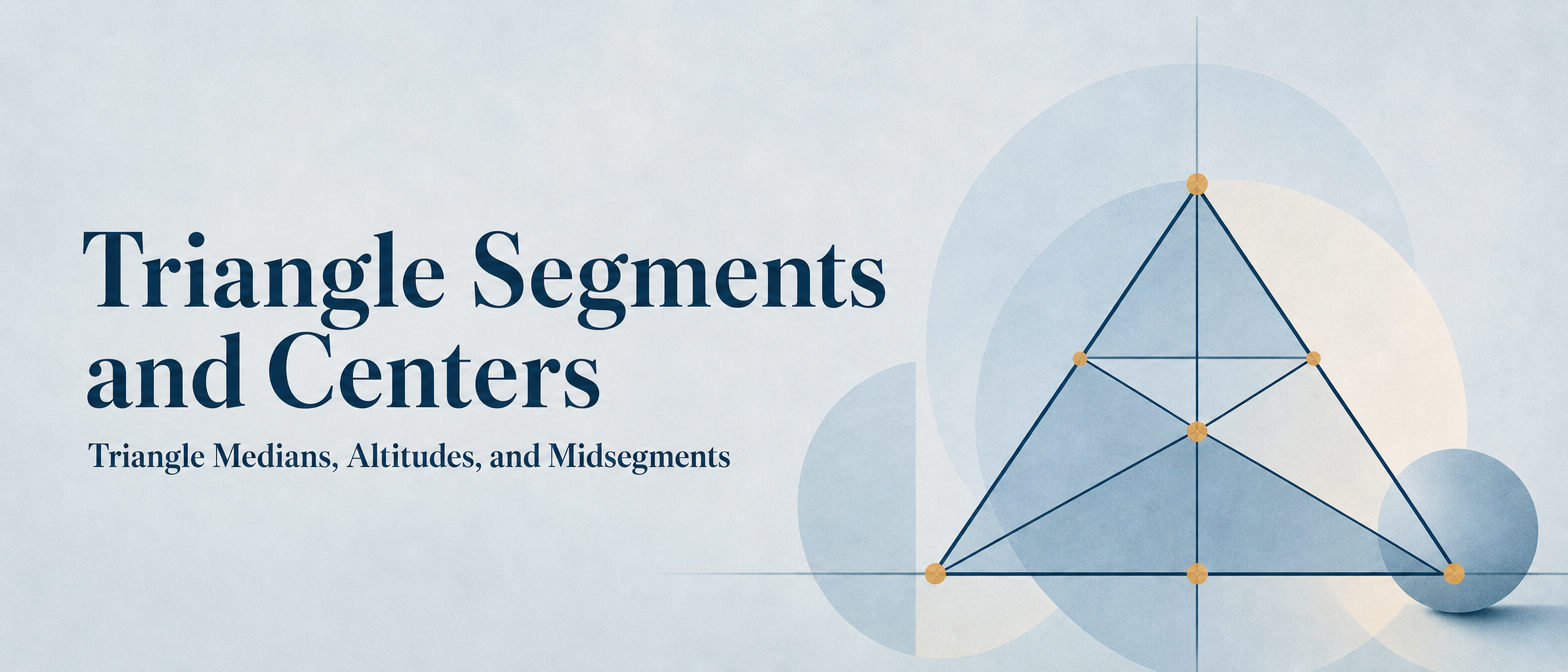
The Balance Point Mystery
A flat triangle cut from stiff cardboard can balance horizontally on one fingertip at one particular point. Where is that balance point? The answer is connected to one of three families of special segments in a triangle
In triangle ABC, one kind of segment connects a vertex to the exact midpoint of the opposite side. Another connects a vertex perpendicularly to the line containing the opposite side. A third connects the midpoints of two sides and has no vertex endpoint. These are medians, altitudes, and midsegments, respectively

The central question is: which segment is which? Their defining relationships—not simply their directions or appearance—determine which equations can be used to find lengths, angles, and line equations
Medians and the Centroid
A median connects a vertex to a midpoint
A median is a segment from a vertex to the midpoint of the opposite side. In triangle ABC, let M be the midpoint of AB, so AM = MB. Connecting vertex C to M gives median CM. Every triangle has three medians, one from each vertex


Worked example: find NK
In triangle JKL, LN is a median with N on JK. Given JN = 4x − 3 and NK = 2x + 9, find NK. Because LN is a median, N is the midpoint of JK, so JN = NK
Set the expressions equal: 4x − 3 = 2x + 9. Subtracting 2x gives 2x − 3 = 9. Adding 3 gives 2x = 12, so x = 6. Substitute into the requested length: NK = 2(6) + 9 = 21. As a check, JN = 4(6) − 3 = 21, so the two halves match

Practice 1: distinguish half from whole
In triangle FGH, GM is a median with M on FH. The given lengths are FM = 3x − 5 and FH = 4x + 6. Here FM is half of the whole side FH
The Centroid Theorem
The three medians meet at a single point called the centroid, the triangle's balance point. In triangle ABC, let X, Y, and Z be the midpoints of AB, BC, and AC, respectively. The medians CX, AY, and BZ meet at centroid P
The Centroid Theorem places P two thirds of the way from each vertex to the opposite side's midpoint: AP = (2/3)AY, BP = (2/3)BZ, and CP = (2/3)CX. Equivalently, the centroid divides each median in a 2:1 ratio, with the longer piece on the vertex side. For example, AP:PY = 2:1

Worked example: from a piece to the whole median
In triangle ABC, the medians meet at centroid P. Along median CX, CP = 10. Find the full median CX. Since CP is the vertex-to-centroid piece, 10 = (2/3)CX. Multiplying by 3/2 gives CX = 10 × (3/2) = 15. The remaining piece is PX = 15 − 10 = 5, so CP:PX = 10:5 = 2:1

Practice 2: locate the centroid
Median AY is represented on a number line with vertex A at 0 and midpoint Y at 18. Where does centroid P lie? Starting at the vertex, AP = (2/3)(18) = 12, so P is at 12. The remaining distance PY is 6. The centroid is not halfway along the median, and the two-thirds distance must be measured from A, the vertex end
Altitudes and the Orthocenter
An altitude is a perpendicular segment from a vertex to the line containing the opposite side. In triangle ABC, if AX is the altitude from A to BC, then X is the foot of the altitude and AX meets BC at a right angle

The right angle is the defining condition. X is not necessarily the midpoint of BC. Matching tick marks establish equal halves for a median; a right-angle square establishes perpendicularity for an altitude
Why an altitude can lie outside the triangle
The definition refers to the line containing the opposite side, not only the side segment. In the course's obtuse triangle DEF, the obtuse angle is at F. The perpendicular from E to the line through DF lands beyond F, on an extension of DF. It is still an altitude because it is perpendicular to the line containing the opposite side
Every triangle has three altitudes. The lines containing them meet at a single point called the orthocenter. Keep the two centers distinct: medians meet at the centroid; altitude lines meet at the orthocenter

Practice 3: identify an altitude by its marks
Triangle JKM contains three candidate segments. The segment from J ends at a point on KM whose two adjacent halves have matching tick marks. The segment from K meets JM at a right-angle square. The segment from M ends at an unmarked point on JK, with no equality or right-angle marks

Midsegments and the Midsegment Theorem
A midsegment joins the midpoints of two sides of a triangle. Neither endpoint is a vertex. In triangle ABC, if D is the midpoint of AB and E is the midpoint of BC, then AD = DB, BE = EC, and DE is a midsegment
The Midsegment Theorem states that a midsegment is parallel to the third side and has half its length. For this triangle, DE ∥ AC and DE = (1/2)AC. The three midsegments do not all meet at one point; together, they form the smaller midsegment triangle

Worked example: reading a midsegment figure
In triangle RST, G is the midpoint of RS and H is the midpoint of ST. Given RT = 26 and GS = 7, point Q lies on RT and QH is drawn. The angle GHQ measures 32°. Find GH, GR, and the measure of angle HQT
Since G and H are midpoints, GH is a midsegment parallel to RT. Therefore GH = (1/2)(26) = 13. Because G is the midpoint of RS, GR = GS = 7
For the angle, QH is a transversal of the parallel lines containing GH and RT. Angles GHQ and HQT lie between those parallels on opposite sides of the transversal, so they are alternate interior angles and have equal measures. Thus m∠HQT = m∠GHQ = 32°

Practice 4: match each length to its value
In triangle ABC, D is the midpoint of AB and E is the midpoint of BC. Given DE = 12, DB = 9, and EC = 7, match AC, AD, and BE to the candidate values 24, 9, 7, and 6
The correct relationships are AC = 2DE = 24, AD = DB = 9, and BE = EC = 7. The value 6 is unused. DE is already half of AC, so finding AC requires doubling 12, not halving it again. The other two answers come directly from equal midpoint halves
Which Segment Is It?
Compare each segment's defining relationship and what happens when all three segments of that family are drawn
| Segment | Defining relationship | Three segments in one triangle |
|---|---|---|
| Median | Connects a vertex to the midpoint of the opposite side. | Meet at the centroid, two thirds of the way from each vertex along its median. |
| Altitude | Connects a vertex perpendicularly to the line containing the opposite side. | Their lines meet at the orthocenter. |
| Midsegment | Connects two side midpoints; neither endpoint is a vertex. | Form the midsegment triangle rather than meeting at one point. |
Practice 5: classify the clues
Which segment type does each clue describe? The clue “Runs from a vertex and meets the opposite side's line at a right-angle mark” describes an altitude. The right angle is the deciding relationship
The clue “Both endpoints are marked midpoints of two sides” describes a midsegment. The clue “One of three segments that meet at the centroid” describes a median
Equations on the Coordinate Plane
Worked example: equation of a median
Triangle PQR has vertices P(−2, 5), Q(6, 1), and R(−2, −3). Write the equation of the median through R in slope-intercept form, y = mx + b. The side opposite R is PQ, the side that does not contain R. The median's line passes through R and the midpoint of PQ


First find midpoint M by averaging the corresponding coordinates: M = ((−2 + 6)/2, (5 + 1)/2) = (2, 3). Thus PM = MQ
Next find the slope through R and M: m = (3 − (−3))/(2 − (−2)) = 6/4 = 3/2. The double negatives in both differences become addition
Use point-slope form through M: y − 3 = (3/2)(x − 2). Distributing gives y − 3 = (3/2)x − 3, so y = (3/2)x. The intercept is zero, so this line passes through the origin. It also contains R because (3/2)(−2) = −3
Practice 6: complete the median equation steps
Triangle GHK has vertices G(−5, 1), H(3, 5), and K(2, −3). Write the equation of the median through K in slope-intercept form by finding the midpoint of GH, the median's slope, and its equation
The side opposite K is GH. Its midpoint is ((−5 + 3)/2, (1 + 5)/2) = (−1, 3). The slope from K to this midpoint is (3 − (−3))/(−1 − 2) = 6/(−3) = −2. Using K gives y + 3 = −2(x − 2), so y = −2x + 1. The three completed steps are therefore (−1, 3), −2, and y = −2x + 1

Keep the coordinate order when averaging: the midpoint is (−1, 3), not (3, −1). The slope is negative because the changes in y and x have opposite signs; it is not 2 or −1/2. Simplifying point-slope form gives an intercept of +1, not −1
Worked example: equation of an altitude
Return to P(−2, 5), Q(6, 1), and R(−2, −3). Now write the equation of the altitude through R in slope-intercept form. The opposite side is still PQ, but an altitude requires perpendicularity rather than a midpoint. Find the slope of PQ, use its negative reciprocal for the altitude's slope, and write the line through R

The slope of PQ is mPQ = (1 − 5)/(6 − (−2)) = −4/8 = −1/2. From P to Q, the change is down 4 and right 8, consistent with that slope. The perpendicular slope is the negative reciprocal of −1/2, which is 2

Use point-slope form through R: y − (−3) = 2(x − (−2)). This becomes y + 3 = 2(x + 2), then y + 3 = 2x + 4, and finally y = 2x + 1. The line passes through R and meets PQ at a right angle
Summary
Median: a segment from a vertex to the midpoint of the opposite side. The opposite side is divided into equal halves, and the three medians meet at the centroid
Centroid Theorem: the vertex-to-centroid distance is two thirds of the full median. The two pieces have a 2:1 ratio, with the longer piece next to the vertex
Altitude: a perpendicular segment from a vertex to the line containing the opposite side. Its foot can lie on an extension of that side. The three altitude lines meet at the orthocenter
Midsegment: a segment joining two side midpoints. It is parallel to the third side and half its length. The three midsegments form the midsegment triangle
Coordinate methods: a median's equation uses the vertex and the opposite side's midpoint. In the altitude examples, the equation uses the vertex and the negative reciprocal of the opposite side's slope. For centroid calculations, remember that a given vertex-to-centroid length is already the two-thirds share
Quiz
Quiz 1: the centroid ratio
In triangle RST, the three medians meet at centroid G. The full median RW measures 24, where W is the midpoint of ST. Find the vertex-to-centroid distance RG

Quiz 2: the midsegment triangle
Triangle XYZ has sides XY = 12, YZ = 16, and XZ = 20. Its three midsegments form the midsegment triangle
Quiz 3: equation of an altitude
Triangle ABC has vertices A(0, 4), B(6, 0), and C(−2, −2). Write the equation of the altitude through C in slope-intercept form. Complete the three steps: slope of AB, altitude slope, and equation
The side opposite C is AB. Its slope is (0 − 4)/(6 − 0) = −4/6 = −2/3. The altitude's perpendicular slope is the negative reciprocal, 3/2. Through C, point-slope form gives y − (−2) = (3/2)(x − (−2)), or y + 2 = (3/2)(x + 2). Distributing and simplifying gives y + 2 = (3/2)x + 3, so y = (3/2)x + 1
The completed answers are −2/3, 3/2, and y = (3/2)x + 1. Keep the negative sign in the slope of AB, change both the sign and reciprocal for the perpendicular slope, and handle the double negatives carefully when substituting C