Properties of Inscribed Angles
An inscribed angle measures half its intercepted arc. This relationship explains why angles sharing an arc are congruent, why a diameter produces a right angle, and why opposite angles of an inscribed quadrilateral add to 180°. Use these connections to find arcs and angles, solve algebraic expressions, and combine circle rules with the triangle angle sum.
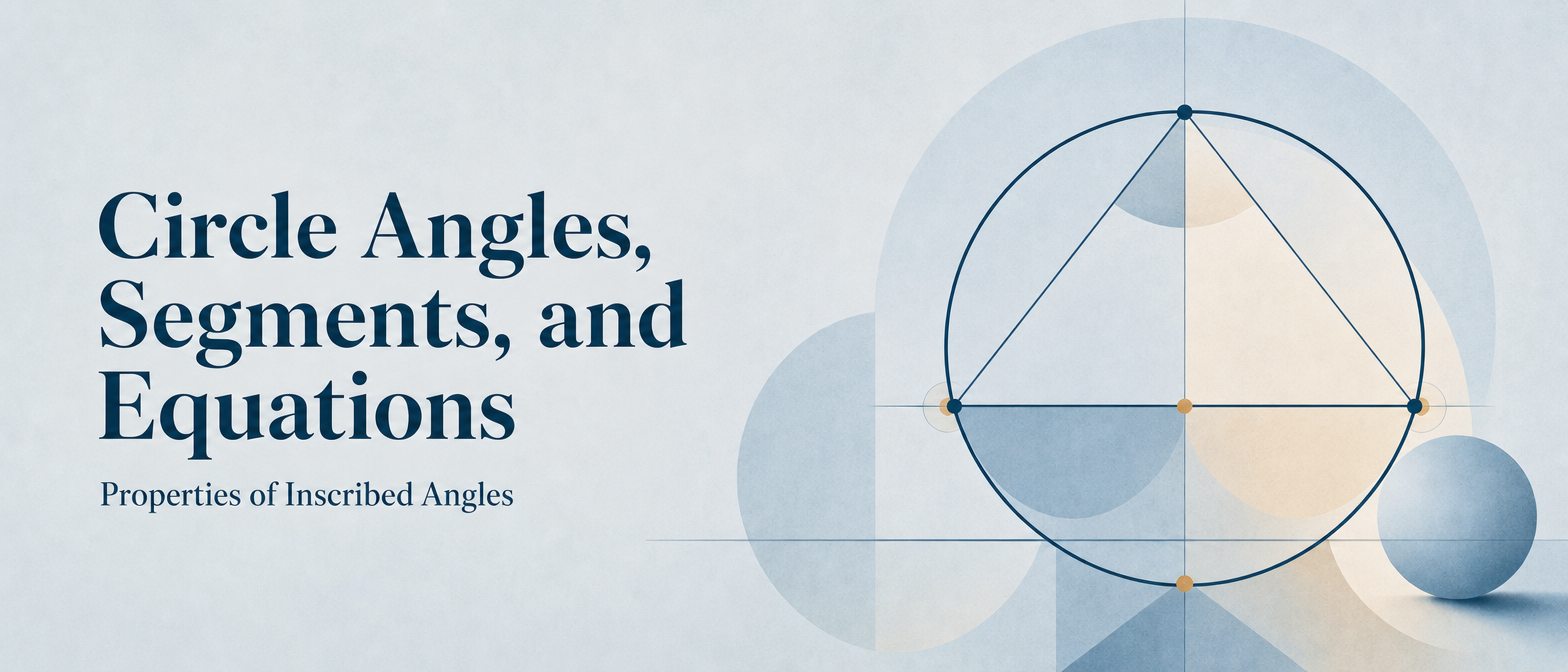
A Wheel Full of Angles
An observation wheel provides a model of a circle: its seats lie around the rim. From one seat, the lines of sight toward two other seats form an angle. How large is that angle, and which part of the circle controls it?
Represent the wheel by a circle with center X and points A, B, and C on its rim. Chords BA and BC form ∠ABC, whose vertex is B. The arc from A to C that does not contain B is the arc cut off by this angle

A central angle, such as ∠AXC opening onto that same arc, has the same measure as its arc. But ∠ABC has its vertex on the circle rather than at the center. Is its measure equal to the arc, greater than it, or smaller? The key relationship in this lesson is that the angle on the rim measures half its intercepted arc
Spotting Inscribed Angles
An inscribed angle has its vertex exactly on the circle and its sides along two chords. In the circle with points A, B, and C, ∠ABC is inscribed because B lies on the circle and BA and BC are chords

Its intercepted arc is the arc between the endpoints of those chords that does not pass through the angle's vertex. To identify the intercepted arc of ∠ABC, follow BA to A and BC to C, then choose the arc AC that does not contain B. Another way to describe the relationship is that this arc subtends ∠ABC

| Angle or term | Identifying feature |
|---|---|
| Inscribed angle | Vertex on the circle; sides are chords. |
| Intercepted arc | Arc between the sides' endpoints, not through the vertex. |
| Central angle | Vertex at the center; its measure equals its intercepted arc's measure. |
| Angle with an off-center interior vertex | Neither inscribed nor central: the vertex is neither on the circle nor at its center. |
Practice 1: Identify the vertex position
A circle has center O. Three angles are described: the angle at D has its vertex on the circle and chord sides DE and DF; the angle at O has its vertex at the center; and the angle at G has its vertex strictly inside the circle but away from the center. Use these conditions to answer the question

The Half-Arc Rule
Keep arc AC fixed at 70° and let B occupy different positions on the rest of the circle, without entering the fixed arc AC. Each resulting inscribed angle ∠ABC measures 35°. Moving the vertex does not change the angle when it continues to intercept the same fixed arc


The half-arc rule holds whether the center lies on a side of the inscribed angle, inside the angle, or outside the angle. The defining condition remains the same: the angle's vertex must be on the circle
| Given and wanted | Relationship |
|---|---|
| Given an arc; find its inscribed angle | Halve the arc measure. |
| Given an inscribed angle; find its intercepted arc | Double the angle measure. |
| Given a central angle; find its intercepted arc | Keep the measures equal. |
From arc to angle
Points M, N, P, and Q lie on a circle. Arc MN measures 88°, and inscribed angle ∠MPN intercepts it. Find m∠MPN. The sides PM and PN end at M and N, so the relevant arc MN is the one not containing P. Therefore m∠MPN = ½(88°) = 44°. Point Q is not needed for this calculation

From angle to arc
In the same circle with points M, N, P, and Q, now ∠NMQ measures 36°. Find the measure of its intercepted arc NQ. The angle's sides end at N and Q, so choose the arc NQ that does not contain M. Double the inscribed angle: m(arc NQ) = 2(36°) = 72°

Practice 2: Use the rule in both directions
Points R, S, T, and U lie on a circle. The whole arc from R through U to T measures 150°, and ∠RST intercepts that whole arc. Also, ∠TRU = 41° and intercepts only the sub-arc UT. Find m∠RST and m(arc UT). The 150° measure belongs to the full arc RUT, not just UT

For the first measure, halve the intercepted arc: m∠RST = ½(150°) = 75°. For the second, double the given angle: m(arc UT) = 2(41°) = 82°. Arc RU and arc UT together make the 150° arc RUT
Angles Sharing an Arc
Let F and G be points on a circle, with a fixed lower arc FG. Points H, J, and K lie on the other arc. The angles ∠FHG, ∠FJG, and ∠FKG all intercept the same lower arc FG. Each angle measures half that very same arc, so all three angles have equal measures

Two angles, one arc
Points A, B, C, and D lie on a circle. The inscribed angles ∠ABD = (6x + 2)° and ∠ACD = (8x − 14)° both intercept arc AD, which contains neither B nor C. Find x and m∠ABD. Since the angles intercept the same arc, their measures are equal: 6x + 2 = 8x − 14

Subtract 6x from both sides to get 2 = 2x − 14. Add 14 to get 16 = 2x, then divide by 2: x = 8. Substitute into the first angle expression: m∠ABD = 6(8) + 2 = 50°. Check the other expression: 8(8) − 14 = 50°, as required
Practice 3: Find the angle, not just the variable
Points P, Q, R, and S lie on a circle. The angles ∠PQS = (3x + 8)° and ∠PRS = (5x − 12)° both intercept the same arc PS

When Chords Cross Inside
Points G, H, K, M, and N lie on a circle. Chords HM and GK intersect at P inside the circle, and chord HK is drawn. Given m∠GNH = 40° and m(arc KM) = 120°, find m∠HPK. Here arc KM is the arc not containing H, and ∠GNH intercepts the arc GH not containing N
The vertex P is inside the circle, not on it, so ∠HPK is not an inscribed angle. The half-arc rule cannot be applied directly to that angle. Instead, use triangle HKP: find its angles at K and H using inscribed angles, then subtract both from 180°

First, ∠GNH intercepts arc GH. Double its 40° measure to obtain m(arc GH) = 2(40°) = 80°
Next, P lies on chord GK, so the ray KP points toward G. Thus the triangle's angle ∠HKP is the same angle as ∠HKG and intercepts arc GH. Therefore m∠HKP = ½(80°) = 40°

Also, P lies on chord HM, so the ray HP points toward M. The triangle's angle ∠KHP is therefore the inscribed angle ∠KHM, which intercepts arc KM. Its measure is m∠KHP = ½(120°) = 60°
Finally, the angles of triangle HKP total 180°. Hence m∠HPK = 180° − 40° − 60° = 80°
The Diameter Shortcut
A diameter passes through the center of a circle and divides it into two semicircles, each measuring 180°. Let AB be a diameter through center O, and let C be a point on the upper arc, distinct from A and B. The inscribed angle ∠ACB intercepts the lower semicircle, so m∠ACB = ½(180°) = 90°


The relationship also works in reverse. A 90° inscribed angle intercepts an arc measuring 2(90°) = 180°, so the chord joining that arc's endpoints is a diameter
Solve with the shortcut
Segment DE is a diameter, F lies on the circle, and m∠DFE = (6n + 12)°. Find n. Since ∠DFE intercepts a semicircle, it measures 90°. Set 6n + 12 = 90. Subtract 12 to get 6n = 78, then divide by 6: n = 13
Practice 4: Locate the right angle
Triangle EFG is inscribed in a circle with center O. Side EF passes through O, so EF is a diameter. G is another point on the circle

Quadrilaterals in a Circle
An inscribed quadrilateral has all four vertices on a circle. For quadrilateral ABCD, with the vertices in order around the circle, ∠B intercepts arc ADC and ∠D intercepts arc ABC. These are the two arcs from A to C, and together they cover the full 360° circle


Each angle is half its intercepted arc, so m∠B + m∠D = ½(360°) = 180°. The same argument gives m∠A + m∠C = 180°. Angles whose measures add to 180° are supplementary
Find every angle
Quadrilateral WXYZ is inscribed in a circle. Given m∠W = (7x + 5)°, m∠X = (10x + 10)°, and m∠Y = (13x − 25)°, find all four angle measures. The opposite pairs are W and Y, and X and Z. W and Y both have expressions, so use them to form the equation (7x + 5) + (13x − 25) = 180
Combine like terms: 20x − 20 = 180. Add 20 to get 20x = 200, then divide by 20: x = 10
Substitute into each given expression: m∠W = 7(10) + 5 = 75°; m∠Y = 13(10) − 25 = 105°; and m∠X = 10(10) + 10 = 110°. Since Z is opposite X, m∠Z = 180° − 110° = 70°
Verify the results: 75° + 105° = 180° and 110° + 70° = 180°. All four angles together total 360°
Practice 5: Find the variable and the fourth angle
Quadrilateral ABCD is inscribed in a circle. Given m∠A = (4y + 6)°, m∠C = (6y + 4)°, and m∠B = 91°, find y and m∠D
A and C are opposite, so (4y + 6) + (6y + 4) = 180. Combine terms to get 10y + 10 = 180, then 10y = 170 and y = 17. B and D are opposite, so m∠D = 180° − 91° = 89°. Do not copy B's 91° measure to D: the pair is supplementary, not necessarily congruent
Summary
An inscribed angle has its vertex on the circle and chord sides. Its intercepted arc joins the sides' endpoints without passing through the vertex
The Inscribed Angle Theorem gives angle measure = ½ × intercepted arc measure, or intercepted arc measure = 2 × angle measure. A central angle, by contrast, has the same measure as its intercepted arc
Inscribed angles intercepting the same arc are congruent. Set their angle expressions equal, solve for the variable, and substitute back if the question asks for an angle measure
An angle inscribed in a semicircle measures 90°. In an inscribed triangle with a diameter as one side, that right angle lies at the vertex opposite the diameter
Opposite angles of an inscribed quadrilateral are supplementary: each opposite pair adds to 180°. Pair opposite corners, not neighbors
Quiz
Quiz 1: Choose the correct relationship
Classify each situation by the move needed: halve it, double it, or keep it equal. The situations are: an arc measures 130° and its inscribed angle is wanted; an inscribed angle measures 27° and its intercepted arc is wanted; a central angle measures 44° and its intercepted arc is wanted
The 130° arc belongs in “Halve it,” because an inscribed angle is half its intercepted arc. The 27° inscribed angle belongs in “Double it,” because its intercepted arc is twice the angle. The 44° central angle belongs in “Keep it equal,” because a central angle and its intercepted arc have equal measures
Quiz 2: Combine the diameter shortcut and triangle sum
Triangle GHK is inscribed in a circle with center O. Segment GH passes through O and is a diameter. K lies on the circle, and m∠G = 34°
Quiz 3: Match opposite angles to their supplements
Quadrilateral ABCD is inscribed in a circle, with A opposite C and B opposite D. Given m∠A = 88° and m∠B = 101°, match m∠C and m∠D to the available measures: 92°, 79°, 88°, and 101°
The correct matches are m∠C = 92° and m∠D = 79°. C is opposite A, so m∠C = 180° − 88° = 92°. D is opposite B, so m∠D = 180° − 101° = 79°. Each unknown is the supplement of its opposite angle, not a copy of a given measure