Paragraphs 101: Your Guide to Writing and Determining How Many Paragraphs Are in Your Essay
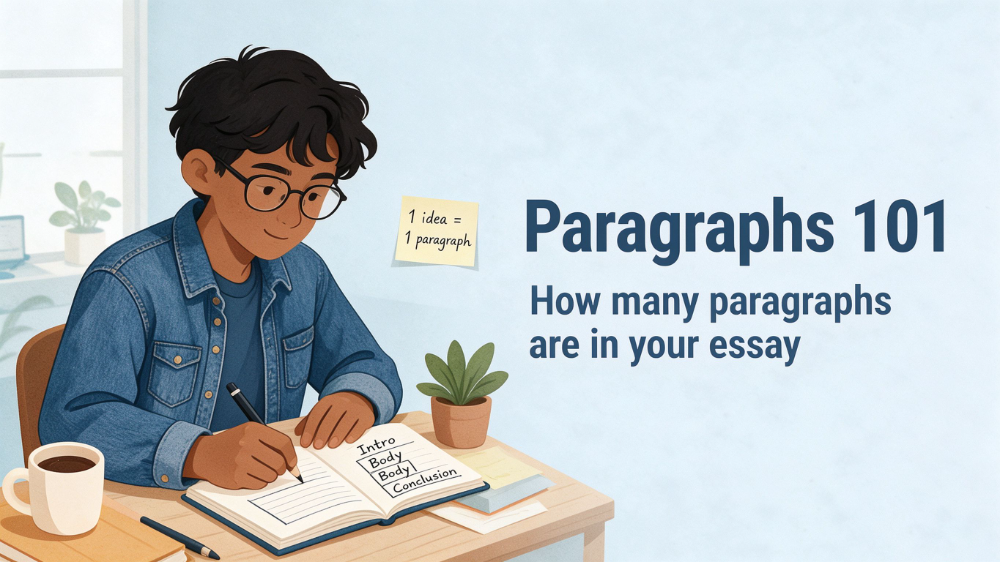
No fixed count fits every essay: you need an introduction, a conclusion, and one body paragraph per idea. Short pieces run 3–4 paragraphs, school essays 4–6; treat five as a start, not a rule, and let your prompt decide.
What is a paragraph?
A paragraph is a self-contained block of writing that develops one main idea. As Merriam-Webster defines it, a paragraph is a section of writing that usually deals with a single theme and begins on a new, indented line. So a paragraph is not just a group of sentences split by a line break; it is one thought, broken into readable pieces.
Picture a paragraph as a small argument in itself. It opens by telling the reader the point it will make, supports that point with detail or evidence, and then turns toward the next idea. The moment a new idea arrives, start a new paragraph, no matter how long or short the current one ran. A quick check: if two neighboring paragraphs open on the same point, merge them; if one paragraph switches idea halfway through, split it.
How many paragraphs are in an essay?
Because a paragraph is one idea, the honest answer to "how many paragraphs are in an essay?" depends on how many ideas you need to cover, not on a magic number. Almost every essay you will write has at least three functional parts:
- An introduction that frames the topic and states your main point.
- Body paragraphs that develop each supporting idea, one per paragraph.
- A conclusion that ties the ideas together.
That is a floor, not a ceiling. A focused short essay can make its case in three or four paragraphs. A longer research or argument essay may need six, eight, or more, because it has more ideas to develop. The body count follows your outline: count your main supporting points, and plan one paragraph for each.
Take an essay arguing that a city should protect its old buildings. It might spend one paragraph on historical value, one on the real cost of demolition, and one on a workable compromise: three body paragraphs, so the piece runs to five. A fourth solid reason simply makes it six. The number follows your argument, not a target you write toward.
Length and essay type change the paragraph count
Treat the table below as a rule of thumb, not a requirement. If your prompt gives a word count, a page length, or a rubric, follow the prompt first; it overrides any range here.
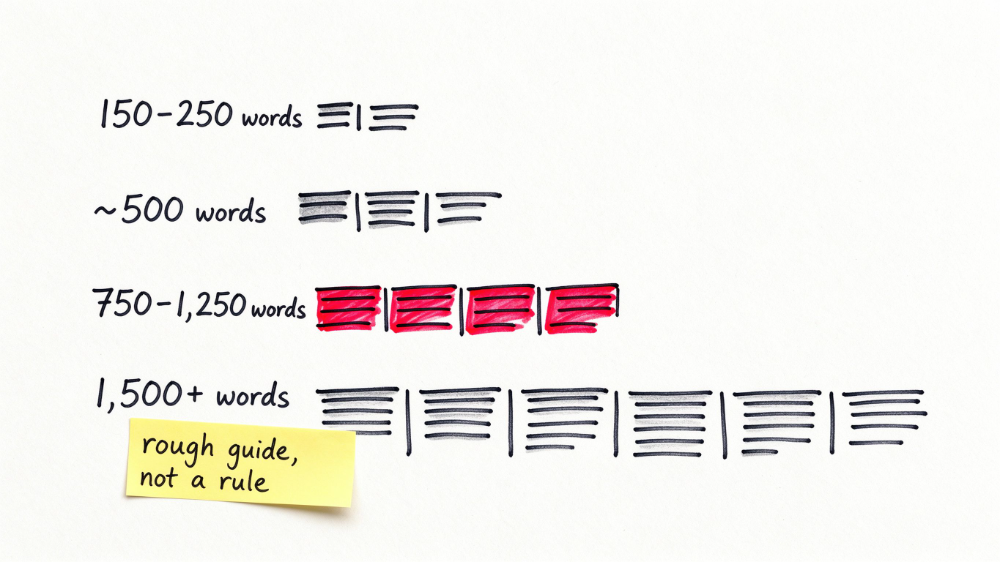
Essay length / type | Rough paragraph count | What it usually contains |
A short answer (about 150–250 words) | 2–3 | One intro point, one body point, one wrap-up |
A short essay (about 500 words) | 3–4 | Intro, one or two body paragraphs, conclusion |
A standard school essay (about 750–1,250 words) | 4–6 | Intro, two to four body paragraphs, conclusion |
A longer essay (about 1,500 words and up) | 6+ | Intro, several body paragraphs grouped by idea, conclusion |
This also answers a worry students raise a lot. A 250-word response is not automatically one paragraph; it often works best as two or three, because it still needs to set up, explain, and wrap up. A single paragraph is fine only when the task asks for one simple idea. Twelve sentences, meanwhile, do not have to split into exactly two paragraphs: if eight develop one point and four develop the next, put the break after the eighth, rather than splitting evenly.
How to structure a paragraph
A paragraph that earns its length has a simple anatomy. The UW–Madison Writer's Handbook frames paragraphs as units of thought, and the shape below applies to almost any body paragraph.
The four-part anatomy of a body paragraph
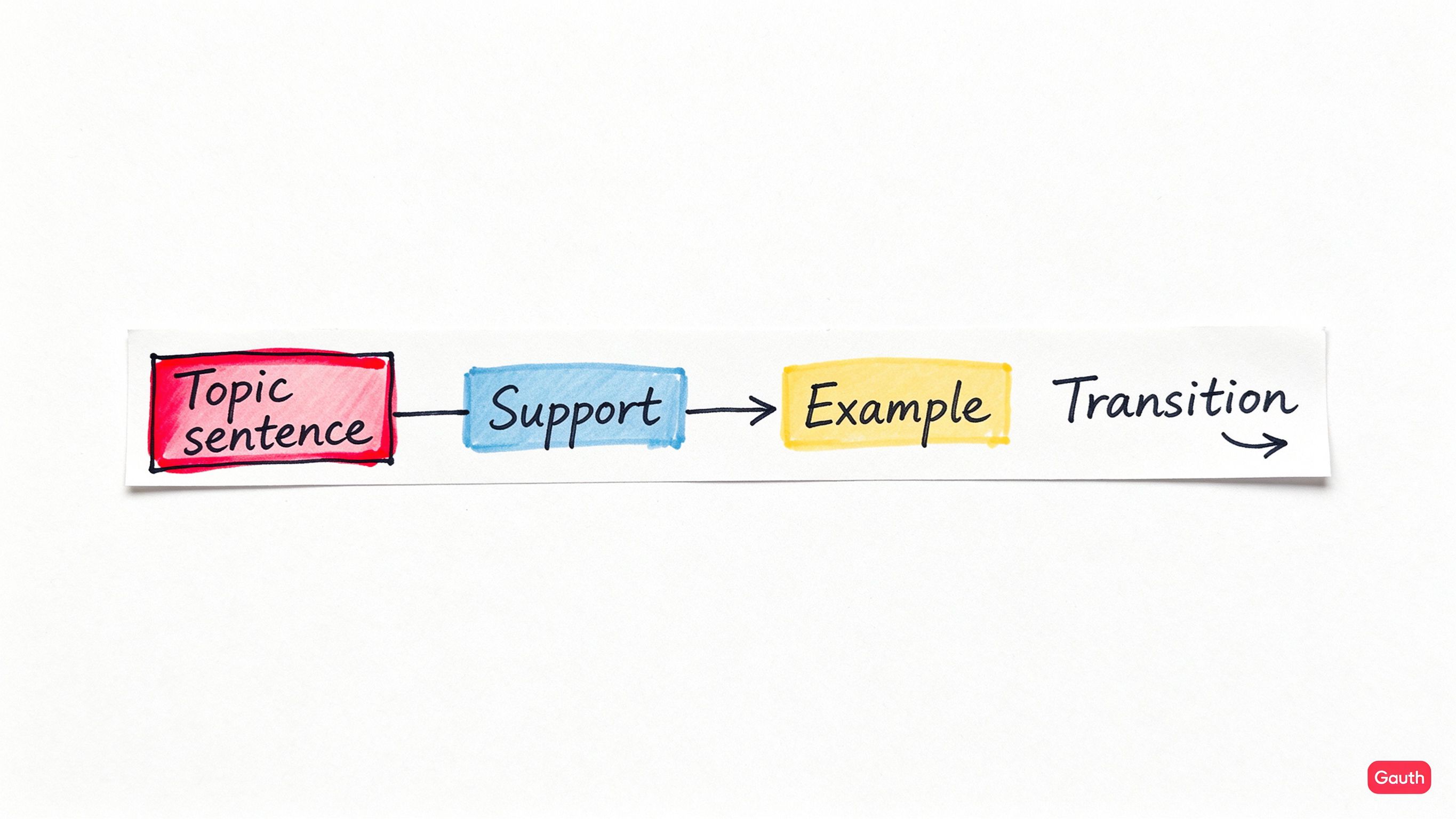
Most strong body paragraphs move through four parts. You do not have to label them, but the reader should feel them in order:
- Topic sentence — the one main idea of the paragraph, stated up front.
- Support — evidence, explanation, example, or detail that develops that idea.
- Connection — how the point supports your thesis or flows into the next idea.
- Transition — a smooth link when the next paragraph begins.
For instance, a topic sentence like "Old buildings anchor a neighborhood's identity" should be followed by a concrete detail — a landmark, a shared memory, a specific street — not another restatement. Skip the support and jump to the next point, and the paragraph reads as an assertion rather than an argument.
How many sentences should a paragraph have?
On length, most body paragraphs run roughly three to five sentences, sometimes more when an idea needs more evidence. That is a comfortable reading range, not a law. A paragraph that explains a complex point may run longer; a transition paragraph may be shorter. If you are packing two unrelated ideas into one block, split it into two paragraphs.
The real check is the idea count, not the sentence count. A tight three-sentence paragraph that fully develops one point beats a sprawling eight-sentence paragraph that abandons an idea halfway.
The five-paragraph essay: a starting structure, not a rule
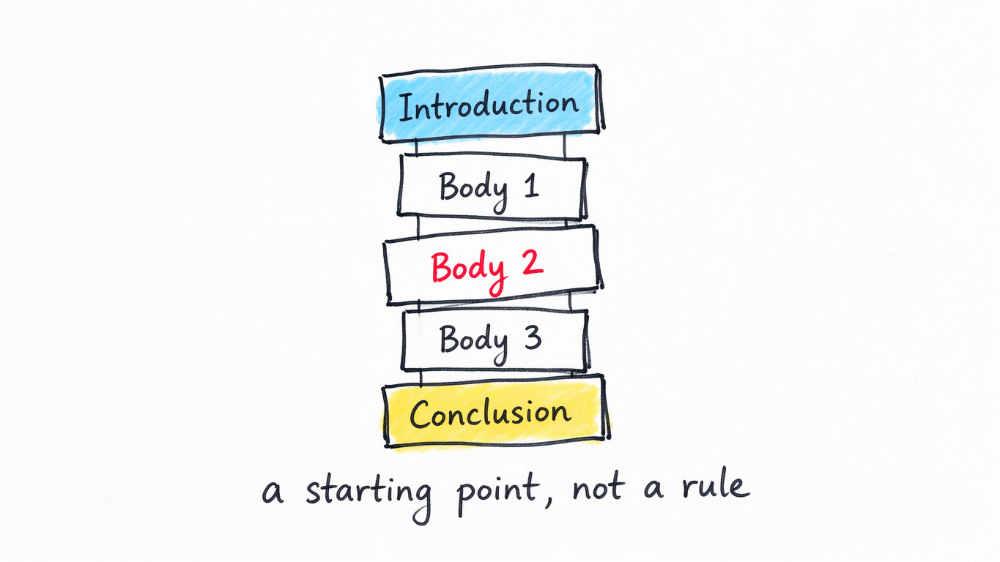
The five-paragraph essay is a classic classroom template: an introduction, three body paragraphs, and a conclusion. It earns its place by forcing early writers to state a thesis, support it three ways, and wrap up.
It is not a law. Once you move past beginner assignments, essays grow or shrink to fit the argument. A complex paper may need more than three body paragraphs; a short reflective piece may need fewer. Use the five-paragraph form as training wheels that teach the shape of an argument, then adjust the count to your ideas and your prompt. Keep one idea to a paragraph and the exact number looks after itself.
A useful tell is the thin third body paragraph. If it mostly repeats the first two, you probably had only two real points, and the essay reads better at four paragraphs. If your thesis genuinely needs four or five supporting reasons, let it run longer. The template is a default, not a cage.
Common mistakes
- Treating the five-paragraph essay as a fixed answer. It is a helpful structure, not a universal requirement, and college readers often expect more flexibility. Ask: does each body paragraph earn its place, or are you padding to reach five?
- Counting sentences instead of ideas. Twelve sentences split into idea groups, not into a mandatory two-paragraph shape. Ask: can you state each paragraph's point in one sentence?
- Stuffing several unrelated points into one paragraph. Change topic, and you change paragraph. Ask: does the topic sentence preview everything that follows?
- Ignoring the prompt. A teacher's required word count, rubric, or question overrides any rule of thumb here. Ask: have you matched the assignment before deciding on length?
Once the count and structure feel right, polishing the sentences around them is the next move; grammar rules for essays covers that step.
Still deciding? Draft it on Gauth
If the right count is still unclear, sketch an outline first: list your main ideas, assign one paragraph to each, and add an introduction and conclusion. You can build that outline and a first draft with the Gauth Essay Helper, then adjust the paragraph count as your ideas take shape.
Sources and review
- Merriam-Webster — paragraph (accessed 2026-09-30). Paragraph definition.
- UW–Madison Writer's Handbook — Paragraphing (accessed 2026-09-30). Guidance on paragraph units of thought and length.