How to Write Geometry Proofs: A Step-by-Step Guide for Beginners
A geometry proof is a deductive chain that starts from the given facts, justifies every statement with a definition, postulate, theorem, or algebraic property, and ends exactly at the statement you must prove. Beginners start with a two-column proof, mark the diagram, plan backward from the Prove line, then write forward one justified row at a time. This guide provides a reasons bank, three worked examples, and self-check practice.
What Is a Geometry Proof?
A geometry proof shows that a statement must be true by logic, not by appearance or measurement. You begin with facts the problem states directly, move through statements that follow from them, and stop only when you reach the statement the problem asked you to demonstrate. Each new statement earns a reason: a definition, a postulate, a previously proven theorem, or an algebraic property. K12 LibreTexts' introduction to proofs puts it plainly: every statement in a proof needs a reason, and "Given" is reserved for information the problem actually supplied.
A diagram is a picture, not evidence. Do not claim two angles are equal because they look equal on the page, or two sides match because they look the same length; the drawing organizes the facts, and the reasoning proves them. The broader vocabulary of points, lines, angles, and figures that proofs use is covered in the geometry concepts guide; this page teaches how to write the argument itself.
Two symbols keep measure and object separate. Use the equals sign = for quantities you measure, such as m∠1 = m∠3 or AB = CD. Use the congruence symbol ≅ for objects that match in shape and size, such as ∠1 ≅ ∠3 or △ABC ≅ △DEF. Equal measures lead to congruent objects, but the two symbols are never interchangeable.
Given, Prove, and the Diagram
Every formal proof opens with two short blocks. The Given block lists the facts the problem supplies, often in geometric shorthand such as C is the midpoint of AE or a ∥ b. The Prove block states the single conclusion you must reach, such as AB ≅ DE or ∠3 ≅ ∠5. Read both before you write a row, because the Prove line decides where the chain has to end.
The proof objects live on a flat surface. Segments, rays, angles, and triangles are figures in the plane, which the plane geometry guide describes in full; here you only need to mark them. A ray names an angle's side, and the ray geometry guide covers that notation in detail.
Once the blocks are clear, mark the diagram the problem provides, or draw your own. Add tick marks on matching sides, arc marks on matching angles, and small arrows on parallel lines. Copy every Given fact onto the picture so you can see what you already know. Leave unmarked anything the problem did not state: a line that looks perpendicular may not be, and an angle that looks right may measure 88 degrees.
Definitions, Postulates, Theorems, and Reasons
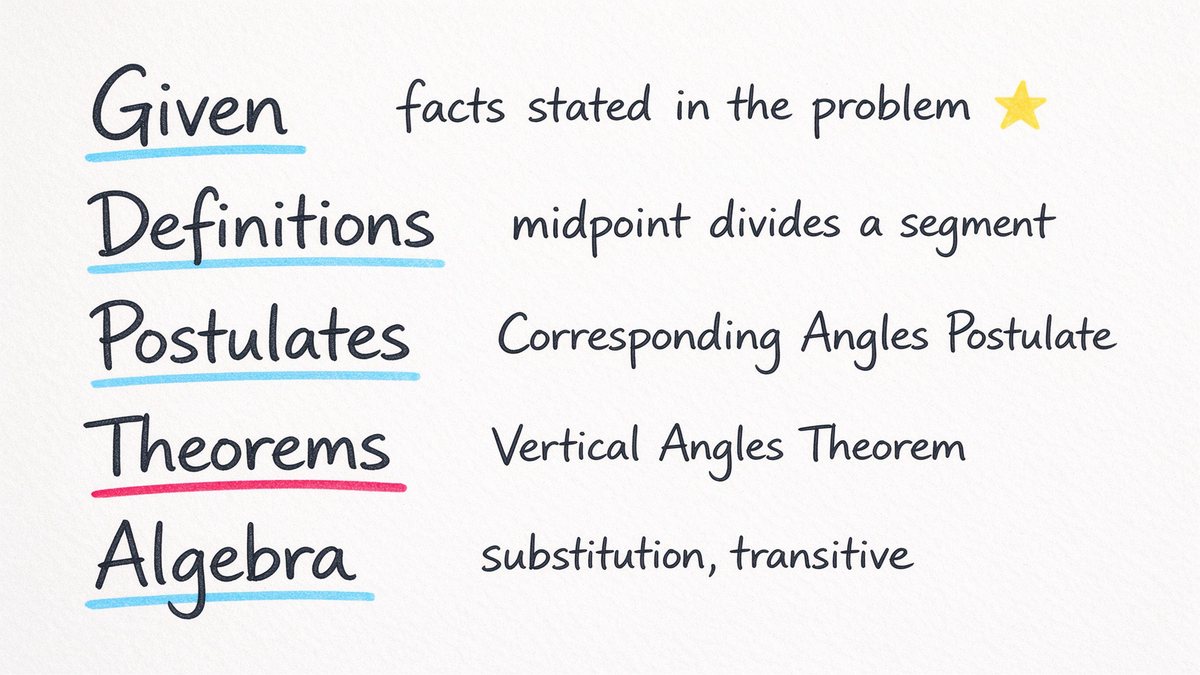
The right-hand column of a proof draws from four buckets, and knowing which bucket each reason belongs to prevents vague entries.
- Given. Facts the problem states directly. It appears only on rows that repeat supplied information.
- Definitions. The meaning of a term: a midpoint divides a segment into two congruent parts; an angle bisector cuts an angle into two congruent angles; perpendicular lines form right angles.
- Postulates. Statements accepted without proof, such as the Segment Addition Postulate, the Angle Addition Postulate, and the Corresponding Angles Postulate.
- Theorems. Statements already proven from postulates, definitions, and earlier theorems, such as the Vertical Angles Theorem or the Alternate Interior Angles Theorem. Once a theorem is proven, you may reuse it without proving it again.
K12 LibreTexts' angle-pair proofs separates these roles clearly: a postulate is accepted as true, while a theorem is established by a short chain of reasons. A fifth bucket, algebraic properties (substitution, transitive, addition, subtraction, reflexive), handles the equation work inside a geometry proof.
Three Proof Formats
The same logic appears in three formats, and Fiveable's study guide to proof types notes that choosing the clearest one depends on the argument's shape.
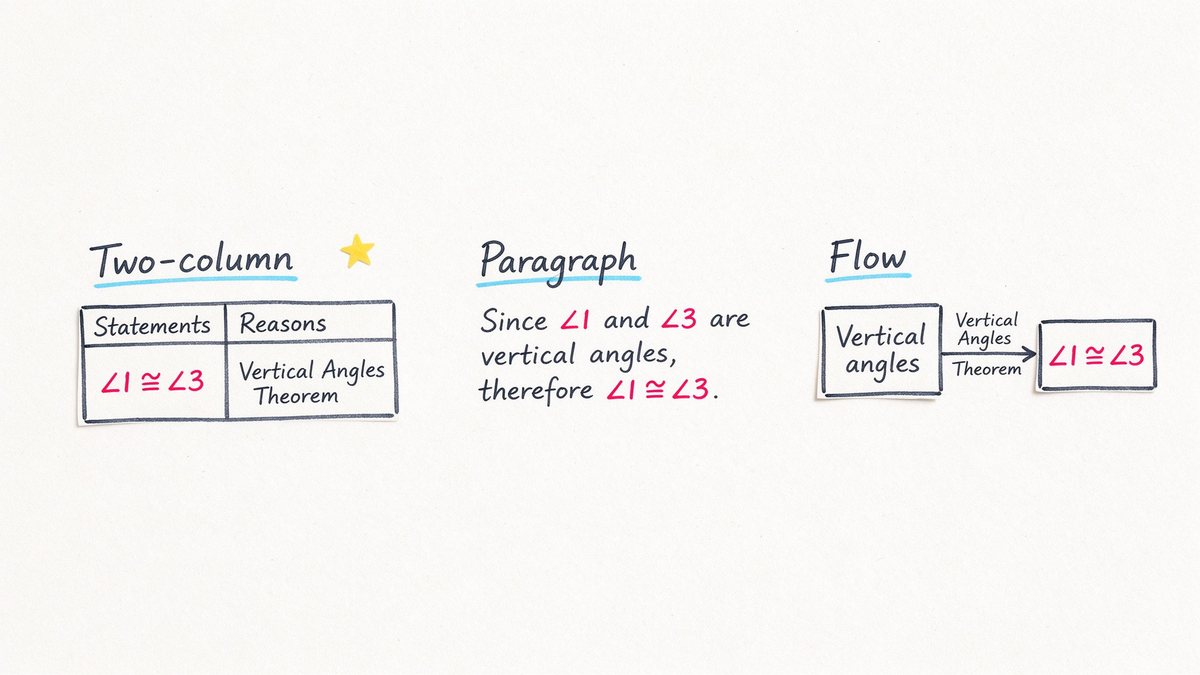
Two-Column Proof
A two-column proof splits the argument into a Statements column on the left and a Reasons column on the right, numbered row by row. Classrooms favor it because every step stays visible and easy to check. Use it for a linear chain where one row leads directly to the next, such as proving two angles congruent or showing two triangles match by a single shortcut.
Paragraph Proof
A paragraph proof writes the same rows as complete sentences, weaving the reason into each step with connectives such as "since," "because," "therefore," and "thus." It reads naturally when you need to explain why a move works, but a long chain becomes hard to follow without row separation.
Flow Proof
A flow proof places each statement in a box and draws an arrow to the next statement, with the reason written beside the arrow. Its strength is branching: two facts can feed into one conclusion, which a linear table hides. Use it when separate chains converge on a single result.
Format | Shape | Best when |
Two-column | Numbered statements beside reasons | Linear, one-step-after-another argument |
Paragraph | Prose with reasons inside sentences | Explaining why each move makes sense |
Flow | Boxes and arrows, reasons beside arrows | Multiple chains branch and merge |
How to Build a Proof: Steps and Backward Planning
Mark Ryan's formal proof method recommends planning before writing: state the theorem, read the Given, draw and mark the figure, state the Prove, and only then build the chain. The five steps below follow that order.
Read the Given and Prove
Write the Given facts in your own shorthand and restate the Prove conclusion. Ask what the Prove statement needs: congruent sides, congruent angles, parallel lines, or right angles. Triangles, segments, and other proof objects are defined in the geometric shapes guide; here you treat them as the things your chain connects.
Mark the Diagram
Transfer every Given fact onto the figure with tick marks, arcs, and parallel arrows. Do not add markings for facts that were not stated; a line that merely looks perpendicular stays unmarked, and an angle that looks right may still be acute rather than exactly right. The marks make each Given fact visible while you write rows.
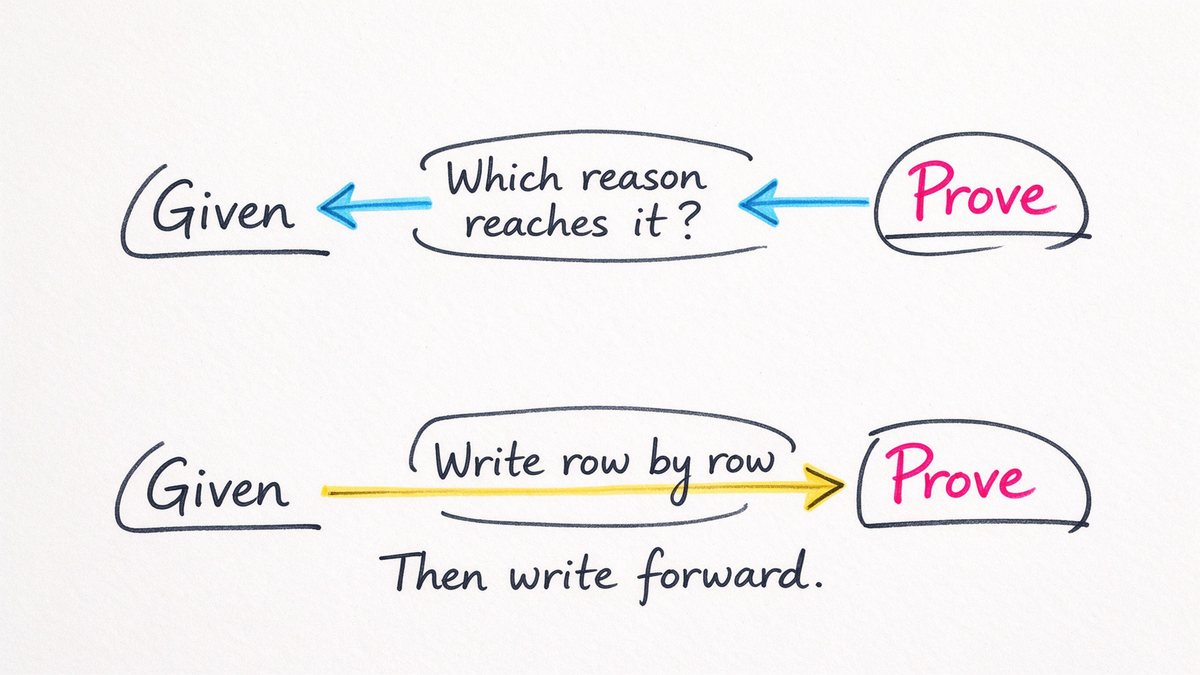
Plan Backward from the Prove
Start at the last line and ask what reason would reach it. If Prove says AB ≅ DE, what would justify that? A definition of congruent segments, a theorem, or CPCTC after triangle congruence. Work backward one or two moves until you meet a fact already in the Given. This backward sketch keeps the written proof from wandering.
Chain Forward
Write rows from the Given toward the Prove, pairing each statement with its reason in the right column. Combine statements that share a reason when it reads cleanly, but never drop a step just because it feels obvious. If a new row has no reason available, stop and return to backward planning instead of guessing.
Check the Final Row
The last statement must match the Prove line word for word. If your final row says something close but not identical, the chain has not finished. This chain rests on a larger axiom-and-theorem foundation: postulates are accepted at the start, and theorems are derived from them later; that foundation receives its own euclidean geometry guide, which is not published yet, so this page stays focused on writing the proof itself.
Common Reasons Bank
Keep this bank beside you while you write. Pick the reason that exactly matches the row rather than a generic phrase.
Bucket | Examples |
Given | Facts stated directly in the problem |
Definitions | Definition of midpoint, angle bisector, perpendicular, congruent angles, supplementary angles |
Postulates | Segment Addition Postulate, Angle Addition Postulate, Linear Pair Postulate, Corresponding Angles Postulate |
Theorems | Vertical Angles Theorem, Alternate Interior Angles Theorem, SSS, SAS, ASA, AAS, HL |
Algebraic properties | Reflexive, substitution, transitive, addition and subtraction properties of equality |
Worked Examples
The three examples below move from angle relations to parallel lines to triangle congruence. Each row carries its own reason, and the final row matches the Prove statement.
Example 1: Prove Vertical Angles Are Congruent
Given: Lines AB and CD intersect at O; ∠1 and ∠3 are the opposite (vertical) angles.
Prove: ∠1 ≅ ∠3.
# | Statement | Reason |
1 | Lines AB and CD intersect at O | Given |
2 | ∠1 and ∠2 form a linear pair; ∠2 and ∠3 form a linear pair | Definition of a linear pair |
3 | ∠1 and ∠2 are supplementary; ∠2 and ∠3 are supplementary | Linear Pair Postulate |
4 | m∠1 + m∠2 = 180°; m∠2 + m∠3 = 180° | Definition of supplementary angles |
5 | m∠1 + m∠2 = m∠2 + m∠3 | Substitution (transitive property of equality) |
6 | m∠1 = m∠3 | Subtraction property of equality |
7 | ∠1 ≅ ∠3 | Definition of congruent angles (equal measures) |
The chain shows that supplements of the same angle match, which is the Vertical Angles Theorem recorded in K12 LibreTexts' angle-pair proofs.
Example 2: Prove Alternate Interior Angles Are Congruent
Given: Lines a and b are parallel; transversal t crosses both. ∠1 and ∠5 are corresponding angles, ∠3 and ∠5 are alternate interior angles, and at the intersection ∠1 and ∠3 are the vertical (opposite) angles.
Prove: ∠3 ≅ ∠5.
# | Statement | Reason |
1 | a ∥ b; transversal t crosses both lines | Given |
2 | ∠1 ≅ ∠5 | Corresponding Angles Postulate |
3 | ∠1 ≅ ∠3 | Vertical Angles Theorem |
4 | ∠3 ≅ ∠5 | Transitive property of congruence |
When parallel lines meet a transversal, corresponding angles match by postulate; vertical angles match by theorem; the transitive property then carries the match from ∠1 to ∠3 and on to ∠5, the same chain LibreTexts presents as a paragraph proof.
Example 3: Prove Segments Congruent After Triangle Congruence
Given: C is the midpoint of AE; BC ≅ DC; ∠ACB ≅ ∠ECD.
Prove: AB ≅ DE.
# | Statement | Reason |
1 | C is the midpoint of AE | Given |
2 | AC ≅ CE | Definition of midpoint |
3 | BC ≅ DC | Given |
4 | ∠ACB ≅ ∠ECD | Given |
5 | △ACB ≅ △ECD | SAS (AC ≅ CE, included ∠ACB ≅ ∠ECD, CB ≅ CD) |
6 | AB ≅ DE | CPCTC |
The included angle is already supplied in the Given, so row 4 records it as Given rather than re-deriving it with a theorem; SAS then pairs the midpoint-derived side AC ≅ CE, that given included angle, and the given side CB ≅ CD.
Khan Academy's congruent triangles lesson explains that SSS, SAS, ASA, and AAS establish triangle congruence, after which CPCTC (corresponding parts of congruent triangles are congruent) gives the remaining matching sides and angles. CPCTC only appears after the triangles are proven congruent; it never opens the proof.
Common Mistakes to Diagnose and Fix
- Skipping an obvious step. A move that feels automatic still needs a reason, such as the definition of supplementary angles after a sum of 180°.
- Reading the answer off the diagram. A drawing supplies marks, not proof; visual equality never justifies a row.
- Circular reasoning. Do not use the Prove conclusion before the chain reaches it.
- Mislabeling the Reflexive Property. BC = BC applies only when a side is shared by both triangles, not to arbitrary segments.
- Mixing = and ≅. Equal measures use =; matching objects use ≅.
- Placing CPCTC too early. Prove the triangles congruent first, then claim a matching part.
- Ending close to but not at Prove. The final row must restate the Prove conclusion exactly.
Practice Problems with Self-Check Answers
Try these before moving on, then check the answers below.
- A proof begins with which block, and what must the final row match?
- Given m∠A = 90° and ∠A ≅ ∠B, write the reason that supports m∠B = 90°.
- Two sides and the included angle match between triangles. Name the congruence shortcut, and state what lets you claim another matching part after that.
Answers
- Begin with the Given block; the final row must match the Prove statement word for word.
- Congruent angles have equal measures (definition of congruent angles), followed by substitution or the transitive property of equality.
- SAS proves the triangles congruent; CPCTC then justifies another corresponding side or angle.
Learn Geometry with Gauth
When you are ready to practice, the existing geometry course works through proof, congruence, and constructions in order. You can also create a focused interactive course for the exact proof type you want to drill, from angle proofs to triangle congruence.
Frequently Asked Questions
Are geometry proofs hard, and are proofs still taught? Proofs feel hard at first because each row carries a reason, but that difficulty comes from the new habit of justifying every step, not from advanced math. They remain a standard part of high school geometry because the practice builds deductive reasoning that carries into later math and science.
What should I do when I get stuck halfway through a proof? Go back to the Prove line and ask what reason would reach it, then look for that reason among the Given facts, marked diagram, and reasons bank. If a row has no reason, stop there rather than guessing.
Do I need to memorize every theorem before writing proofs? No. Learn the postulates and core theorems your current unit teaches, keep the reasons bank nearby, and reuse theorems after they are proven in class. Theorems build on postulates and earlier theorems, so memorizing the whole list at once adds little.
Conclusion: Pick a Format and Start Small
Beginners should write angle proofs in two-column form first, because the numbered rows make every reason visible. Move to a paragraph proof when you want to explain why a step works, and to a flow proof only when separate chains converge. Work the self-check set, then retry Example 1 without looking, before moving to parallel lines and triangle congruence. Build a focused practice course around the proof type that trips you up next.
Sources and Review
K12 LibreTexts, 2.13 Introduction to Proofs, accessed 2026-10-21: two-column structure, a reason for every statement, Given usage, and reason types.K12 LibreTexts, 2.15 Proofs: Angle Pairs and Segments, accessed 2026-10-21: vertical angles, parallel-line transversal, corresponding postulate, alternate interior, and postulate-versus-theorem roles.Fiveable, Types of proofs: two-column, paragraph, and flow, accessed 2026-10-21: three formats, four reason buckets, format selection, paragraph connectives, and flow branching.Khan Academy, Corresponding parts of congruent triangles are congruent, accessed 2026-10-21: SSS/SAS/ASA/AAS/HL criteria and CPCTC.dummies, Mastering the Formal Geometry Proof (Mark Ryan), accessed 2026-10-21: five-step formal proof process, planning before writing, and the final Prove row.