What Is a Ray in Geometry? Definition, Naming, and Real-Life Examples
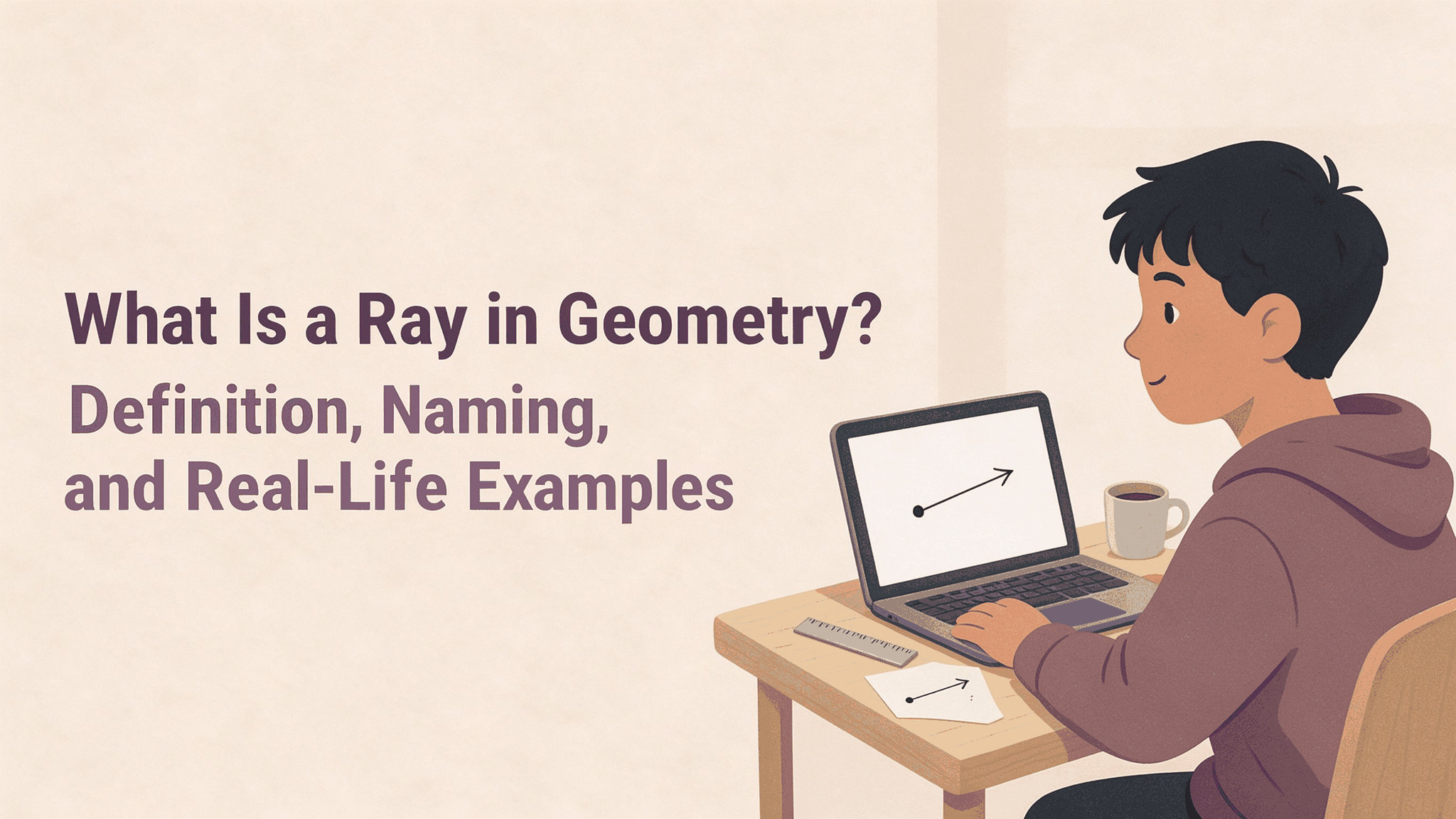
In ray geometry, a ray is part of a straight line with one fixed endpoint that extends infinitely in one direction, so it has no measurable length. Name it with the endpoint first, followed by any second point on the ray, and a one-direction arrow; reversing the letters names a different ray. Before naming a figure, classify it against a line, which extends both ways, and a segment, which has two endpoints and a measurable length.
What Is a Ray in Geometry?
A ray belongs to the same point-and-line building-block system covered in the geometry concepts guide. In ray geometry, a ray is part of a line that starts at one fixed endpoint and continues in a single direction forever; MathWorld describes the figure as a half-infinite line. With no far end to measure, it has no length the way a segment does; there is no stopping point at which to attach a number.
This geometric ray is a straight figure, not the optical light beam discussed in physics. The everyday beam model only helps picture the one-way direction; the geometry definition depends on the endpoint and the infinite extension, not on light itself.
Parts and Properties of a Ray
Endpoint
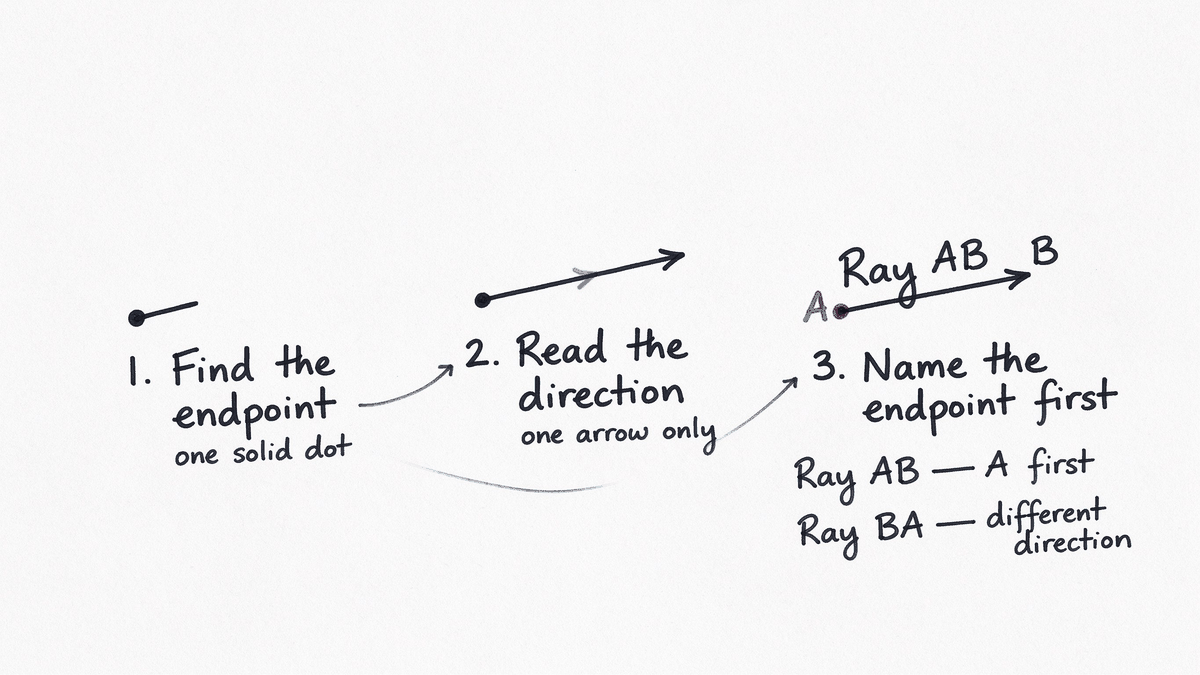
The endpoint is the fixed starting point of the ray, drawn as a small dot and always written first in the ray's name. Nothing extends backward from it, so every ray you meet has exactly one such point, never two. When you read a diagram, locate this dot before tracing the direction or writing a name; the endpoint decides which letter comes first and which way the arrow points.
One Direction and Infinite Length
From the endpoint, the ray travels in one direction only and continues forever in that direction. It has no stopping point on that side, which means its length cannot be measured the way a segment's can. A ruler placed along it never reaches a far end, so no number of units can describe how long the ray is. This single-direction, no-far-end behavior separates a ray from both a line and a segment.
Dimension
A ray has zero thickness: it sits on one straight path and contains infinitely many points, even though a drawn ray looks thick on paper for visibility. The thickness of the ink is only a drawing choice; the mathematical figure itself has no width, height, or surface. Treat the ray as a straight set of points arranged on one path, with the endpoint as the first point in that set.
How to Name and Write a Ray
Naming Order: AB vs BA
Write the endpoint first, then any second point the ray passes through, and place a one-direction arrow above the two letters; K12 LibreTexts notes that ray naming order matters, unlike a segment. With endpoint P and a second point Q on the ray, you write ray PQ, with the arrow pointing toward Q. The first letter always carries the endpoint, which makes the order mandatory rather than a preference.
That second point can be anywhere on the ray; choosing R instead of Q still names the same figure. Reverse the letters, though, and the figure changes: ray QP starts at Q and heads the other way, so it is not another name for ray PQ. This order trap is the most common naming error, because swapping two letters looks like a harmless rewrite but points the ray in the opposite direction.
The Arrow Symbol
The notation uses a small arrow drawn over the two letters, pointing from the endpoint toward the open end. It shows one direction only, unlike a line, which carries arrows on both ends, or a segment, which carries no arrow at all. Keep the arrow on top of the letters rather than at the end of the line in the diagram, and match its direction to the way the ray actually travels from its endpoint.
Line vs Ray vs Line Segment
The three figures look alike because every one is made of straight points on one line, which is why they get mixed up. Sort them by endpoints, direction, and whether a length can be measured.
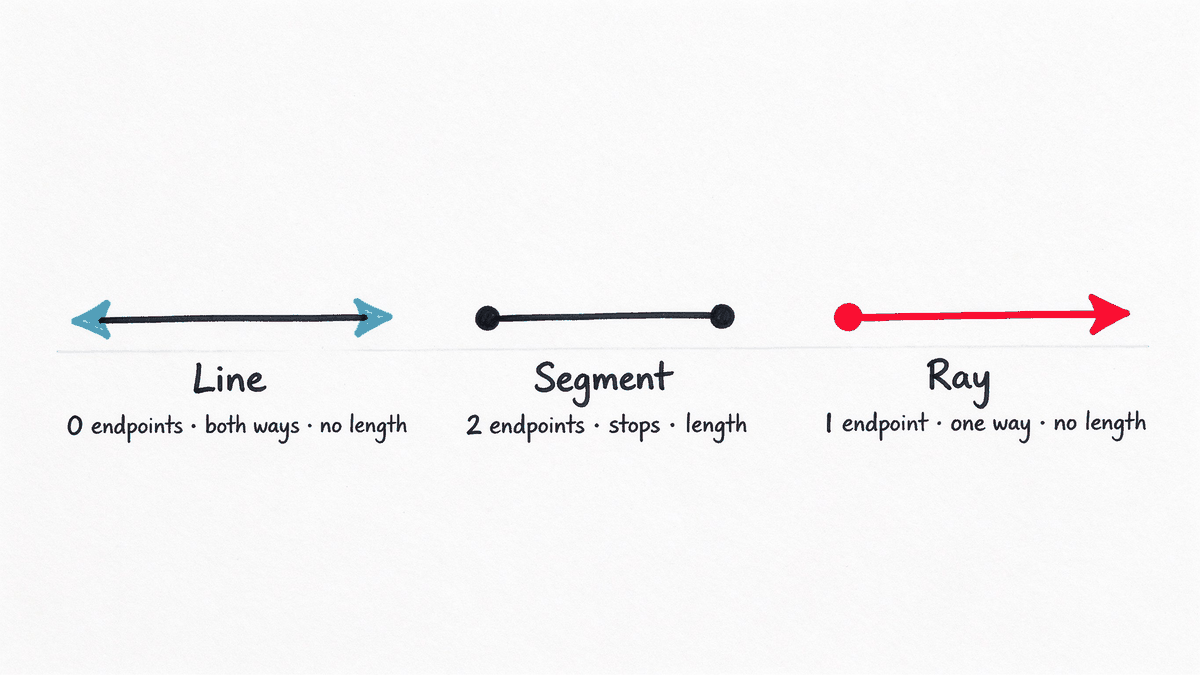
Figure | Endpoints | Direction | Measurable length? |
Line | 0 | Infinite in both directions | No |
Line segment | 2 | Stops at both endpoints | Yes |
Ray | 1 | Infinite in one direction | No |
A line has no endpoints and runs forever both ways. A segment has two fixed endpoints and a length you can measure. A ray has one endpoint and runs forever one way. Once a figure has two endpoints, it is a segment; arrows on both ends make it a line rather than a ray.
What Are Opposite Rays?
Opposite rays start at the same endpoint and extend in exactly opposite directions along one straight path. They share that single point, but each goes away from it on its own side. Because the two directions form a straight line, the pair makes a straight angle of 180 degrees rather than a bent opening.
Two rays qualify as opposite only when they share the endpoint and point straight away from each other; rays that merely cross at a point, or leave the endpoint at an angle, are not opposite rays.
How Rays Form Angles
Two rays sharing one common endpoint form an angle. The shared endpoint is the vertex, and the two rays are the arms; each reaches out from the vertex to create the opening you measure in degrees. This is why the ray is a building block for angles rather than a separate topic that never reappears.
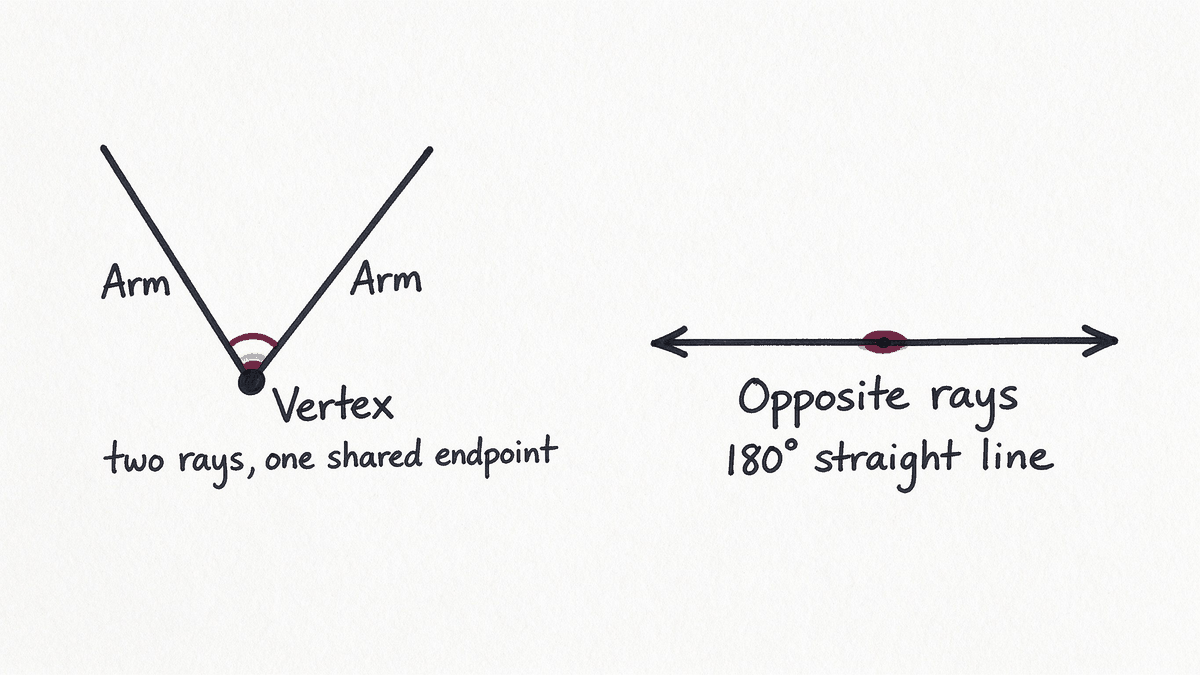
This page stops at the connection between rays and angles; angle classification and measurement belong to the angle unit that follows.
Real-Life Examples
A flashlight beam leaving the bulb models a ray: the bulb is the fixed starting point, and the beam travels outward in one direction. Sunlight leaving the sun works the same way, with the sun as the starting point and the light moving outward. A laser beam aimed in one direction and the straight path of an arrow after release are everyday models as well.
A wall that blocks a flashlight beam is a physical obstacle, not an endpoint the geometry definition provides; the modeled ray itself keeps going, and the blockage only ends the visible beam in the room.
Spot the Ray: Quick Identification Practice
Try each figure before reading the solution; working the endpoint and direction yourself is what keeps the notation exact. Khan Academy's geometry directory pairs points, lines, and angles with practice problems if you want a second worked explanation.
Example 1. A figure starts at G and passes through H and K. Name the ray. The endpoint is G, so write ray GH (or ray GK); G stays fixed as the starting point in first position.
Example 2. Two rays start at G, one through H and one through C in the opposite direction. They are ray GH and ray GC, opposite rays that share G and form a straight angle.
Example 3. A figure has endpoints A and B and no arrows. It is not a ray: two fixed endpoints make it segment AB, with a measurable length.
Example 4. A figure starts at O and passes through A before continuing. Ray AO misnames it, because O must come first as the endpoint; the correct name is ray OA.
Common Mistakes and How to Check Your Work
A ray has no finite far end, so do not try to attach a measured length at the point where it seems to end. Reversing the endpoint letters is the easy slip, and it names a different ray instead of a typo. A figure with two endpoints is a segment, and arrows on both ends mark a line. Before you submit, locate the endpoint, trace the single direction the arrow points, and confirm the first letter in the name matches that endpoint.
Learn Geometry with Gauth
When you are ready to move from naming to practice, the existing geometry course takes points, lines, planes, and angles in order. You can also create a focused interactive course for the exact ray and angle topic you need. The plane these figures live in is covered in the plane geometry guide.
Frequently Asked Questions About Rays
Does a ray have thickness, and how many points lie on it? A mathematical ray has zero thickness and lies on one straight path made of infinitely many points. The thick line you draw on paper is only for visibility; the figure itself has no width or surface.
How do you draw and identify a ray in a figure? Dot the endpoint, draw a straight line through a second point that extends in one direction, and add one arrowhead on the open end. To identify one in a diagram, locate the single endpoint and the single arrowhead; two endpoints mark a segment, and arrows on both ends mark a line.
Sources and Review
Ray -- from Wolfram MathWorld, accessed 2026-10-21: the ray as a half-infinite line.K12 LibreTexts, 1.1 Geometry Terms, accessed 2026-10-21: undefined terms, segment and ray, and the angle formed by two rays.Khan Academy, Geometry course directory, accessed 2026-10-21: points, lines, and angles coverage support.