Plane Geometry Explained: 2D Figures, Measurement, and the Coordinate Plane
Plane geometry is the branch of geometry that studies flat, two-dimensional figures lying on a plane: points, lines, rays, angles, polygons, and circles. A plane is a flat, thicknessless surface that extends infinitely; a sheet of paper is only a finite physical model. The branch sorts figures by dimension first, places points on the coordinate plane, and measures them with perimeter and area. Classify a figure by depth before naming it.
What Is Plane Geometry?
Plane geometry deals with figures contained in one flat plane; solid geometry covers objects with depth. The broader discipline, its branches, and its core topics are mapped in the geometry concepts guide, and this page covers the plane branch only. MathWorld places plane geometry beside solid geometry as the study of figures that lie in a plane.
Figures on the plane run from the simplest blocks (points, lines, segments, rays) to combined shapes: angles made by two rays, closed polygons such as triangles and quadrilaterals, and circles. Coordinate systems and perimeter/area measurement are tools used inside the branch, not separate branches themselves.
What Is a Plane in Geometry?
A plane is one of geometry's undefined terms, alongside point and line. Textbooks do not build it from a simpler definition; they describe it as a flat, two-dimensional surface with no thickness that extends infinitely in every direction, as K12 LibreTexts sets out in its geometry-terms overview. The surface has no curve, no side, and no edge where the mathematical plane stops.
A sheet of paper, a tabletop, or a wall models a plane, but each is a finite physical object with thickness and borders. They help picture the idea; the mathematical plane continues past every edge you draw and carries no thickness at all. Two rays share an endpoint inside this same plane to form an angle, and the dedicated ray geometry guide covers ray naming and direction in full.
Building Blocks on the Plane
Every figure on the plane starts from a small set of undivided pieces. This section gives a quick map; each block has its own dedicated treatment elsewhere.
Points
Every point simply marks a spot on the plane; it carries no dimension of its own. On paper, writers show it as a tiny dot next to a capital letter, often A. Polygon corners, a circle's center, and the ends of segments and rays are all named by points.
Lines and Segments
Given any two points, a straight line passes through both and keeps going without end on either side. A segment means the straight stretch locked between two named endpoints; its length can be measured directly. Polygons are built from these straight stretches, and the same pieces let you read a coordinate grid.
Rays
Take a single endpoint and let one direction continue forever: that object is a ray. When two such rays meet at that endpoint, their opening becomes an angle, so a ray serves as raw material rather than a completed figure. Naming order and directional notation are covered fully in the ray geometry guide linked above.
Core 2D Figures: Angles, Polygons, and Circles
Once the building blocks are in place, plane geometry studies the combined figures they make. This page navigates them; the full definitions, interior-angle rules, and family hierarchy belong to the geometric shapes guide.
Angles
An angle is the opening between two rays that share a vertex. It is measured in degrees and classified by size, from acute and right to obtuse and straight. An angle sits on the plane as an opening between rays; it has no area the way a closed shape does.
Polygons
A polygon is a closed figure made of straight segments connected end to end. Triangles, quadrilaterals (including squares and rectangles), pentagons, and hexagons all belong here. Their side counts, interior-angle sums, and special quadrilateral types are catalogued in the shapes guide rather than repeated here.
Circles
A circle is the set of all points on the plane at the same fixed distance (the radius) from one center point. It has no straight sides, which separates it from every polygon. Its radius, diameter, circumference, and area are measured with formulas collected in the formula reference.
Representing Figures on the Coordinate Plane
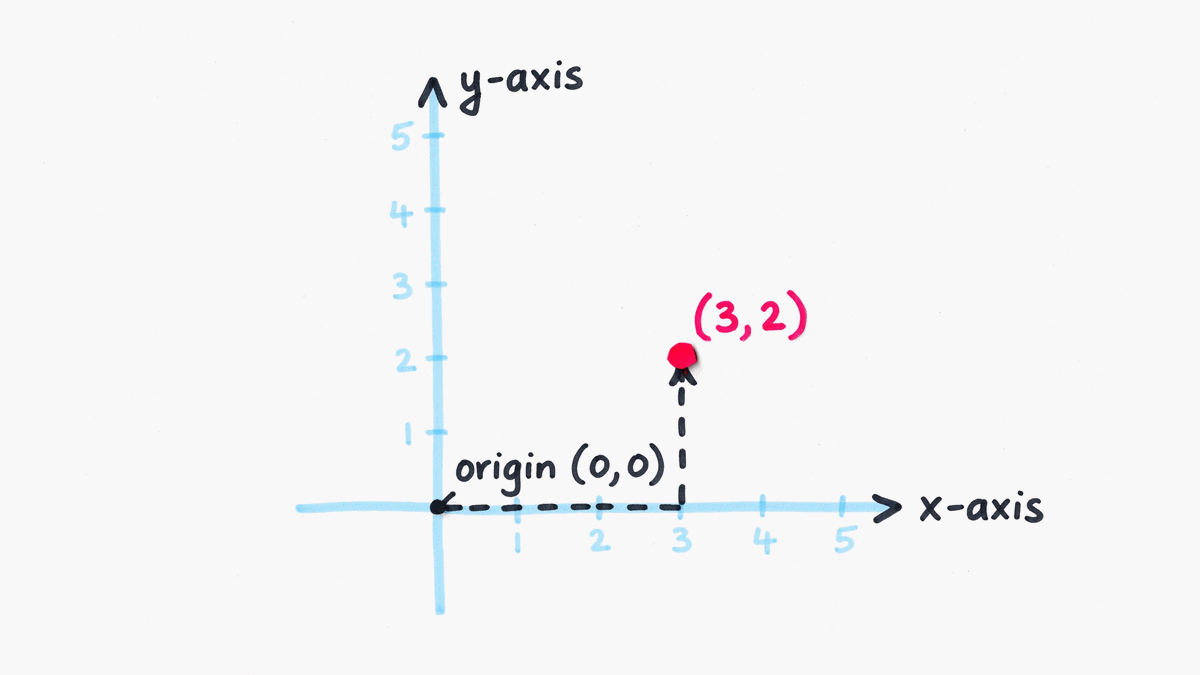
A coordinate plane is one model used to describe figures on a plane. It builds from two perpendicular numbered axes: a horizontal x-axis and a vertical y-axis that cross at the origin, labeled (0, 0). Khan Academy's geometry directory uses this grid to place and practice plane figures.
Any point on the plane gets an ordered pair (x, y): the first number moves the point right or left from the origin, and the second moves it up or down. Take point (3, 2): start at the origin, move 3 units right along the x-axis, then 2 units up along the y-axis. Plot the corners of a polygon this way, connect them in order, and the shape still lives in the same flat plane; the coordinate grid only gives each point an address.
Perimeter and Area: The Measurement Framework
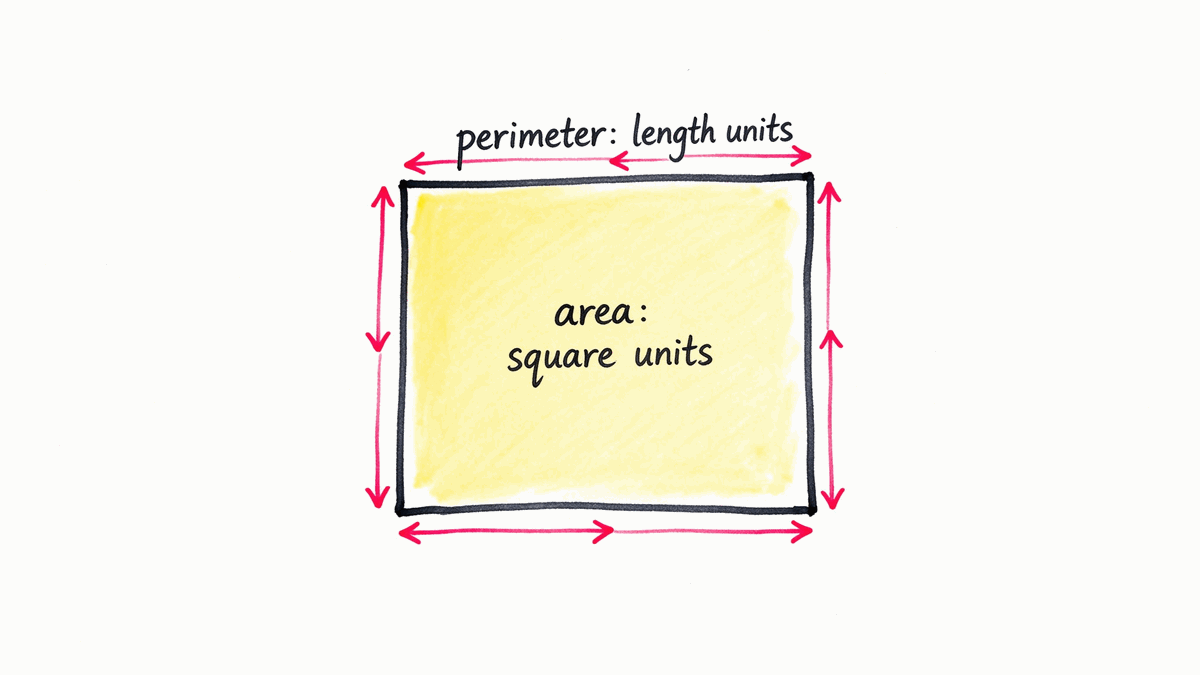
Plane geometry measures flat figures with two different quantities, and mixing their units is a common error. Perimeter is the distance around the outside of a closed figure, measured in ordinary length units such as centimeters or inches. Area is the amount of flat space the figure covers, measured in square units such as square centimeters or square inches.
For a 4-by-4 square, tracing its four sides gives a perimeter of 16 length units, while the space it fills covers 16 square units. The numbers match here, but the units do not, so perimeter and area are never interchangeable. The specific perimeter and area formulas for each figure are listed in the geometry formulas reference; this page keeps the framework, not a formula table.
Plane Geometry vs Solid Geometry
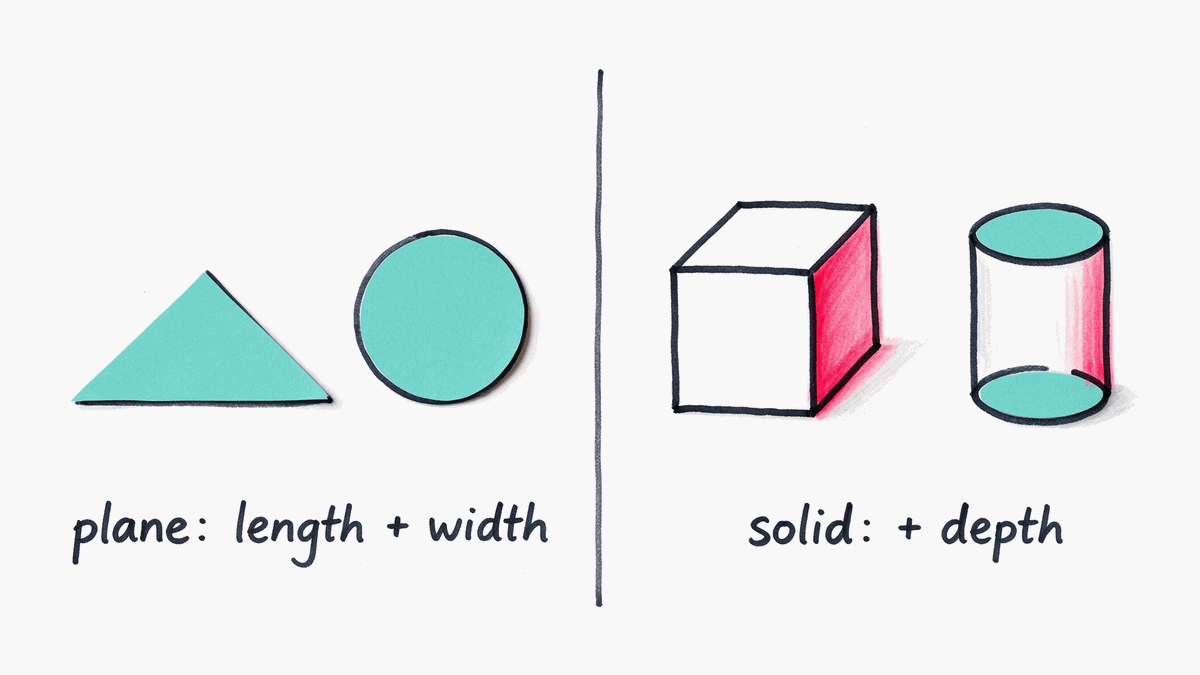
Dimensions settle the question before anything else. Flat figures carry two measures, length and width, without any depth; solid bodies add a third measure, depth, and fill space in all three directions. MathWorld draws the same split between figures lying in a plane and figures treated by solid geometry.
Feature | Plane geometry | Solid geometry |
Dimensions | Length and width | Length, width, and depth |
Thickness | None | Present |
Measurement | Perimeter and area | Surface area and volume |
Example figures | Triangle, circle, square | Cube, cylinder, sphere |
Check four figures before reading the placement: a triangle lies flat with no depth, so it belongs to plane geometry. A circle also belongs to the plane branch. A cube has depth and volume, so it is a solid figure. A cylinder occupies space in three directions and belongs to solid geometry. A drawing of a cube on paper is a plane representation, but the cube itself is solid; the picture stays on the plane, the object does not.
A Short Note on Euclid and the Elements
The plane geometry taught in schools descends from a system organized by Euclid of Alexandria, who flourished around 300 BCE. His treatise the Elements devotes Books I through IV to elementary plane geometry and Book III to circles, while Books XI through XIII treat three-dimensional stereometria, according to Britannica. For more than 2,000 years the Elements set the deductive standard of stating definitions, postulates, and conclusions in order; classrooms often call Euclid the father of geometry as shorthand for that historical role, even though the title is not a formal academic designation.
Where Plane Geometry Shows Up
Outside the textbook, plane geometry appears whenever a flat layout matters. A floor plan maps rooms on a flat plane with length and width. A road map places streets and landmarks by coordinates. A phone or screen grid gives every touch point an (x, y) address, and an architect's technical drawing reports wall lengths and room area before any depth or volume is added.
How to Study Plane Geometry
Learn the blocks first: points, lines, segments, and rays. Next, classify the combined figures (angles, polygons, circles) on the plane, then practice locating points on the coordinate plane before measuring perimeter and area. Finish by checking dimension: no depth means plane geometry, added depth means solid geometry. Routing the details keeps each topic on its own page: ray naming to the ray guide, shape attributes to the shapes guide, and every formula to the formula reference. The broader axiom-and-theorem history behind this system will be covered in the euclidean geometry guide once that page publishes.
Learn Geometry with Gauth
When you are ready to practice, the existing geometry course takes points, lines, planes, and angles in order. You can also create a focused interactive course for the exact plane geometry topic you want to work on, from coordinate plotting to perimeter and area.
Frequently Asked Questions About Plane Geometry
Is there one single formula for plane geometry? No. The branch has no master formula because every figure measures differently: a triangle, a circle, and a square each carry their own perimeter and area expressions. Learn the perimeter-versus-area framework here, then look up the specific expression for the figure you are working on in the formula reference.
Why is a plane called an undefined term? Geometry starts from a small set of objects it cannot build from anything simpler: point, line, and plane. Instead of defining a plane with earlier words, textbooks describe it (flat, no thickness, infinite) and accept that description as a starting point. The undefined status does not mean the plane is vague; it means the plane is a foundation rather than a compound idea.
Sources and Review
Plane Geometry -- from Wolfram MathWorld, accessed 2026-10-21: figures lying in a plane, contrasted with solid geometry.K12 LibreTexts, 1.1 Geometry Terms, accessed 2026-10-21: the plane as an undefined flat, thicknessless, infinite surface.Khan Academy, Geometry course directory, accessed 2026-10-21: coordinate plane, plane figures, perimeter, and area coverage support.Euclid | Biography, Contributions, Geometry, & Facts | Britannica, accessed 2026-10-21: the Elements book grouping and its deductive role.