What is 1st Person, 2nd Person, and 3rd Person: Important Grammar Rules You Should Know
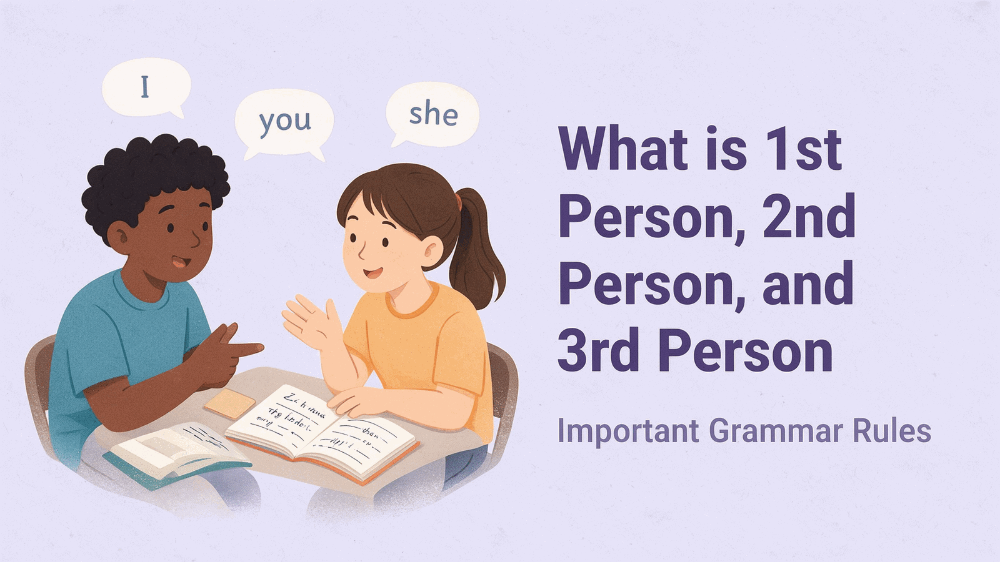
First person is the speaker's own view (I, we). Second person talks to the reader (you). Third person covers anyone outside the two of you (he, she, it, they). Point of view is which of these the narrator uses. The table below lines them up, and the rule after it picks one for your task.
What the three persons mean
Grammar uses "person" to track who is in a sentence. First person is the one talking or writing. Second person is the one being talked to. Third person is everyone and everything else being talked about. Picture three seats: the speaker, the listener, and the people off to the side.
It matters because the same facts can feel close or far depending on which seat the narrator takes. A first-person narrator lives inside the "I" and reports only what that one character sees. A third-person narrator stands outside and can move among several characters. Merriam-Webster walks through that narrator-to-character relationship.
The three persons and their pronouns
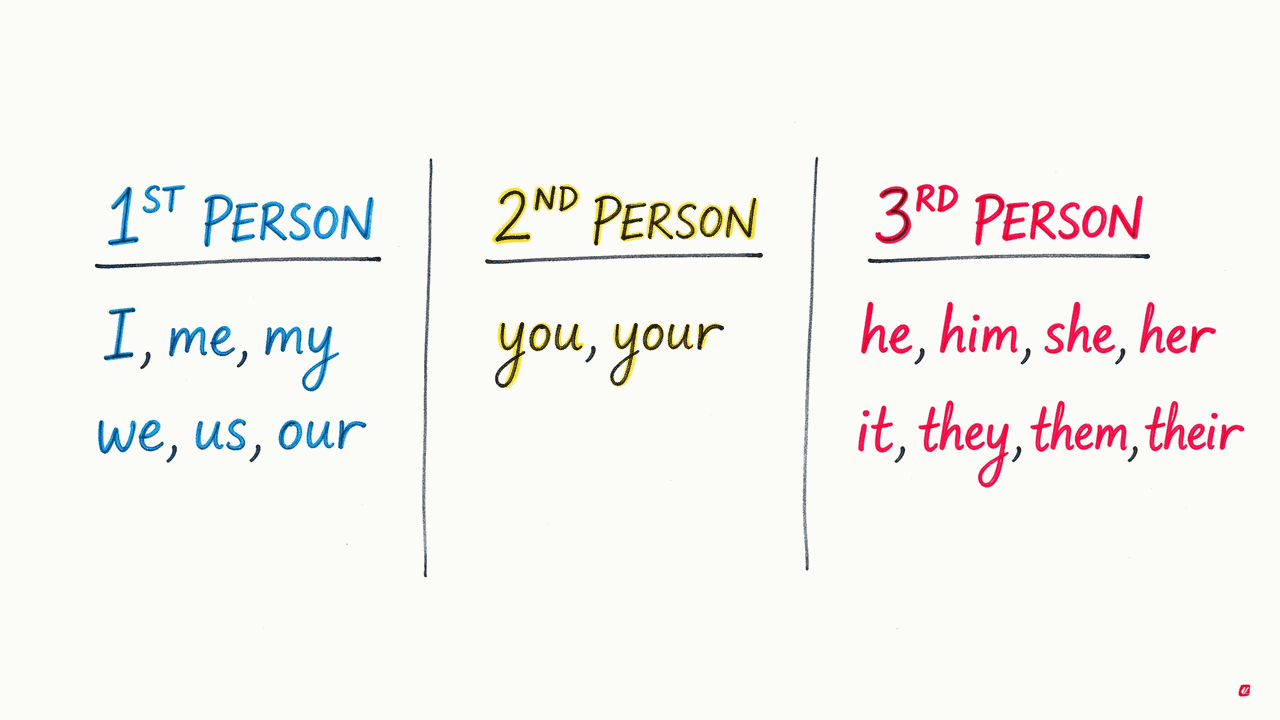
The fastest way to tell the persons apart is the pronoun doing the action. The subject forms are below; Cambridge Dictionary lists the full personal-pronoun set.
Person | Who it is | Subject pronouns | Feels natural for | Example sentence |
1st | The speaker or writer | I, we | Personal stories, reflections, eyewitness accounts | I opened the old letter. |
2nd | The reader, spoken to directly | you | Instructions, process writing, advice | Open the letter on a flat table. |
3rd | Anyone outside the two of you | he, she, it, they | Reports, analysis, most fiction | She opened the old letter. |
Person also shows up in object and possessive forms, following the same split: first person keeps me/my/mine and us/our/ours; second person stays you/your/yours; third person spreads across him/his, her/hers, its, and them/their/theirs.
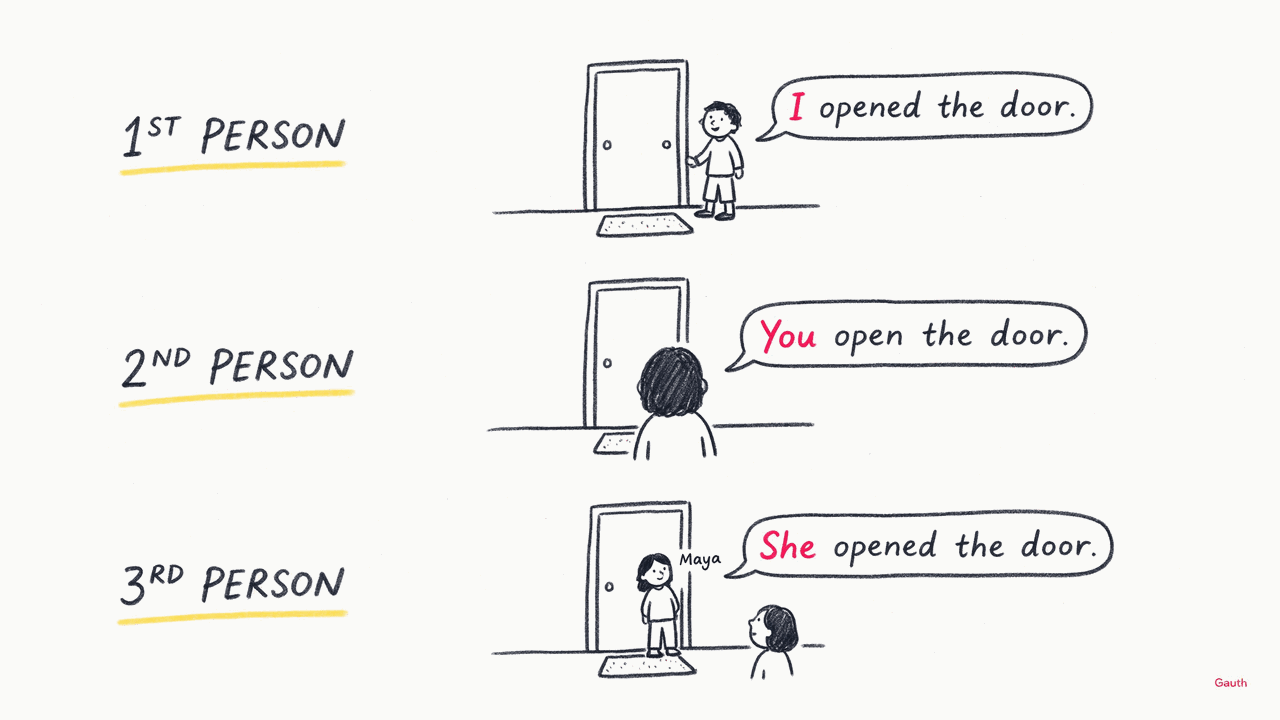
The same scene told three ways: worked examples
Run the same scene through the three persons and the change is obvious. Keep the facts fixed; change only who is telling the story.
- First person: "I heard the door click before I saw anyone." The narrator reports only their own senses, which feels intimate but limited to what that one character notices.
- Second person: "You hear the door click before you see anyone." The narrator hands the moment to the reader, so you are the one at the door; this pulls you in but is rare in essays.
- Third person: "Maya heard the door click before she saw anyone." The narrator watches Maya from outside and can move to what other characters do, which suits reporting and most stories.
The facts do not move; the angle on them does.
How to choose which point of view to use
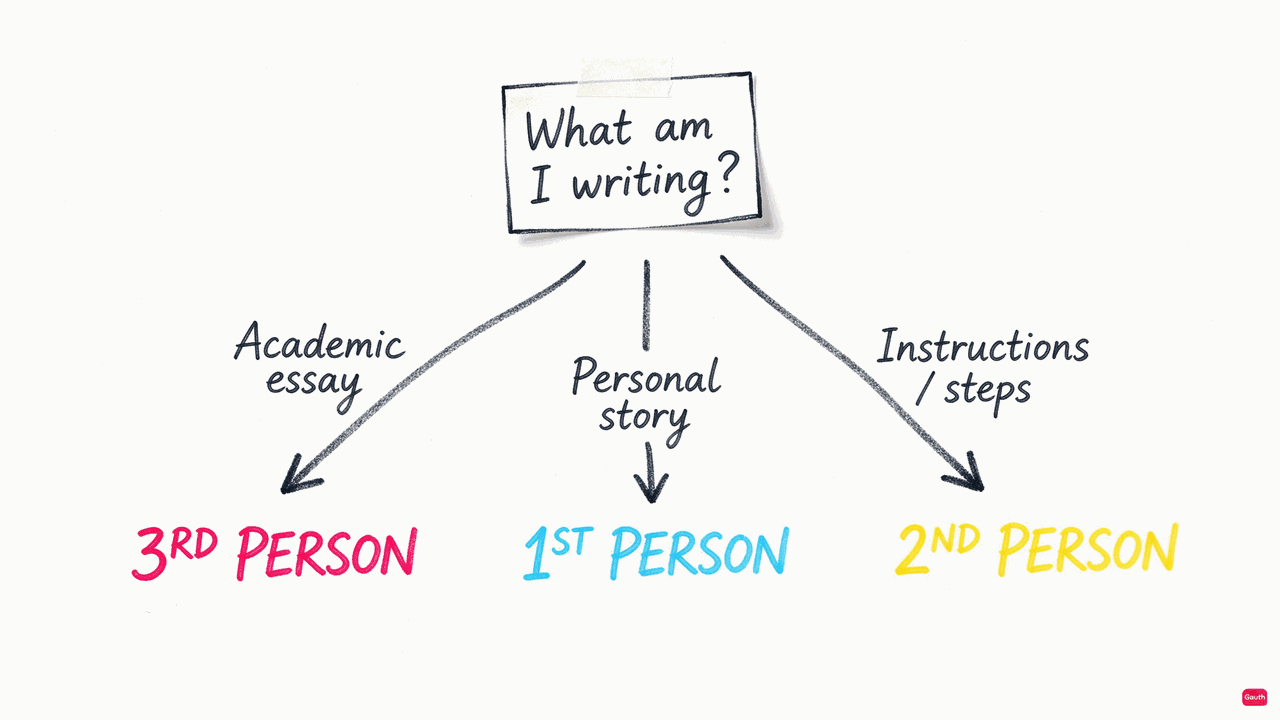
There is no best one; choose by the writing task and match the person to the assignment.
Academic essays and formal analysis: default to third person
Academic essays, lab reports, and formal analysis usually take third person, which keeps the focus on the subject instead of on "I think." Writing about a study, event, or text in third person lets your evidence carry the claim and reads as measured to most teachers. Reserve first person for a reflection the prompt explicitly asks for.
Personal narrative and reflection: reach for first person
Personal narrative and reflection essays take first person because the point is what you did, noticed, and felt. First person lets you trace a real change in your own thinking, and the "I" makes that growth credible. If the prompt asks what you learned, first person is the expected choice.
Instructions and process writing: use second person
Instructions, recipes, how-to guides, and advice take second person, because they walk the reader through a step. Addressing the reader as "you" turns a list into a direct process and keeps each step active. This is why this explanation talks to you directly rather than hiding behind third person.
Fiction: choose between first and third
Fiction can lean on first or third, and the two feel different on purpose. First person is close and intimate, locked inside one narrator's surprises. Third person can range across several characters and reveal what each one knows. Pick first when the voice is the draw; pick third when the plot needs to cut between people.
A boundary: when second person is off-limits in formal writing
One boundary to watch: second person reads as chatty in a formal essay, so most teachers want you to drop "you" and write in third person. The fix is to name the actor instead of addressing the reader: write "a researcher should control the variables" rather than "you should control the variables."
Common point-of-view mistakes
A few slips show up once students choose a person on purpose; catching them early keeps the writing consistent.
Singular "they" is still third person
Write "The student forgot their notebook" and their still points to one person, so it stays third person even though it sounds plural. Do not promote it to first or second, and do not reach for "he or she" by reflex when "they" is smoother. The agreement stays third: "they were" is correct here.
"You" stays the same in singular and plural
"You" works for one reader or for a whole room, and it never takes an s. "You is" is always wrong; "you are" covers both. Because the word does not change shape, the verb is the only signal, so keep it plural.
Do not switch person mid-writing
Hold the person you started in. Do not open with first person ("I walked over") and drift into second ("then you realize"), because the reader suddenly has to ask who is speaking. Pick one person for the whole piece and check each paragraph for a stray pronoun.
Skip experimental 4th and 5th person
Skip 4th or 5th person. Those are experimental fiction ideas, not a standard school choice, and they will confuse a reader who expects the three ordinary persons. The three above are the only ones you need for an essay or a story.
Still deciding? Practice your point of view
Once the persons have names, use one on purpose. Pick a paragraph, circle every pronoun, and confirm they all sit in the same person; rewrite any stray sentence.
Sketch a scene in the Gauth Essay Helper, then check your pronouns stay in the chosen person.
Beyond pronouns, grammar rules for essay writing covers the rest of a polished draft. And once the point of view holds steady, the next craft lever is figurative language: what a metaphor is.
Sources and review
- Cambridge Dictionary: Personal pronouns (I, me, you, him, it, they, etc.), accessed September 30, 2026.
- Merriam-Webster: Point of View - It's Personal, accessed September 30, 2026.
