Relationships Between Arcs and Chords
Arc measures match their central angles, percentages describe portions of 360°, and adjacent arcs add. In the same circle or congruent circles, congruent chords, arcs, and central angles determine one another. A radius perpendicular to a chord bisects it, allowing right triangles to connect chord lengths, radii, and distances from the center.
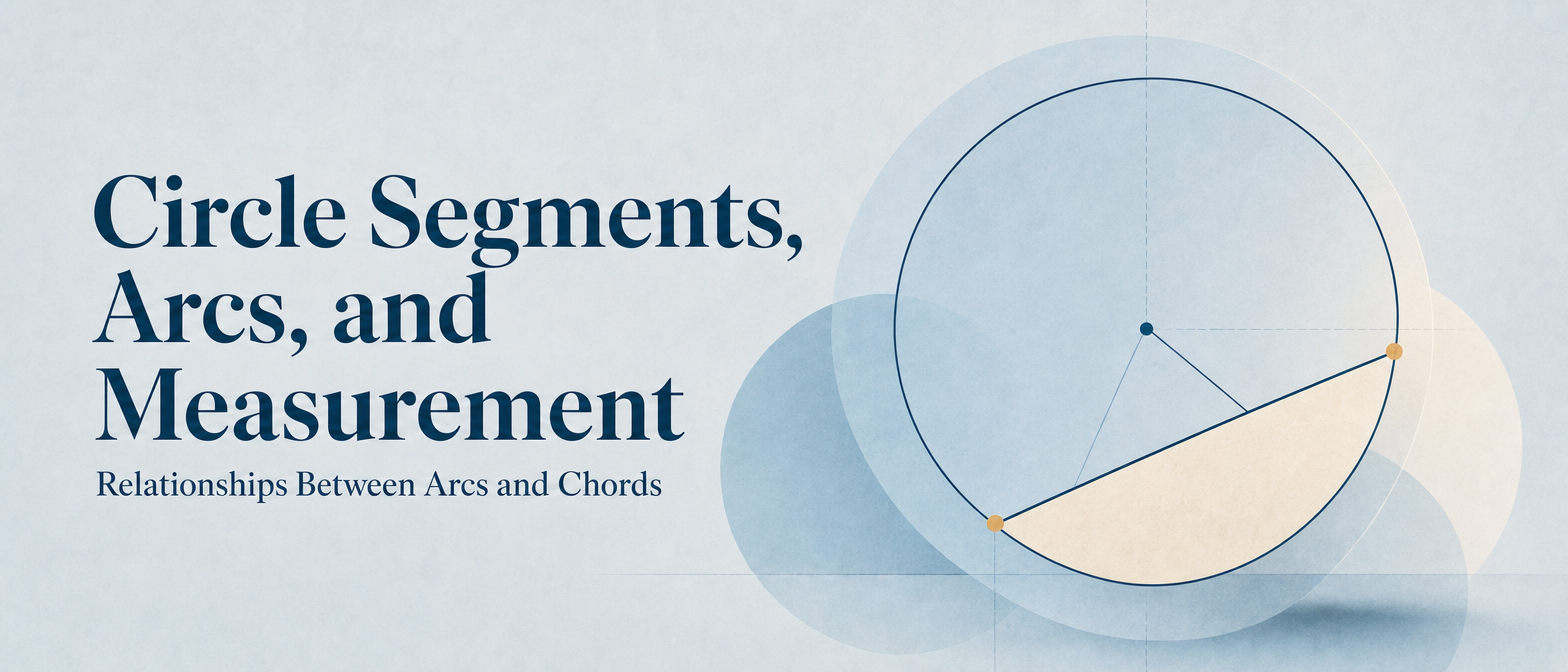
A Circle Hides Three Measures
A round pizza provides a model for several parts of a circle. The two straight edges of a slice suggest radii, the angle between them lies at the center, and the curved crust suggests an arc. A straight cut joining two points on the circle suggests a chord

In a circle with center O, radii OA and OB form the central angle ∠AOB. The curved part of the circle from A to B is an arc, written ⌢AB. A segment CD joining two points on the circle is a chord; in the opening example, this chord does not pass through O
The guiding question is: if one measure is known, what other measures can be found? This lesson uses central angles, percentages, adjacent arcs, congruence, and perpendicular radii to find arc measures and lengths
Arcs and Central Angles
| Term | Meaning |
|---|---|
| Central angle | An angle whose vertex is the center of the circle and whose sides are radii. |
| Minor arc | The shorter arc between two endpoints, lying on or inside its central angle. |
| Major arc | The remaining, longer arc between the endpoints; its measure is 360° minus the minor arc's measure. |
| Semicircle | An arc whose endpoints lie on a diameter; it measures exactly 180°. |


The measure of a minor arc equals the measure of its central angle: m⌢AB = m∠AOB. The small letter m means “the measure of.” For example, if m∠AOB = 60°, then m⌢AB = 60°. The major arc measures 360° − 60° = 300°

Example: Finding both arcs
In circle O, central angle ∠AOB measures 115°. Find the measures of the minor arc and the major arc between A and B
The minor arc matches the central angle, so m⌢AB = 115°. The major arc is the rest of the full circle: 360° − 115° = 245°. Checking the total gives 115° + 245° = 360°
Practice 1 conditions: In circle T, the major arc from D to E measures 285°. Radii TD and TE form ∠DTE, the central angle of the minor arc
Arc Measures from Percents
A circle graph represents one full circle, so its central angles total 360°. Each sector's percentage of the data is the same percentage of 360°. To find the sector's central angle or arc measure, convert the percentage to a decimal and multiply: arc measure = (percent as decimal) × 360°

Example: The Class Pets graph
A Class Pets survey has four categories: dogs 45%, cats 30%, fish 15%, and birds 10%. Points A and C are the endpoints of the fish sector's arc, and B lies on that arc. Find m⌢ABC

The radii bounding the fish sector form central angle ∠AOC, so m⌢ABC = m∠AOC. Convert 15% to 0.15, then calculate m⌢ABC = 0.15 × 360° = 54°. This is less than 90°, consistent with the fish sector being smaller than a quarter of the circle
Practice 2: The tacos sector
A school lunch survey will be drawn as a circle graph. Use the table to find the arc measure of the tacos sector
| Lunch choice | Percentage |
|---|---|
| Pizza | 40% |
| Salad | 25% |
| Tacos | 30% |
| Soup | 5% |
Complete the computation for the tacos sector's arc measure: arc measure =
$$decimal$$
× 360° =
$$degrees$$
. The original choices are 0.30, 30, 3.0, 108°, 1080°, and 90°
The correct entries are 0.30 and 108°: 30% = 0.30, and 0.30 × 360° = 108°. Use the tacos row, not the salad row; 90° corresponds to salad's 25%. A result greater than 360° cannot represent this sector
Adding Adjacent Arcs
Adjacent arcs share exactly one endpoint. If arcs ⌢CD and ⌢DE meet only at D, the Arc Addition Postulate gives m⌢CDE = m⌢CD + m⌢DE. The combined arc runs from C through D to E

Example: Crossing diameters
In circle C, segments GK and HL are diameters. Points G, H, J, K, and L lie in that order around the circle. Given m⌢GH = 20° and a right angle between radii CJ and CK, find m⌢JKL
First, ∠JCK is a right angle, so m⌢JK = 90°. Next, m∠GCH = m⌢GH = 20°. Because GK and HL are straight lines through C, ∠GCH and ∠KCL are vertical angles. They are congruent, so m∠KCL = 20° and m⌢KL = 20°

Arcs ⌢JK and ⌢KL share only K. Add their measures: m⌢JKL = 90° + 20° = 110°. The combined central angle spans those same two angles
Practice 3 conditions: Points W, X, and Y lie in order on circle Z. Arcs ⌢WX and ⌢XY meet only at X, with m⌢WX = 65° and m⌢XY = 48°
Congruent Chords, Arcs, and Angles
In the same circle or in congruent circles, congruent central angles, their corresponding minor arcs, and their corresponding chords determine one another. Congruent central angles have congruent chords and arcs; congruent chords have congruent arcs and central angles; congruent arcs have congruent central angles and chords


Example: Two ticked chords
In one circle, chords AB and CD each carry one matching tick mark, so AB ≅ CD. Their arcs have measures m⌢AB = 7x° and m⌢CD = (4x + 45)°. Find m⌢AB
Congruent chords in the same circle have congruent arcs, so 7x = 4x + 45. Subtract 4x to obtain 3x = 45, then divide by 3 to obtain x = 15. The requested measure is m⌢AB = 7(15) = 105°. Check the other expression: 4(15) + 45 = 105°

Example: Across two congruent circles
Given ⊙S ≅ ⊙V and ⌢TU ≅ ⌢WX, central angle ∠TSU measures (5x + 7)° and central angle ∠WVX measures (9x − 21)°. Find m∠TSU. The circles are congruent, so radii ST, SU, VW, and VX are all congruent
Congruent arcs in congruent circles have congruent central angles. Therefore, 5x + 7 = 9x − 21. Subtract 5x and add 21 to obtain 28 = 4x, so x = 7. Substitute: m∠TSU = 5(7) + 7 = 42°. The other angle also measures 9(7) − 21 = 42°

Practice 4 conditions: Circles M and N are congruent, and ⌢DE ≅ ⌢FG. In circle M, m∠DME = (8x + 9)°. In circle N, m∠FNG = (10x − 13)°
Perpendicular Radius and Chord
If a radius or diameter is perpendicular to a chord, it bisects the chord and its arc. The two chord halves are equal, and the arc is divided into two equal parts. Conversely, the perpendicular bisector of a chord passes through the center of the circle

Example: How long is the chord?
In circle O with radius 13, radius ON is perpendicular to chord AB at M, and OM = 5. Find AB. A radius OB to endpoint B forms right triangle OMB, with hypotenuse OB = 13 and leg OM = 5

Apply the Pythagorean Theorem: MB² + 5² = 13². Thus MB² = 169 − 25 = 144, so MB = 12. Use the positive square root because MB is a length
Because ON ⊥ AB, M bisects the chord and AM = MB = 12. The whole chord is AB = 12 + 12 = 24. The right triangle gives only half the chord, so double that half-length to answer the question
Practice 5 conditions: In circle E, chord CD has length 16. The perpendicular segment from center E meets CD at its midpoint F, and EF = 6. Radius EC is the hypotenuse of right triangle ECF
Summary
1. Arc and central angle: A minor arc's measure equals its central angle's measure. The major arc measures 360° minus the minor arc
2. Percent data: Convert the sector's percentage to a decimal and multiply by 360° to find its arc measure
3. Adjacent arcs: Arcs sharing exactly one endpoint can be combined using m⌢CDE = m⌢CD + m⌢DE
4. Congruence: In the same circle or congruent circles, congruent central angles, corresponding arcs, and chords determine one another. Set equal measures equal, solve, and then calculate the measure requested—not just x
5. Perpendicular radius: A radius perpendicular to a chord bisects the chord and its arc. A radius to a chord endpoint forms a right triangle with the half-chord and the perpendicular distance from the center. Use a² + b² = c², and double the half-chord when the whole chord is requested
Quiz
Quiz 1 conditions: In a survey drawn as a circle graph, the streaming-music sector represents 55% of all responses. A full circle measures 360°
Quiz 2 conditions: In circle O, chords JK and LM each carry one matching tick mark, so JK ≅ LM. Their corresponding central angles have measures m∠JOK = (6x + 12)° and m∠LOM = (9x − 24)°
Quiz 3: Distance to a garden beam
A circular garden bed is crossed by a straight support beam that forms chord UV. Circle P has radius 17 ft, chord UV is 30 ft long, and segment PT is perpendicular to UV at T. Find UT, half the chord, and PT, the distance from the center to the beam
Fill in the half-chord UT and the distance PT from the center to the chord: UT =
$$half$$
; PT = √(17² − UT²) =
$$dist$$
. The original numerical choices are 15, 8, 30, 2, and 64
Because PT is perpendicular to the chord, T is its midpoint. Thus UT = TV = 30 ÷ 2 = 15 ft. In right triangle PTU, radius PU = 17 ft is the hypotenuse. Therefore PT = √(17² − 15²) = √(289 − 225) = √64 = 8 ft. The correct entries are 15 and 8. Use half the chord as the triangle leg, and take the square root rather than stopping at 64