How to Solve a Linear Equation Step by Step
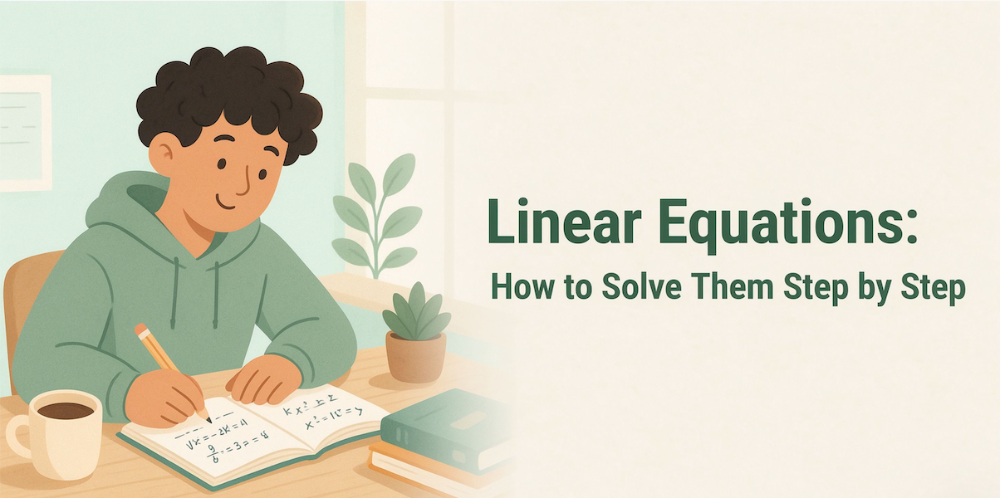
A linear equation uses the variable only to the first power. Simplify each side, choose an opening move from the equation's form, apply the same valid operation to both sides, and isolate the variable. Check the result in the original equation. If the variable disappears, the remaining statement shows whether there is no solution or infinitely many solutions.
What Makes an Equation Linear?
Three characteristics of a linear equation make it predictable: the variable appears only to the first power, it can be rearranged into the standard form below, and its two-variable version graphs as a straight line.
In one variable, a linear equation can be written as:
Ax + B = 0, where A ≠ 0
Once the expression is simplified, the variable has an exponent of 1. You will not find it multiplied by another variable, sitting in a denominator, or raised to a higher power.
These equations are linear:
- 3x - 7 = 11
- 2(x + 4) = 5x - 1
- x/3 + 1/2 = 5/6
These equations fall outside the one-variable linear category:
- x² + 3 = 7
- 1/x = 4
- xy + 2 = 10
An equation such as y = 2x + 1 links two variables and can be drawn as a line. Here, the focus is one unknown: finding the value that makes the equation true. Solving one-variable equations is also the first practical step into a broader linear algebra study guide, where these same ideas grow into vectors, matrices, and systems.
Choose the Right First Step
Look at the equation before moving any terms. Its form usually points to the most useful opening move.
What you see | First move | Reason |
No brackets or fractions, as in 5x - 7 = 18 | Undo the added or subtracted constant | This moves the variable term closer to being isolated |
Brackets, as in 3(2x - 1) + 4 = 2x + 13 | Distribute first | You need visible like terms before collecting them |
Fractions, as in x/3 + 1/2 = 5/6 | Multiply every term by the least common denominator | This removes the constant denominators in one valid step |
Variables on both sides | Move variable terms to one side | You need one combined variable term to isolate |
The variable cancels | Inspect the remaining statement | A true or false statement identifies a special solution case |
The table gives you a starting point, not a shortcut. To understand linear equations, remember that every first move still has to keep both sides equal; a clever opening does not change that rule.
A Step-by-Step Method for Solving Linear Equations
An equation says that two expressions have the same value. Apply an operation to one side, and you must apply that operation to the other. That is how you preserve equality while isolating the variable, and it is the same balance rule used across Paul's Online Notes and Pearson's worked solutions.
Work through the equation in this order:
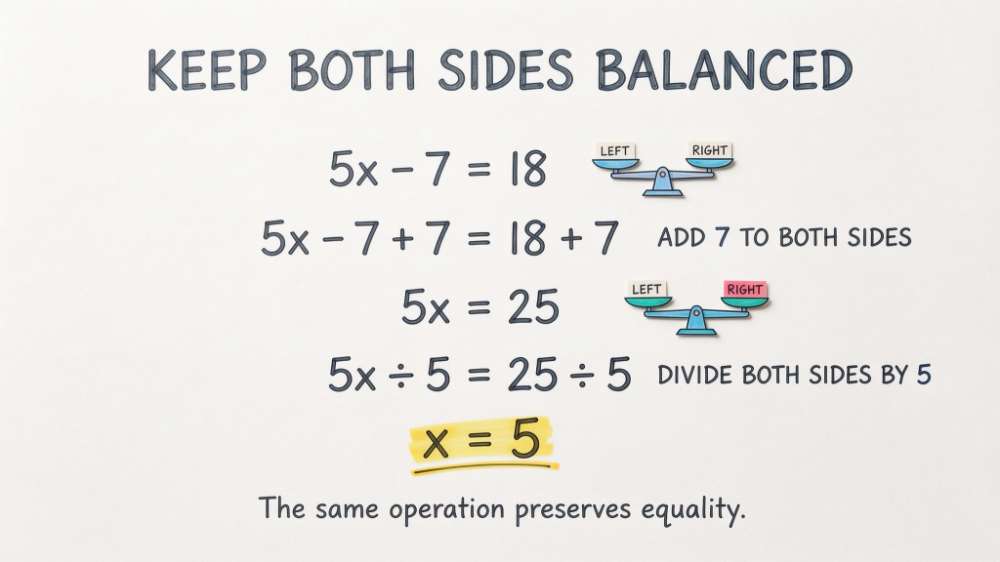
- Simplify each side. Distribute through brackets and combine like terms.
- Clear constant denominators when useful. Multiply every term on both sides by a common denominator.
- Collect variable terms on one side. Add or subtract the same variable term on both sides.
- Collect constants on the other side. Apply the same addition or subtraction to both sides.
- Isolate the variable. Multiply or divide both sides by the same nonzero number.
- Check the result. Substitute it into the original equation.
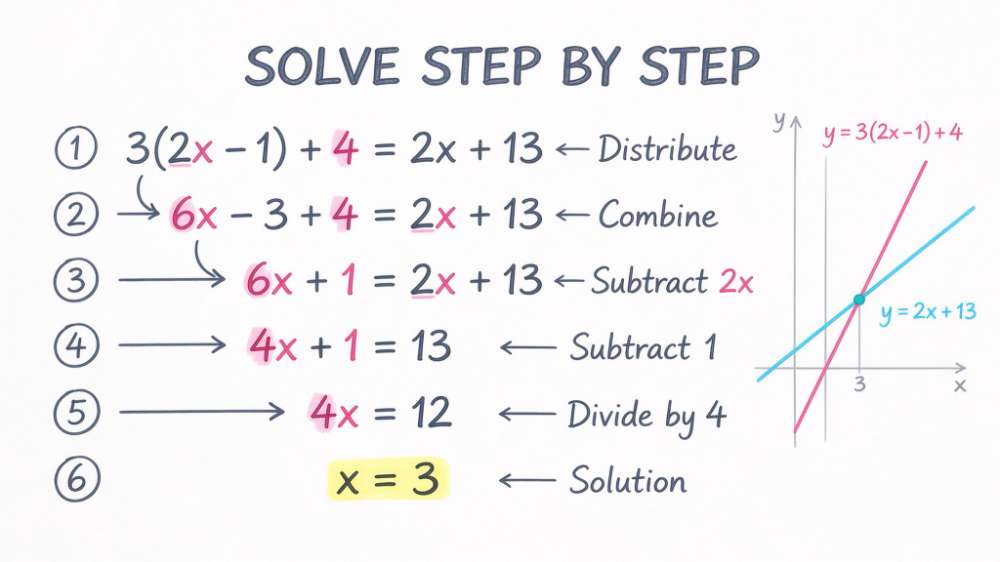
You may need only some of these steps. A one-step equation can start at step 5, while brackets usually send you to step 1. Division by 0 is never valid.
Worked Examples: Brackets, Both Sides, and Fractions
These linear equations examples move from a basic two-step case to brackets, variables on both sides, and fractions, with every step shown.
Example 1: A two-step equation
Solve 5x - 7 = 18.
Adding 7 to both sides undoes the subtraction next to the variable term:
5x = 25
Now divide both sides by 5, because 5 is the coefficient of x:
x = 5
Example 2: Brackets and variables on both sides
Solve 4(2x + 1) - 3 = 5x + 10.
Start by distributing so you can see the like terms:
8x + 4 - 3 = 5x + 10
Combine the constants on the left:
8x + 1 = 5x + 10
Move the variable terms together by subtracting 5x from both sides:
3x + 1 = 10
Subtract 1, then divide by 3:
3x = 9
x = 3
Example 3: An equation with fractions
Solve x/3 + 1/2 = 5/6.
The least common denominator is 6, so multiply every term on both sides by 6:
2x + 3 = 5
Subtract 3, then divide by 2:
2x = 2
x = 1
Because every term receives the same nonzero multiplier, equality is preserved. The fraction equation has become an ordinary two-step equation.
How to Check a Solution
Put the proposed value back into the original equation. If the solution is correct, the left and right sides will match. Substitution is the standard final check after isolating the variable.
Check x = 3 in the original equation from Example 2:
Left side:
4(2 × 3 + 1) - 3 = 4(7) - 3 = 25
Right side:
5 × 3 + 10 = 25
Each side equals 25, confirming that x = 3 satisfies the original equation.
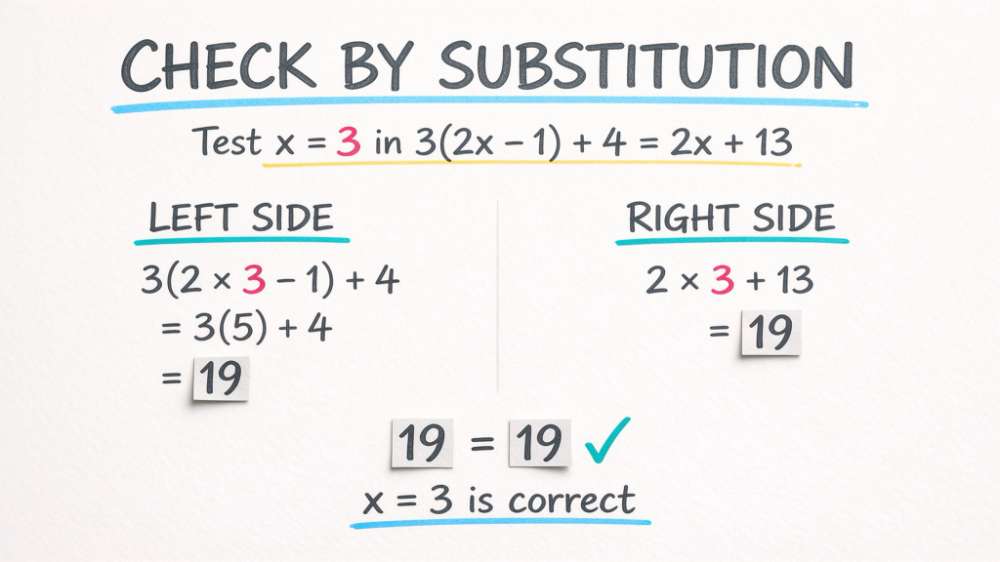
Always return to the original equation. Checking a later line can miss an arithmetic or distribution error made earlier.
One Solution, No Solution, or Infinitely Many?
Valid simplification leaves a one-variable linear equation with one of three outcomes, often described as conditional, inconsistent, and identity equations.
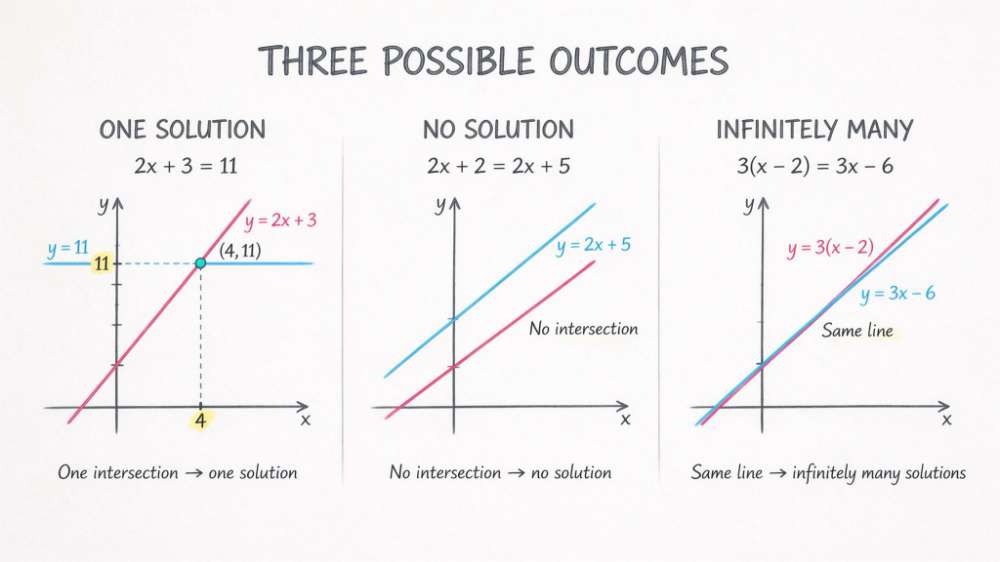
One solution
The equation reduces to one value:
2x + 3 = 11
2x = 8
x = 4
No solution
The variable cancels, leaving a false statement:
2(x + 1) = 2x + 5
2x + 2 = 2x + 5
2 = 5
Since 2 = 5 is false, no value of x can satisfy the original equation.
Infinitely many solutions
The variable cancels, leaving a true statement:
3(x - 2) = 3x - 6
3x - 6 = 3x - 6
-6 = -6
Since -6 = -6 holds for every value of x, the original equation has infinitely many solutions.
Common Mistakes and What to Practice Next
These are the most common mistakes students make with linear equations. When an answer fails the substitution check, trace the work with these questions:
- Did only one side change? Write the operation next to both sides before simplifying.
- Did a term vanish during distribution? Multiply every term inside the brackets, including a negative constant.
- Were unlike terms combined? Keep variable terms and constants in separate groups.
- Were only some fractions cleared? Multiply every term on both sides by the common denominator.
- Did the variable cancel before another division? Read the statement that remains and decide whether it is true or false.
- Was a later line used for the check? Substitute the result into the original equation.
Equations such as y = 2x + 1 lead into graphs and linear functions. A problem with two equations sharing the same variables is a system; How to Solve a System of Equations covers that next step.
Practice These Skills in Gauth AI Course
This article is closest to Algebra 1, Unit 3: Linear Equations. The current path contains five lessons, beginning with addition and subtraction equations and progressing to multi-step equations and equations with variables on each side.

The panels show the Unit 3 course map, the opening lesson screen, a balance-rule exercise, and an Ask gauth answer to a question about making the same change on both sides.
- Example 1 draws on the addition, subtraction, multiplication, and division lessons.
- Example 2 fits Multi-Step Equation Solutions and Equations with Variables on Each Side.
- Example 3 becomes a multi-step equation once its denominators are cleared.
Open the course when you want guided instruction and practice. Return to this article for a quick check on the first move, substitution, or special solution cases.