Linear Algebra: Key Concepts, Examples, and Study Guide
Linear algebra studies vectors and the linear transformations that move them, with matrices acting as a practical language for calculation. Start with vectors and linear combinations, then learn matrices and systems, vector spaces and basis, transformations, and finally eigenvalues. At each stage, connect the geometry to the arithmetic, work a small example by hand, and check the result by substitution or reconstruction.
What Is Linear Algebra?
Linear algebra studies vectors, vector spaces, and linear transformations. Matrices give you a compact way to represent many transformations and the coefficients in a system of linear equations. The same objects therefore appear in several roles: a vector may be data, a direction, or an unknown, while a matrix may move that vector or organize a collection of equations. LibreTexts defines it as the study of vectors and linear transformations, and Britannica connects those ideas to matrices and vector spaces.
High-school algebra supplies important tools for linear algebra: solving equations, interpreting functions, and working with coordinates. Linear algebra organizes those skills around multidimensional objects and structure. Its central questions include: Which combinations of vectors are possible? Does a system have a solution? What information does a matrix preserve? Which directions remain unchanged by a transformation?
How the Core Ideas Connect
Treat the chapters as connected views of the same problem, and the subject becomes much easier to navigate.
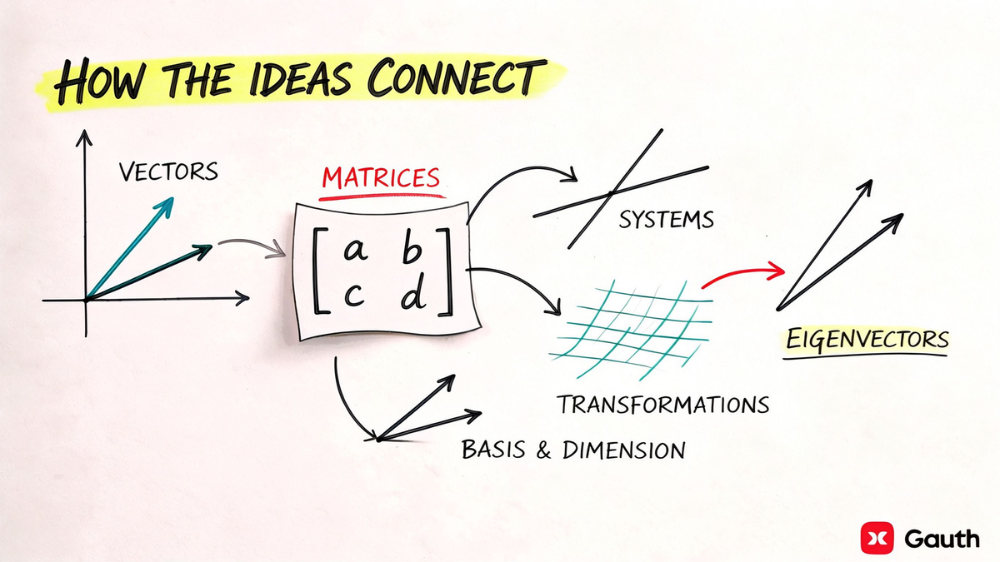
- Vectors are the objects you combine, transform, and solve for.
- Linear combinations describe what you can build by scaling and adding vectors.
- Matrices organize coefficients and represent linear transformations.
- Linear systems ask for a vector $$x$$ that satisfies $$Ax=b$$.
- Span, independence, basis, and dimension describe the structure of a vector space.
- Eigenvectors identify directions that a transformation scales without turning into a different direction.
Introductory courses arrange some details differently, although the relationships above stay consistent. MIT OpenCourseWare 18.06 includes systems of equations, vector spaces, determinants, eigenvalues, similarity, and positive definite matrices. Gilbert Strang's textbook sequence starts with vectors and linear equations, then develops vector spaces, orthogonality, determinants, eigenvalues, singular value decomposition, and linear transformations.
What You Should Know Before Starting
You can begin a first linear algebra course when you can do four things with reasonable confidence:
- Solve one-variable equations and small systems of equations.
- Read points, lines, and vectors on a coordinate plane.
- Substitute values into a function and interpret function notation.
- Keep multi-step arithmetic organized, including fractions and negative signs.
Calculus appears in some applications and degree programs. The opening ideas in this guide rely on algebra, functions, and coordinate geometry. Course prerequisites vary, so use your syllabus to check the requirements for your class.
Try this quick diagnostic. Solve the system $$x+y=5$$ and $$x-y=1$$, then plot the two lines. If you can find $$(3,2)$$ algebraically and recognize it as the intersection point, you have the main algebra and graphing skills needed for the first matrix examples. If the calculation is difficult, review how to solve a system of equations before continuing.
A Matrix Viewed Two Ways
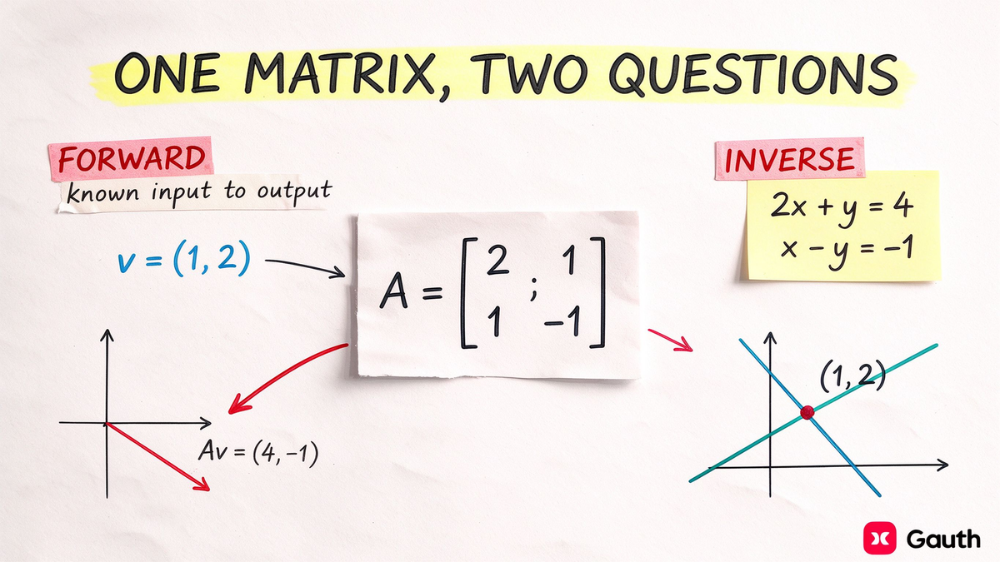
Consider the matrix
and the vector
.
View 1: a transformation
Multiplying gives
.
The matrix sends the input vector $$(1,2)$$ to the output vector $$(4,-1)$$. This is the forward question: where does this transformation send a given vector?
View 2: a system
Now suppose the output is known and the input is unknown:
.
This matrix equation represents
$$2x+y=4$$
$$x-y=-1$$.
From the second equation, $$y=x+1$$. Substituting into the first gives $$2x+x+1=4$$, so $$x=1$$ and $$y=2$$. Check the result in the original equations: $$2(1)+2=4$$ and $$1-2=-1$$.
Both viewpoints use the same matrix. The first asks for the output of a known input; the second asks which input produces a known output. That link explains why matrices appear throughout the subject. Matrix products also represent compositions of transformations, and changing their order usually changes the result. Britannica's linear algebra entry explains this relationship.
Key Concepts to Learn
Concept | The question it answers | A useful check |
Vector | What quantity or direction am I working with? | Check the number and meaning of its coordinates. |
Linear combination | What can I build from these vectors? | Write the target as weighted vectors and reconstruct it. |
Matrix | How are coefficients or a transformation organized? | Check dimensions before adding or multiplying. |
Linear system | Which vector satisfies all equations at once? | Substitute the solution into every original equation. |
Span | Which vectors can these inputs reach? | Describe every reachable vector as a linear combination. |
Linear independence | Does any vector repeat information already supplied by the others? | Test whether a nonzero coefficient combination gives the zero vector. |
Basis and dimension | What is the smallest independent coordinate system for the space? | Confirm the set spans the space and is independent. |
Linear transformation | How does a rule move vectors while preserving linear combinations? | Test addition and scalar multiplication on simple vectors. |
Determinant | For a square matrix, what does the transformation do to signed scale, and is the matrix invertible? | Compare the determinant with row-reduction results. |
Eigenvector and eigenvalue | Which nonzero direction is only scaled by the transformation? | Verify $$Av=\lambda v$$ directly. |
Before using a formula, identify the question it answers. A determinant, for instance, can help determine whether a square matrix is invertible. You still need the system, transformation, or vector-space context to explain the result.
A Practical Linear Algebra Study Order
Use this sequence as a dependency map. Your course calendar may arrange the topics differently.
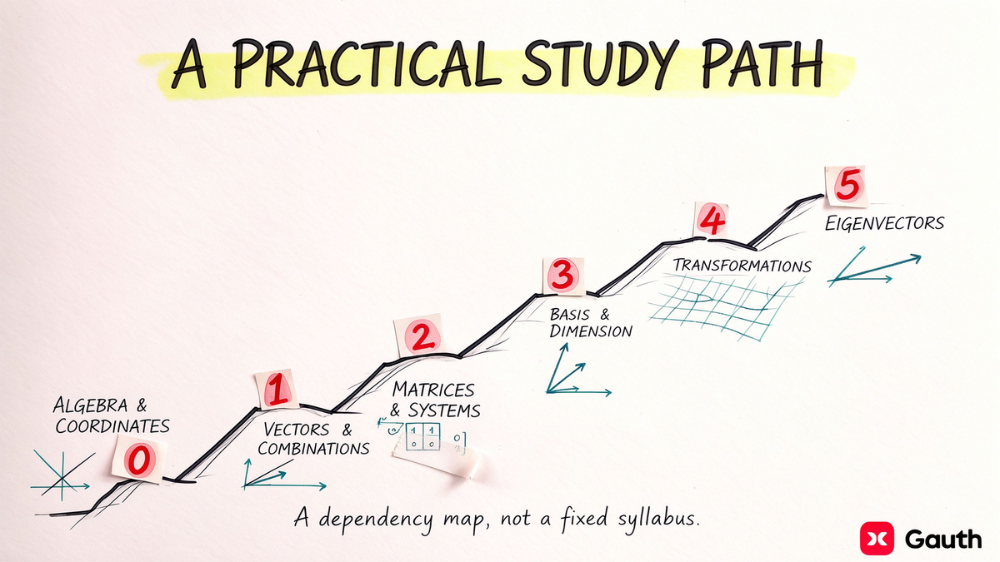
Stage 0: prerequisite algebra
Review equations, functions, coordinates, and careful symbolic manipulation. Your milestone is being able to solve a small system and verify the result without losing signs or coefficients.
Stage 1: vectors and linear combinations
Learn vector addition, scalar multiplication, dot products, and geometric interpretation. Your milestone is explaining what a linear combination represents and deciding whether a target vector can be built from a given set in small examples.
Stage 2: matrices and systems
Learn matrix arithmetic, row reduction, $$Ax=b$$, inverses, and solution types. Your milestone is solving a system, describing whether it has zero, one, or infinitely many solutions, and checking the answer in the original equations.
Stage 3: vector spaces, independence, basis, and dimension
Move from coordinate calculations to structure. Your milestone is explaining why a set spans a space, why it is independent or dependent, and how a basis supplies coordinates.
Stage 4: linear transformations
Connect functions with matrices. Study kernel, range, composition, and the matrix of a transformation. Your milestone is moving between a rule, its matrix, and its effect on selected vectors.
Stage 5: eigenvalues, eigenvectors, and later topics
Study invariant directions, diagonalization, orthogonality, least squares, and singular value decomposition as your course requires. Your milestone is verifying $$Av=\lambda v$$ and explaining what that statement means geometrically.
The sequence reflects dependencies visible in established course and textbook structures. An instructor may introduce transformations earlier or move determinants later, so let your syllabus set the final order.
How to Review for a Linear Algebra Exam
Build each review session around four activities:
- Recall the definition. State terms such as span, independence, basis, kernel, range, eigenvector, and eigenvalue without looking.
- Compute a small example. Row-reduce a system, multiply matrices, find a basis, or check an eigenpair.
- Explain the geometry. Describe what the calculation means for vectors, spaces, or transformations.
- Verify the result. Substitute into the original system, reconstruct a vector from a basis, or check $$Av=\lambda v$$.
Flashcards work well for definitions, conditions, and notation. Calculations need separate practice. Write cards that prompt a decision or check—“How do I verify that a set is a basis?”—instead of pairing a term with a vague definition.
The Introduction to Linear Algebra resource page includes problem sets and practice-exam links. After a past exam, label each missed problem by concept and error type, then redo one nearby problem without notes. The result is a diagnosis you can use for the next review session.
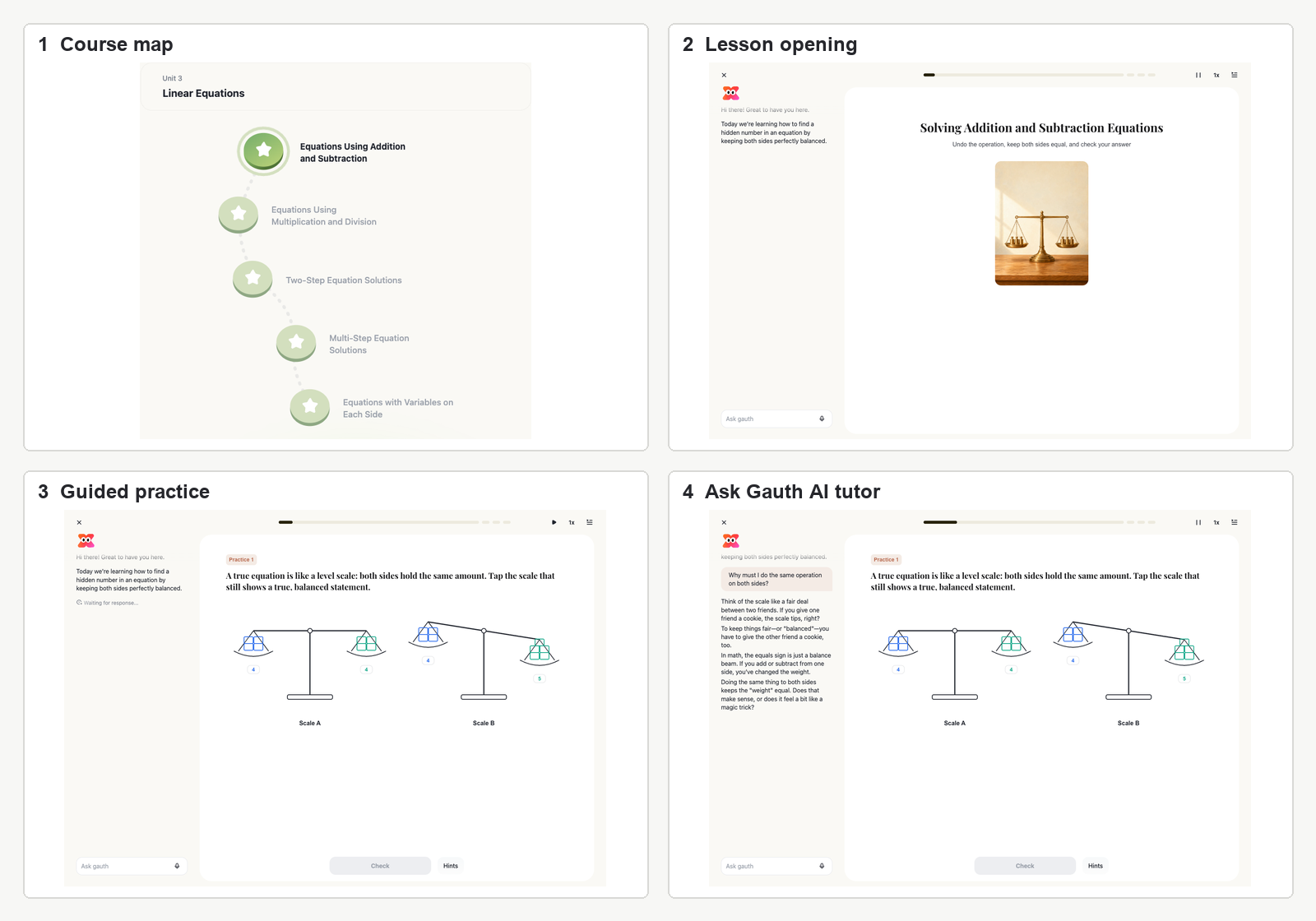
For a more guided review, you can open Gauth AI's existing Linear Transformations and Models or Linear Systems, Inequalities, and Optimization course. The course experience combines a learning path with lesson explanations, interactive practice, and an AI tutor you can question while studying.
If the available units do not match your syllabus, open Gauth Math Courses and choose Create Course. Enter the topic and your level, and Gauth AI can generate a personalized interactive micro-course. Use either route as focused review support, alongside your assigned linear algebra materials.
Common Mistakes and How to Check Your Work
- Multiplying incompatible matrices. Write the dimensions before calculating. For an $$m\times n$$ matrix times an $$n\times p$$ matrix, the result has dimensions $$m\times p$$.
- Reversing multiplication order. Compare $$AB$$ with $$BA$$ only after checking that both products are defined. They usually represent different compositions.
- Treating row operations as unexplained symbol moves. State the purpose: eliminate a variable, expose a pivot, or identify a free variable.
- Calling any nonzero vector an eigenvector. Verify the equation $$Av=\lambda v$$ for a specific scalar $$\lambda$$.
- Using a determinant as the whole explanation. Pair the determinant with row reduction or transformation geometry so you can explain what the result means.
- Stopping after arithmetic. Reconstruct the original quantity whenever possible. A correct-looking reduced matrix is not the final check.
Sources and review
- MIT OpenCourseWare 18.06: Linear Algebra, accessed September 21, 2026.
- Gilbert Strang, Introduction to Linear Algebra, Fifth Edition: resources and table of contents, accessed September 21, 2026.
- LibreTexts: Linear Algebra by Waldron, Cherney, and Denton, accessed September 21, 2026.
- Encyclopaedia Britannica: Linear algebra, accessed September 21, 2026.
- Gauth Interactive Math Courses, accessed September 21, 2026.