Why Does That Puddle Never Get Closer?
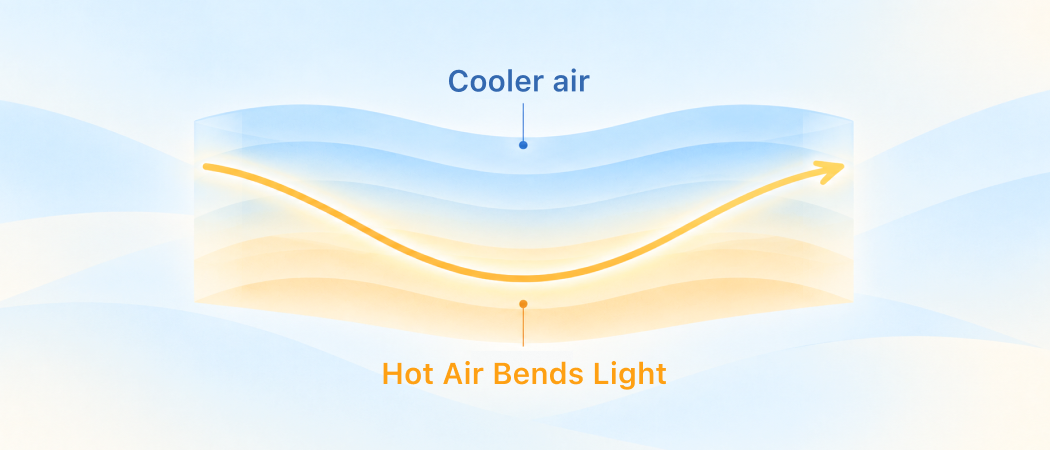
A hot-road mirage is an image of the sky, not water on the pavement. Hotter air near the surface has a lower refractive index, so a shallow ray of sky light can curve upward into your eyes. Your visual system projects its arrival direction backward toward the road, creating an apparent puddle whose position changes with your viewing geometry.
The Puddle That Isn't There
A Puddle on a Dry Road
A puddle on a dry road
Imagine driving down a highway on a hot, sunny day. A few hundred meters ahead, the road looks soaked, as if a wide puddle were reflecting the sky. But when you reach that spot, the road is bone-dry, and the puddle seems to have moved farther away
Imagine driving down a highway on a hot, sunny day. A few hundred meters ahead, the road looks soaked, as if a wide puddle were reflecting the sky. But when you reach that spot, the road is bone-dry—and the puddle seems to have moved farther away
Watch the bright patch shimmer on the road ahead. It resembles a puddle, yet it keeps retreating as the vehicle moves forward
How We Will Explain It
Here is how we will explain the mirage
Refraction, total internal reflection, visual interpretation, and changing viewing geometry
| Item | Properties |
|---|---|
| Refraction | Why light changes direction when its speed changes. |
| Total internal reflection | What happens beyond the critical angle in an ideal boundary model. |
| Why it looks like water | How the eye and brain place sky light near the road. |
| Why it disappears | How a changing viewing position breaks the light path. |
Refraction & Total Internal Reflection
1. Start with Refraction
1. Warm air: Picture the air above a sun-heated road as layers. Near the road, the air is warmer and less dense


2. Lower index: That small change gives the warm layer a slightly lower refractive index

3. Faster light: So light moves through it a little faster

4. Ray bends: When a ray enters that layer at an angle, the change in speed turns the ray farther from the normal

5. Result: Across many thin layers, those tiny turns join into a smooth curve

2. The Critical Angle and Total Internal Reflection
1. Warm: Keep the incoming ray at the same angle and change only the temperature of the lower air. In the first case, that layer is warm, so its refractive index is only a little lower and the ray still passes into it
2. Hotter: Now heat the lower layer more. Its refractive index drops, and the transmitted ray lies closer to the boundary. So the angle to the boundary becomes smaller, while the refracted angle measured from the normal becomes larger

3. Critical: At the critical state, the ray runs exactly along the boundary

4. Beyond critical: If the lower layer becomes hot enough for its refractive index to fall beyond that threshold, no ray is transmitted into it; the light returns to the cooler layer. That final case is total internal reflection. Heating alone is not enough—the fixed incoming angle and the index difference must together reach the critical condition

Quick Check
Quick check
Why We See Water
3. Build the Hot-Road Gradient
Now build the hot-road gradient
The road heats the air nearest the surface. The temperature and refractive index change gradually with height, so the light path curves smoothly rather than making one sharp turn
The road heats the air nearest the surface. Because temperature changes gradually with height, the refractive index changes gradually too, turning a shallow ray along a smooth upward curve
- Air layers: On a sunny day, the road absorbs sunlight and gets hot. It warms the air just above its surface, leaving hotter air below relatively cooler air


2. Light path: Now follow some light from the sky. As it travels downward through this changing air, its path bends. It becomes more nearly horizontal. With the right angle and temperature difference, it then curves upward and reaches your eyes. Why upward? The light curves toward the cooler air above, where the refractive index is higher. That continuous bend first levels out its downward path, then turns it upward. There is no water bouncing the light back. The turn happens entirely in the air
4. Your Brain Projects the Ray Backward
Next, notice what your visual system assumes
Your eye receives the bent light, but your visual system traces its final direction backward in a straight line
Your eye receives the bent ray, but your visual system interprets the final arrival direction as if the light had traveled in a straight line. That backward projection places the image near the road
- Light path: Your eyes receive this light, but they do not reveal the curved journey it took

2. Virtual image: Instead, your visual system traces the arriving light backward in a straight line. Follow the purple dashed line: it points down toward the road. So light that actually came from the sky seems to come from near the pavement. You are seeing an image of the sky in an unexpected place
5. Why It Looks Like a Puddle
Why does the image look like water?
A real puddle reflects the bright sky. A mirage creates a similar bright patch because bent sky light appears to come from near the pavement
A real puddle reflects the bright sky. A road mirage also delivers sky light from near the pavement, creating a similar bright patch; moving warm air can make it shimmer like ripples
- Water: A real puddle reflects the bright sky. That is why water can look shiny against a dark road


2. Air: A mirage creates a similar bright patch, so it is easy to mistake it for water. Moving warm air can also make the image shimmer, a little like ripples. The same kind of mirage can appear above hot desert ground. There, too, an apparent pool may be an image of the sky

The appearance can be similar, but the light paths and the road surface are different
| What you see | Real puddle | Road mirage |
|---|---|---|
| Bright sky-like patch | Reflection from water | Refraction through air |
| Shimmering | Ripples on water | Moving warm air |
| Road surface | Wet | Dry |
Why It Disappears
6. Why You Can Never Reach the “Water”
Finally, why does the water disappear as you approach?
The apparent puddle is not fixed to one patch of road. It depends on your viewing position, viewing angle, and the temperature gradient
The apparent puddle is not attached to one patch of road. It exists only when your position, viewing angle, and the temperature gradient line up so that bent sky light reaches your eyes
- Shallow angle: Why can you never reach this puddle? Because it is not sitting on the road. The image depends on where you are looking from

2. Steeper angle: As you approach, your viewing angle changes. The light path that produced the mirage no longer lines up with your eyes in the same way, and the pavement looks dry. Farther ahead, the conditions may line up again. So the next time you see that mysterious water, remember: a hot road can bend light and make a piece of sky appear down below

The Whole Explanation
Now connect the whole explanation
A hot road creates a temperature gradient. The gradient changes refractive index. A shallow ray from the sky curves upward into your eye. Your brain projects it backward toward the road. When you move, the geometry changes and the apparent puddle shifts away
| Item | Properties |
|---|---|
| Hot road | Creates hotter, lower-index air near the surface. |
| Bent sky light | A shallow ray curves upward through the gradient. |
| Apparent puddle | The brain projects the arriving ray backward. |
| Disappearing image | Changing position breaks the previous viewing geometry. |