How Can Adding Sound Make Things Quieter?
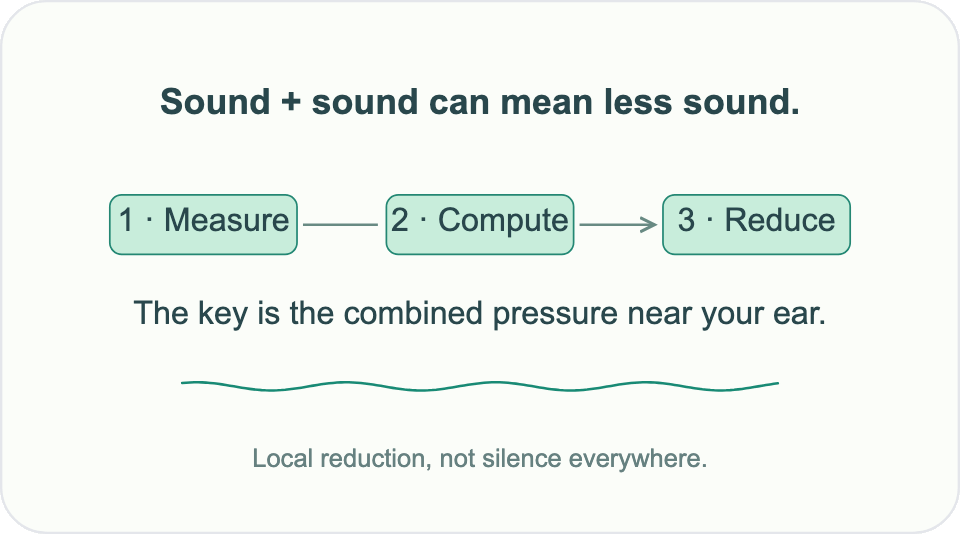
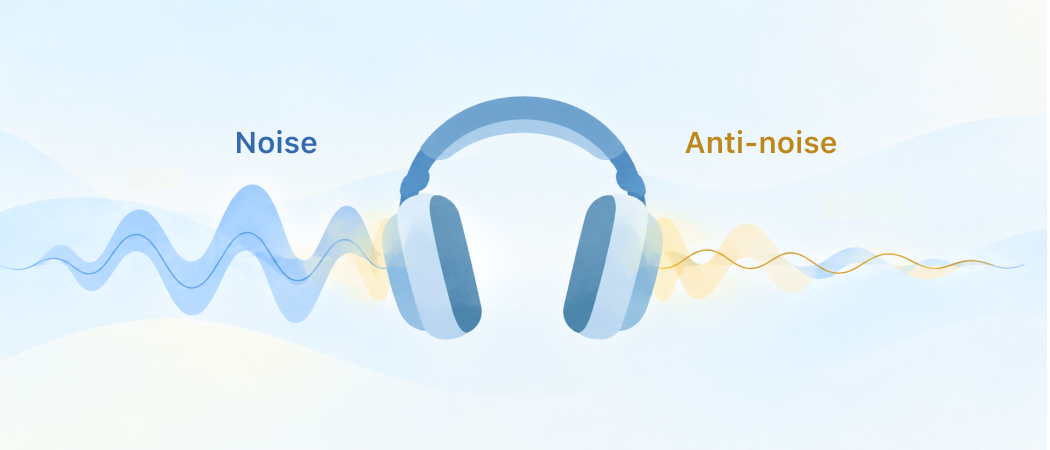
Noise-cancelling headphones add anti-noise to reduce the combined pressure changes near your ears. Understanding how sound waves add explains the headphones’ continuous control process, why timing and fit matter, and why steady engine hum is easier to reduce than a changing voice.
The Mystery
The Cabin Suddenly Feels Quieter
Imagine sitting on an airplane
A steady low rumble fills the cabin. The engines keep humming, and nothing outside has changed
The engines keep humming. Nothing outside has changed
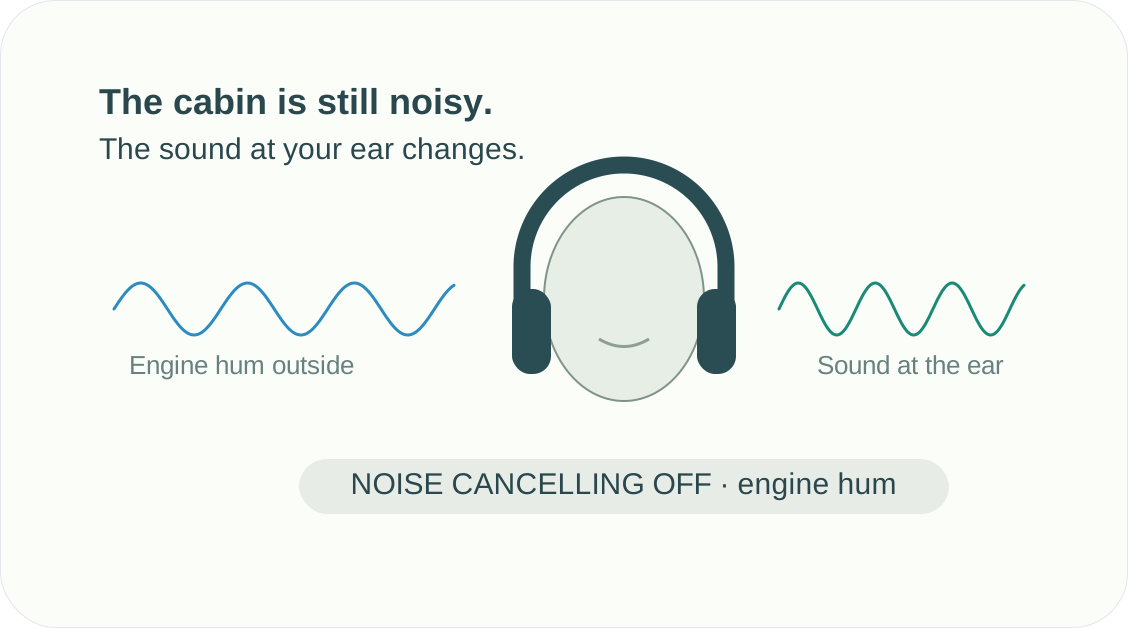
- Cancellation off: You put on your headphones. With noise cancelling still off, the engine hum reaches your ear at almost full strength
2. Cancellation on: Now turn the mode on. Suddenly, the wave at your ear shrinks, and the cabin feels much quieter—even though the engines are still running
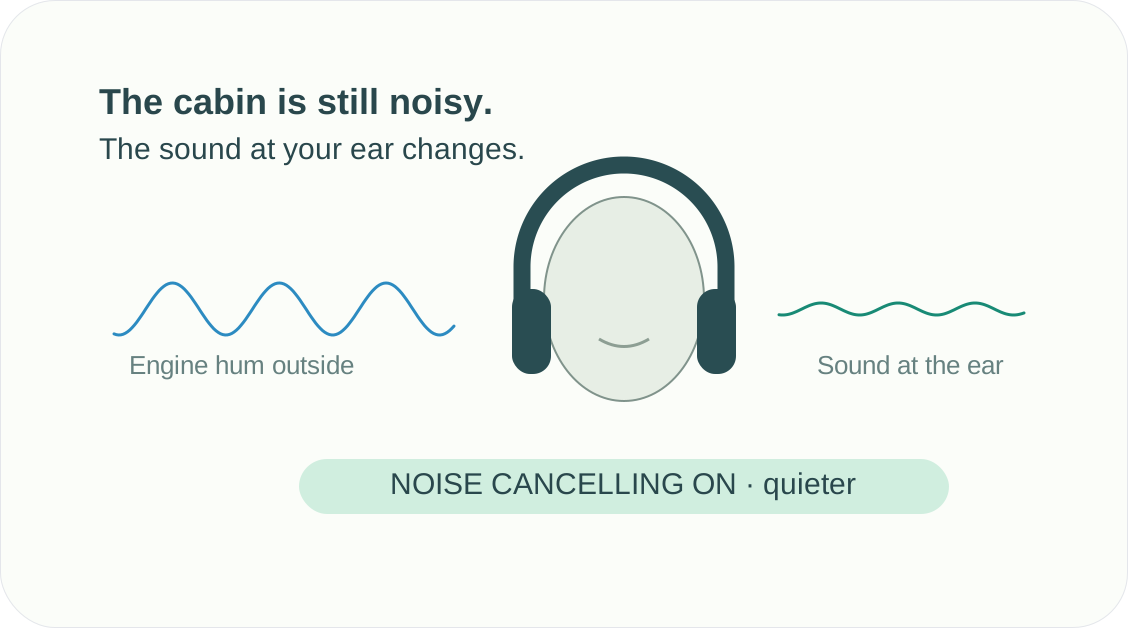
But the engines never stopped. So where did the sound go?
The engines never stopped—so where did the sound go?
The Short Answer—and Our Route
Here is the short answer, followed by the route we will use to explain it
We will explain it in three parts. First, how sound and anti-noise combine. Second, how the headphones create that second sound. Third, why some noise still gets through
We will explain it in 3 parts:
How sound and anti-noise combine
How the headphones create that second sound
Why some noise still gets through
Two Ways to Reduce Noise
Headphones usually reduce noise in two ways: P N C and A N C
P N C, passive noise cancellation, physically blocks sound with ear cups, cushions, and a good seal. A N C, active noise cancellation, uses microphones, a processor, and the speakers to create anti-noise. Today, we are focusing on A N C
PNC (Passive Noise Cancellation) physically blocks sound. ANC (Active Noise Cancellation) actively creates anti-noise. This course focuses on ANC
Sound Is a Traveling Pressure Pattern
First, let us make the invisible motion of sound visible
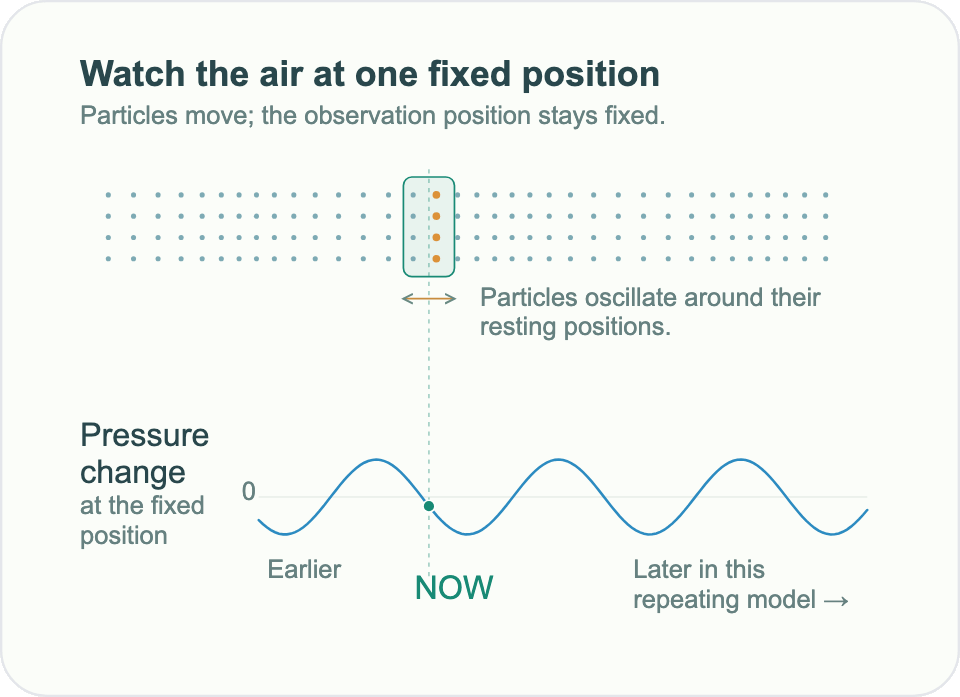
Sound travels through air as small pressure changes. The air itself vibrates back and forth
Air particles oscillate around equilibrium. The pressure pattern travels; the particles do not travel with it
Watch the particles in the upper half. They move around their resting positions instead of traveling across the screen with the sound. Now keep your eye on the green observation region. It stays fixed. When particles crowd together there, local pressure rises; when they spread apart, local pressure falls. Follow the dotted line down to the green point. The particles move sideways, while the graph records pressure changing over time at one fixed location. Those changing pressures are what make your eardrum vibrate
Waves Add
Two Sounds Add at the Same Place
Now watch what happens when two sounds reach the same place
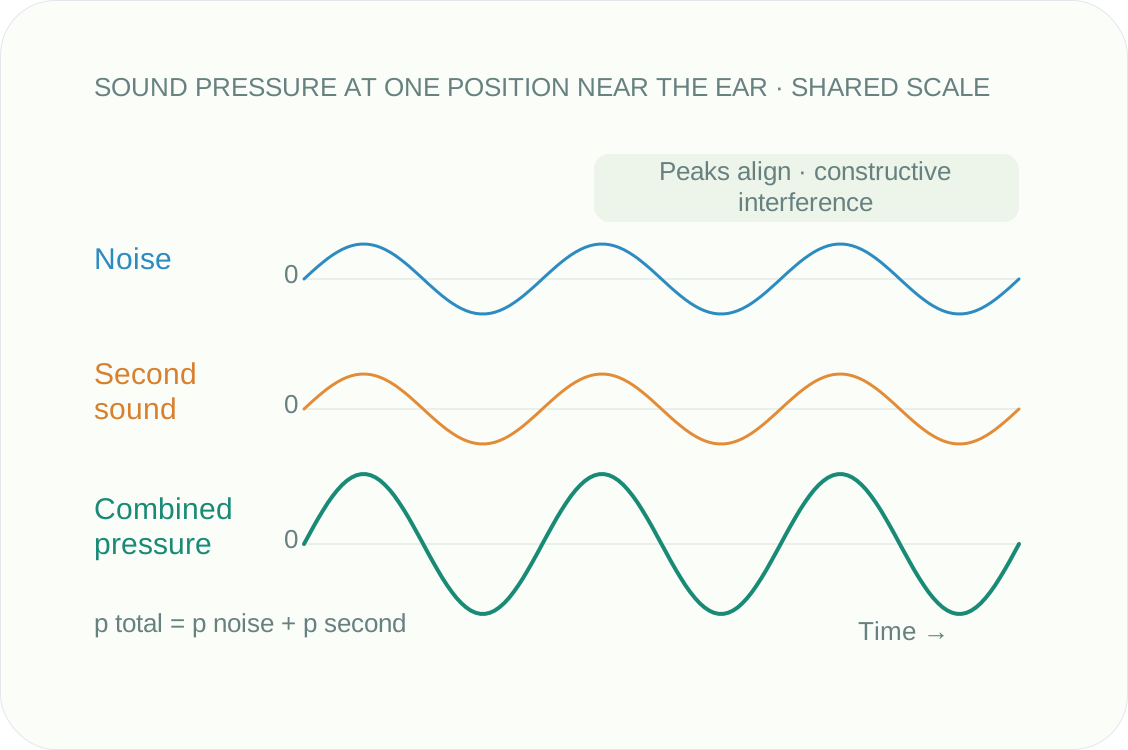
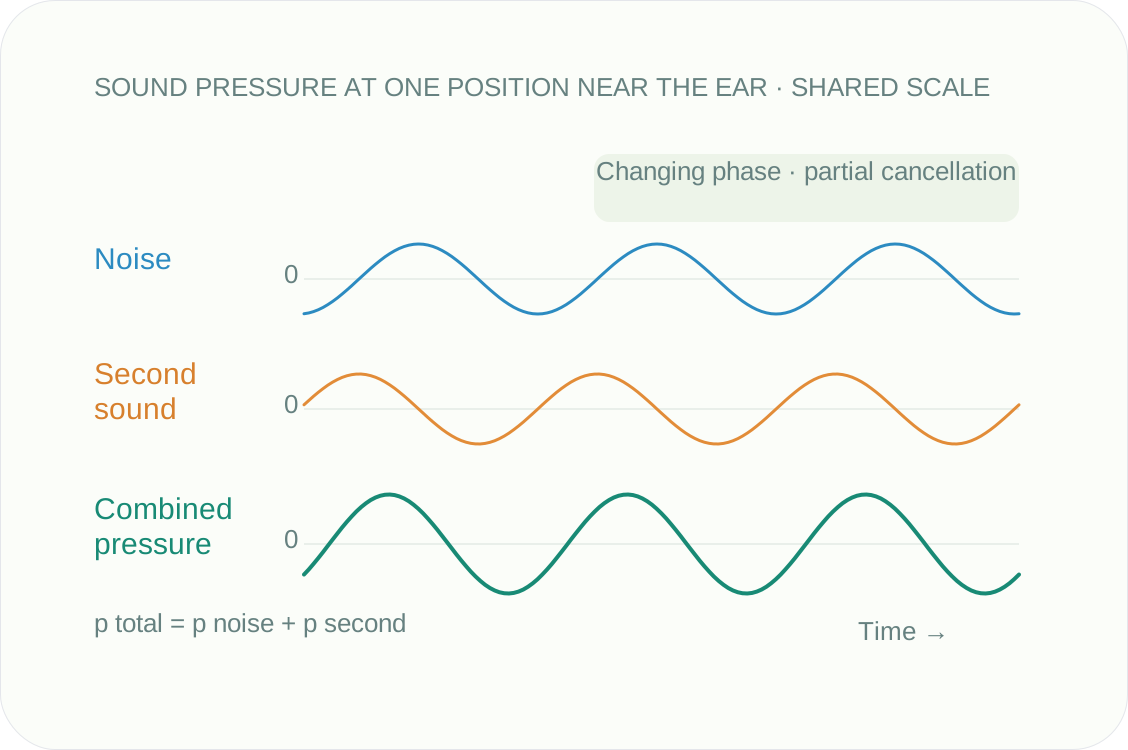
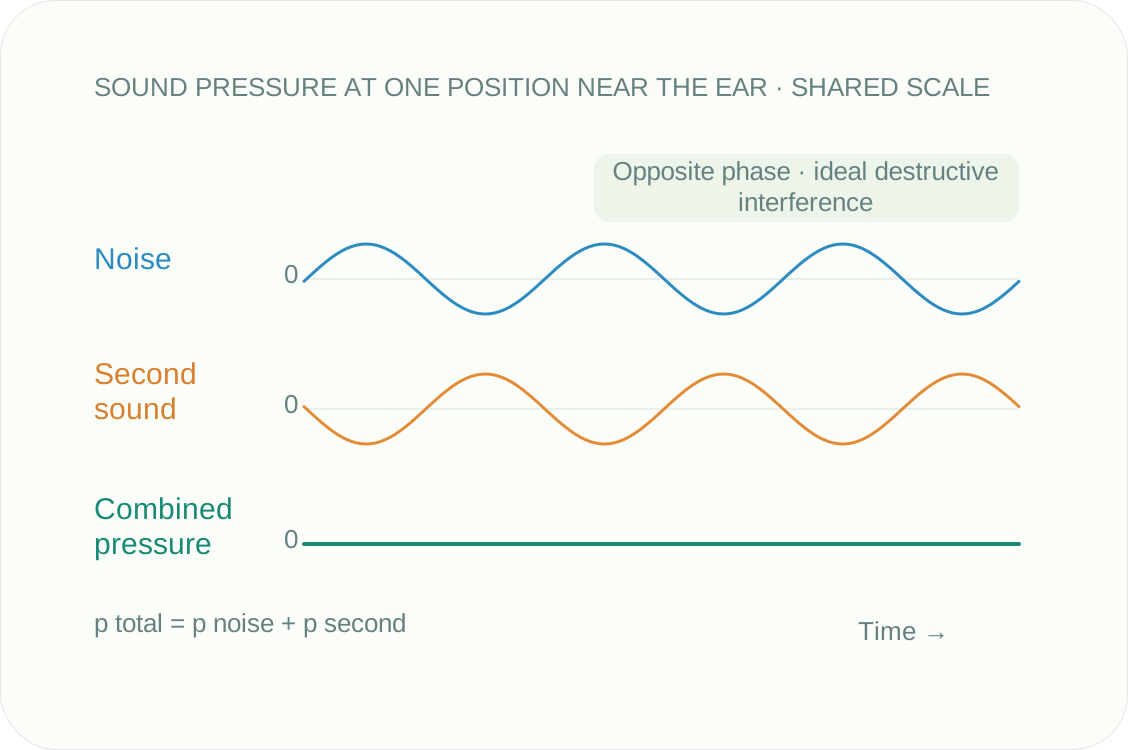
Their pressure changes add together. This is called superposition
Same-direction pressure changes reinforce. Opposite pressure changes reduce the result
- Peaks align: Watch the blue and orange curves, then compare them with the green result below. At first, their peaks line up. Both waves increase pressure together, so the green combined wave becomes larger. This is constructive interference
2. Changing phase: Now shift the orange wave by half a cycle. Its peaks move toward the blue wave's dips
3. Opposite phase: An increase from one is balanced by a decrease from the other, and the green sum falls toward zero. That is ideal destructive interference at this location
ANC in Action
ANC Is a Continuous Control Loop
Next, look inside the headphones
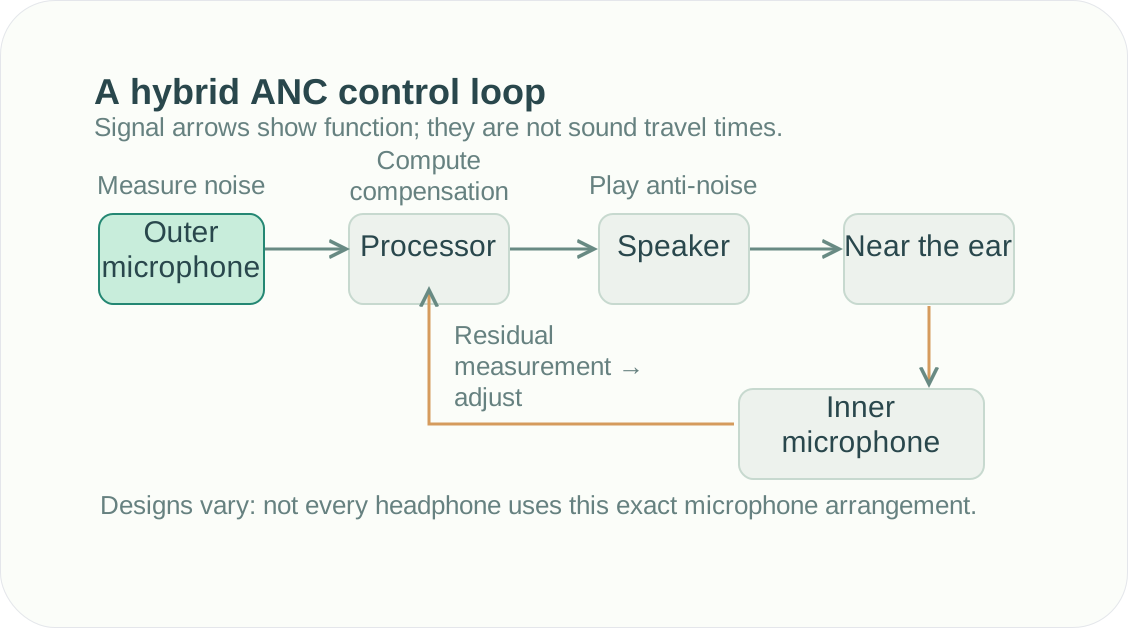
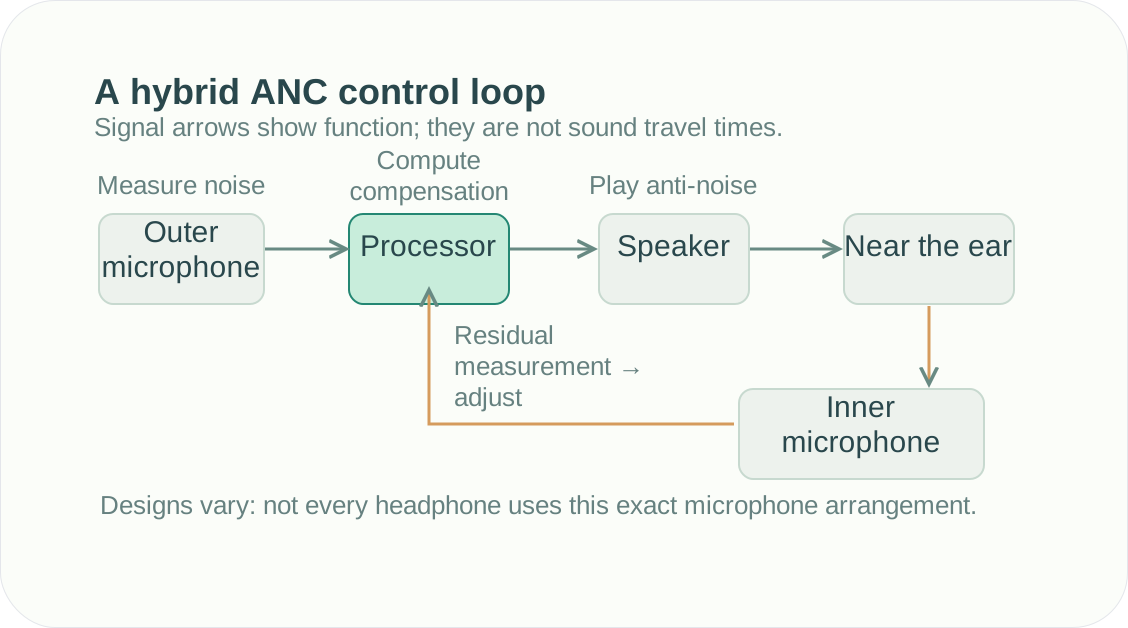
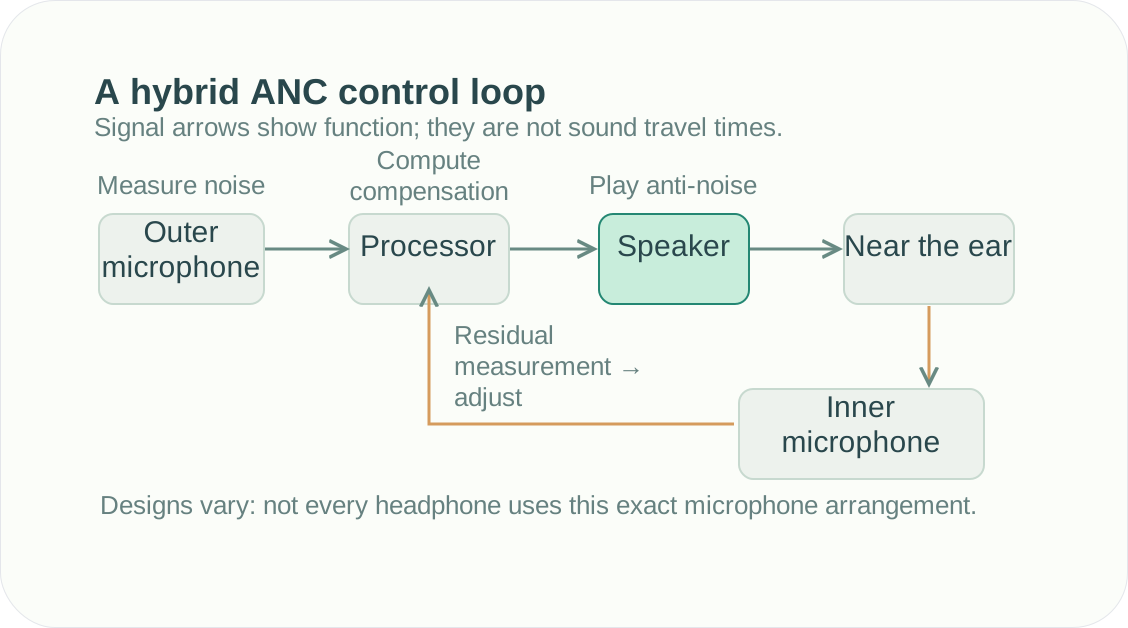
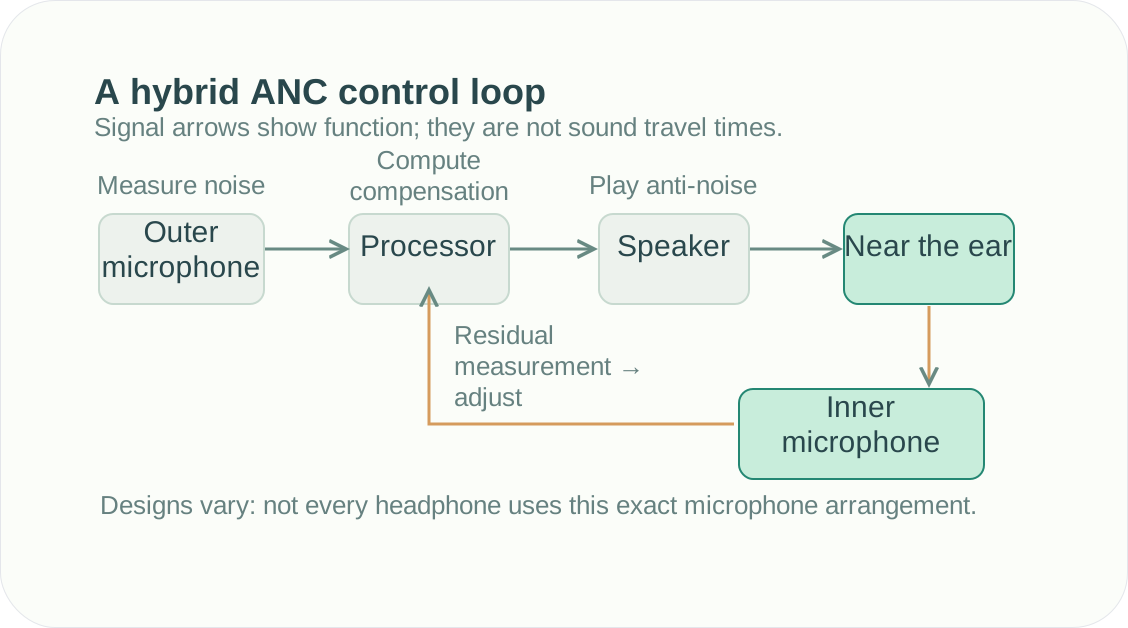
Active noise cancellation is a continuous control process, not a one-time reversed recording
Microphone → processor → speaker → ear. Some designs add an inner microphone for feedback
- Measure noise: Follow the highlighted path from left to right. First, the outer microphone measures the incoming noise
2. Compute compensation: Next, the processor calculates a compensation signal, accounting for timing and loudness
3. Play anti-noise: Then the speaker turns that signal into anti-noise near your ear
4. Measure residual: Some designs also use an inner microphone to measure the sound that remains and feed that error back to the processor. The system keeps measuring and adjusting while you listen
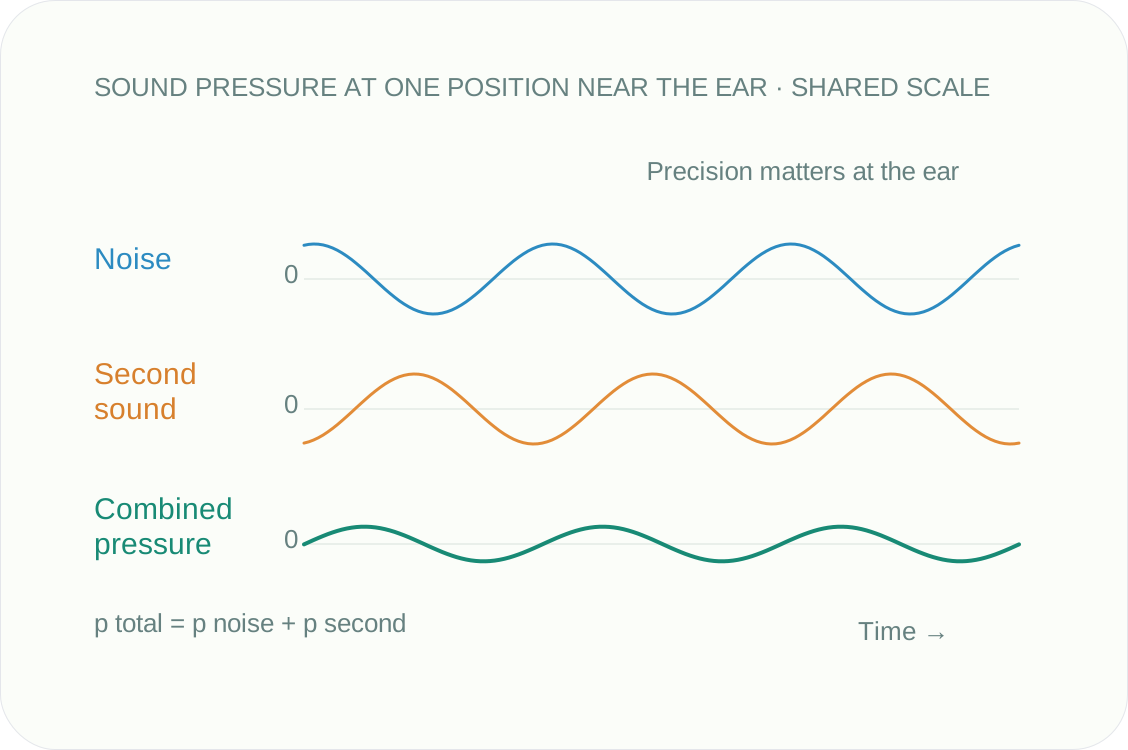
Cancellation Works Only When the Match Is Right
The match must be precise at your ear
Right size, opposite phase, correct timing, and the correct listening position all affect the result
Amplitude, phase, timing, and listening position determine the residual sound
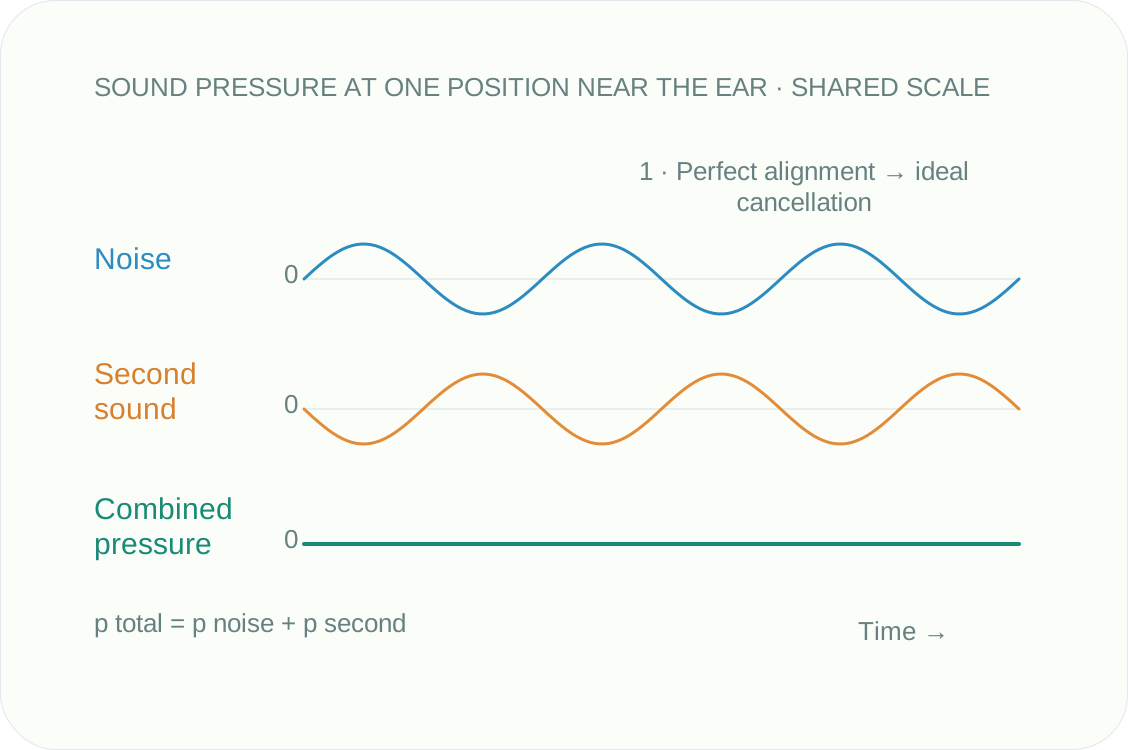
- Ideal alignment: First, look at ideal cancellation. The blue noise and orange anti-noise have equal size and opposite phase, so the green sum is almost flat
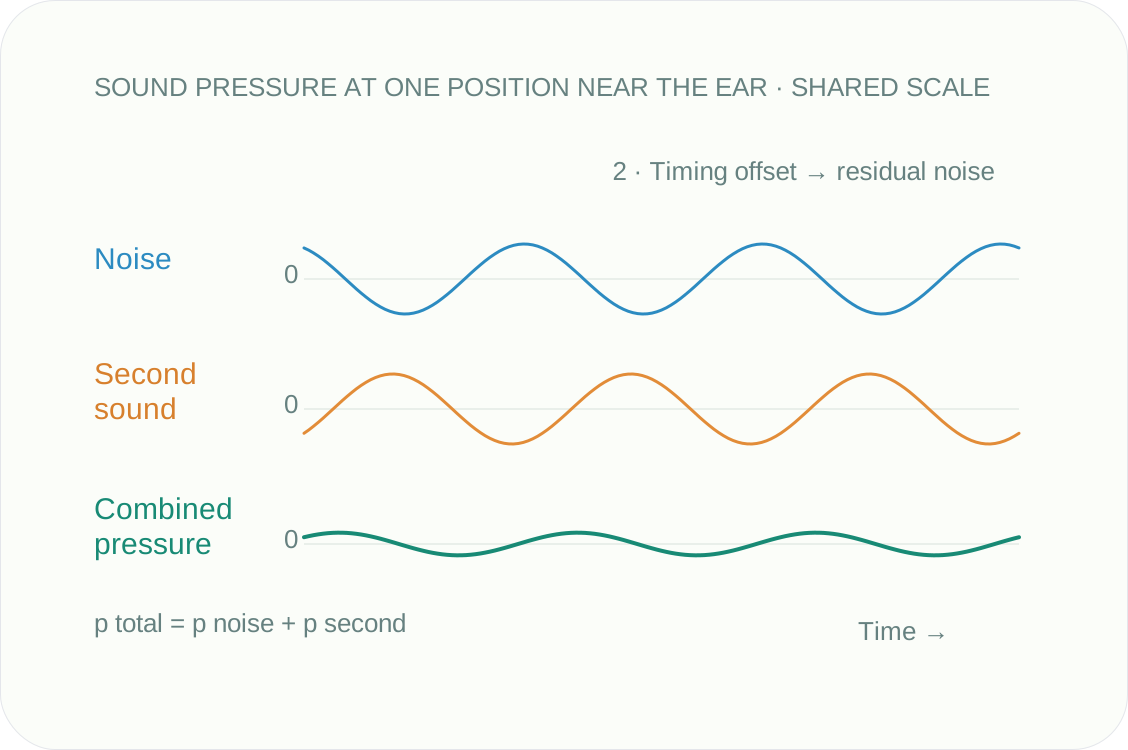
2. Timing offset: Now the orange wave shifts slightly in time. The peaks and dips no longer match, and a green residual wave appears
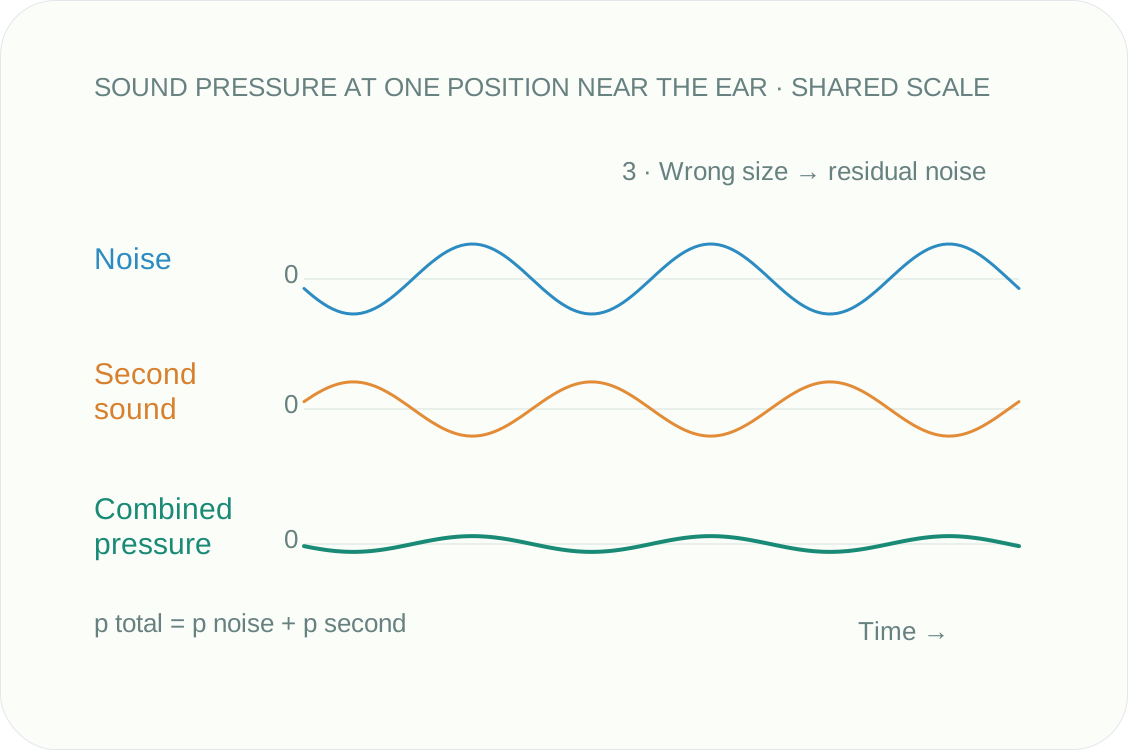
3. Wrong amplitude: Next, restore the timing but make the anti-noise smaller. Once again, the cancellation is incomplete
4. Residual sound: Finally, remember that high-frequency waves complete each cycle faster, so the same tiny delay becomes a much larger phase error
Limits & Locality
Why You Still Hear “Your Food Is Here!”
Now for the question that really matters on a flight: why can someone still get your attention?
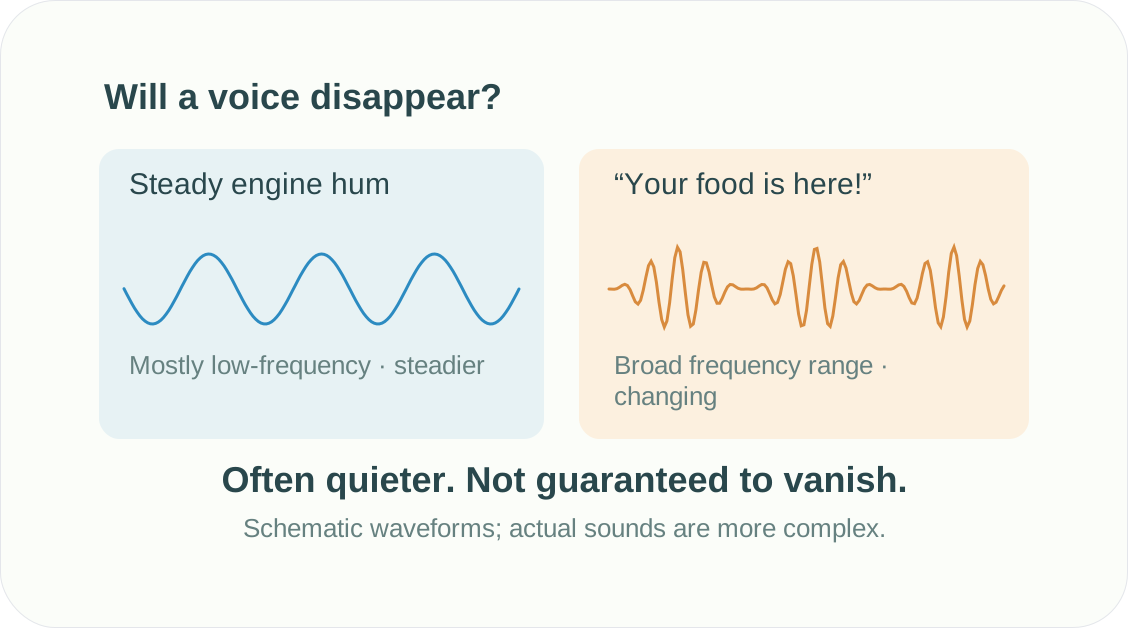
A steady engine hum repeats in a predictable pattern. Human speech keeps changing its pitch, loudness, and timing from one syllable to the next
ANC loves a predictable hum. A changing human voice is more like a surprise pop quiz
- Predict the result: Picture this: the engine hum fades, you settle into your quiet little bubble, and then someone calls, “Your food is here!” You still hear it. That does not mean the headphones failed
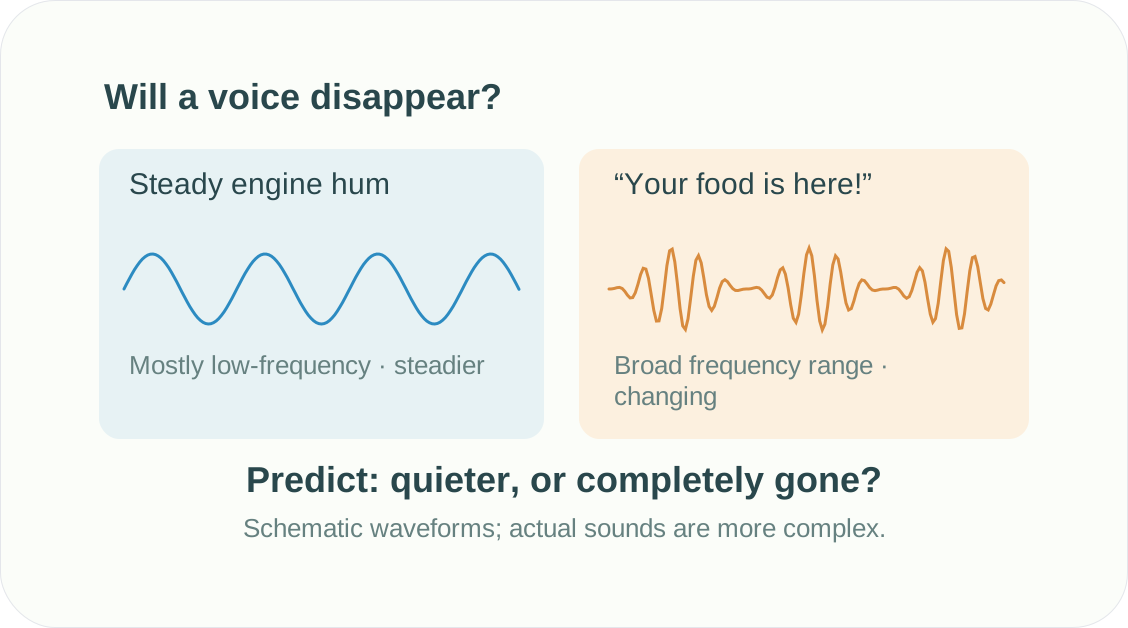
2. Voice remains: ANC is best at tracking steady, low-frequency patterns. A voice jumps across many frequencies and changes from moment to moment, so it is much harder to match with precisely timed anti-noise. The voice may become quieter, but it usually does not disappear—and honestly, missing your meal would be a terrible feature
The Sound Did Not Vanish—It Met Its Opposite
So, did the airplane become silent? Not quite—and that is the fun part
Your headphones do not silence the airplane. If they did, the engineers would be impressed—and probably a little worried. They reduce the combined pressure change in a small region near your ears
The engine keeps roaring. Near your ears, noise + anti-noise leaves a smaller pressure change
Here is the whole trick. The microphones listen, the processor predicts, and the speakers answer with anti-noise. When the timing and size line up, the incoming noise and anti-noise partly cancel near your ears, so the cabin rumble fades. But a fast-changing voice is harder to match, which is why “Your food is here!” can still reach you. The outside world never vanished; your headphones simply engineered a quieter little neighborhood around your ears