Peptide Bonds and Condensation
A peptide bond joins an amino group to a carboxyl group in a condensation reaction. Follow chain growth, identify its ends, and relate peptide geometry and bond count to its structure.
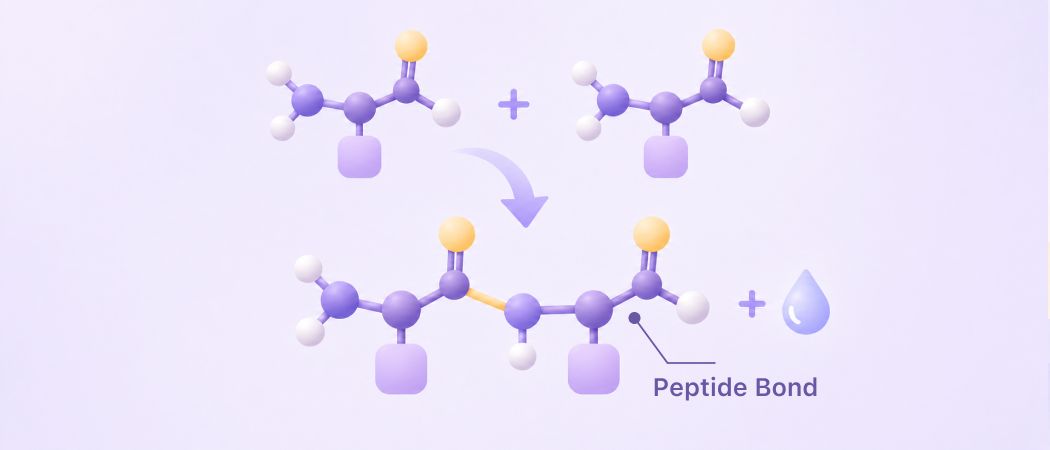
How a peptide bond forms
Bond-forming groups
Two glycines → a dipeptide + water
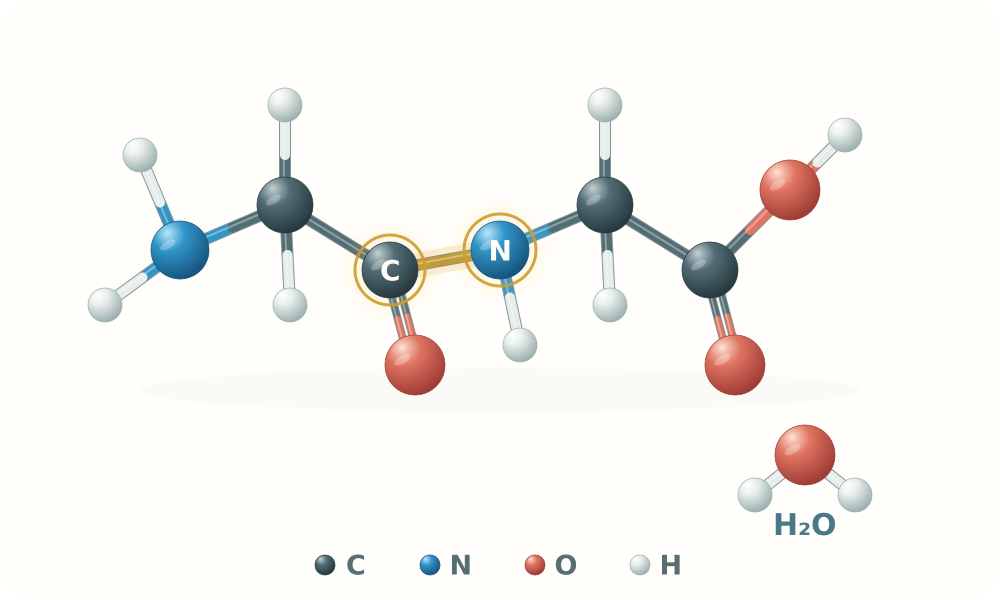
Two glycine molecules that join to form one peptide bond
Two amino acids, one new bond. Which atoms actually join together, and where does the water molecule come from? Let's assemble two glycines and account for every atom on the way
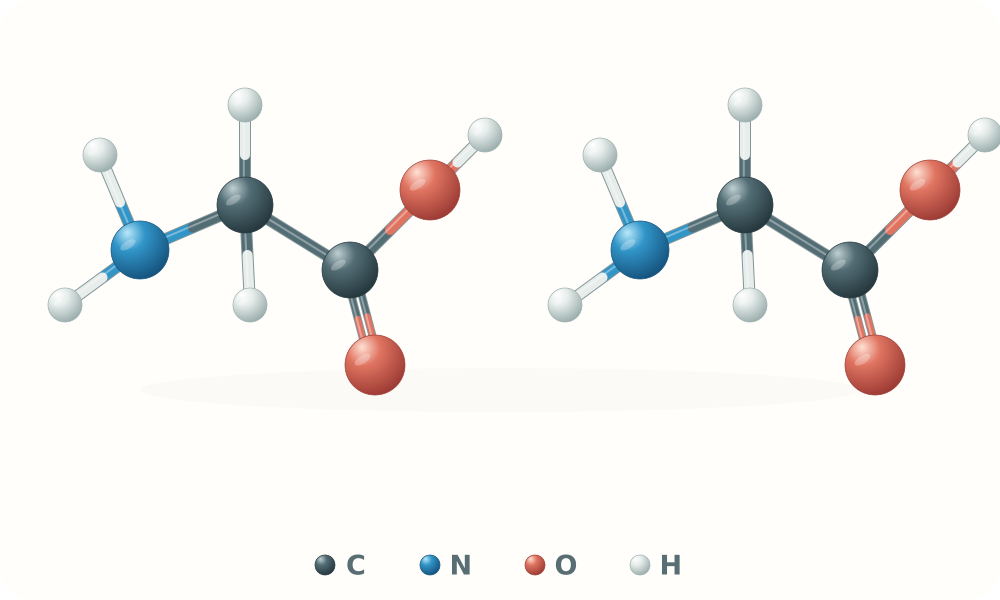
| Item | Properties |
|---|---|
| New link | Carboxyl C → amino N |
| Water atoms | Carboxyl –OH + amino –H |
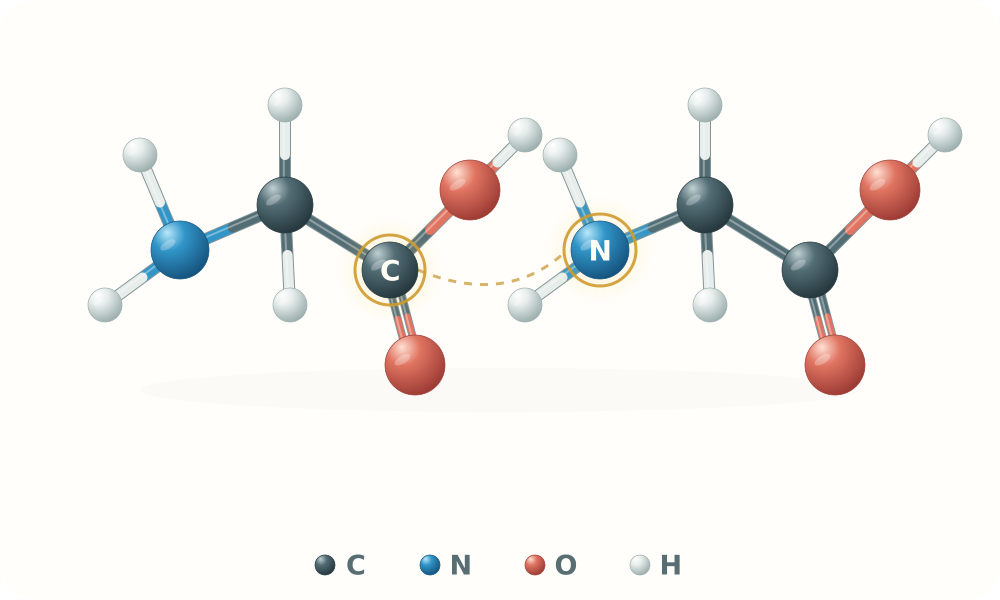
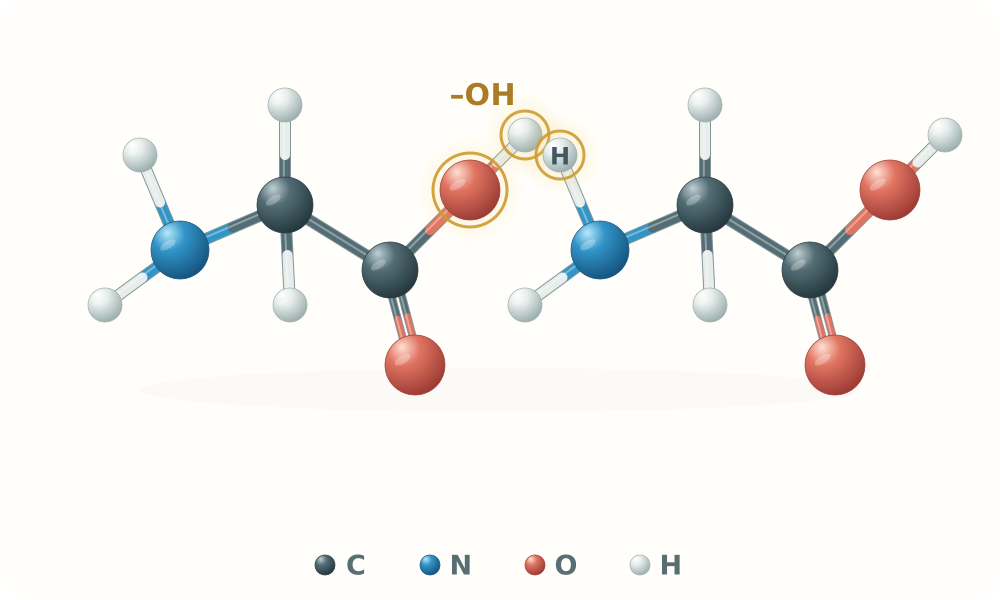
Atoms through condensation
2. Align: Bring the carboxyl carbon of the first amino acid — the C=O carbon of –COOH — next to the amino nitrogen of the second. These backbone atoms are the joining partners, not the side chains
3. Track: Mark the atoms that will leave: the hydroxyl group –OH from the carboxyl, and one hydrogen –H from the amino group. Two hydrogens and one oxygen together give exactly one molecule of water
4. Join: Now redraw the model: those three atoms leave as water, and the carboxyl carbon forms a new covalent bond to the amino nitrogen. This is the net condensation equation, not a picture of two free amino acids reacting on their own in a beaker
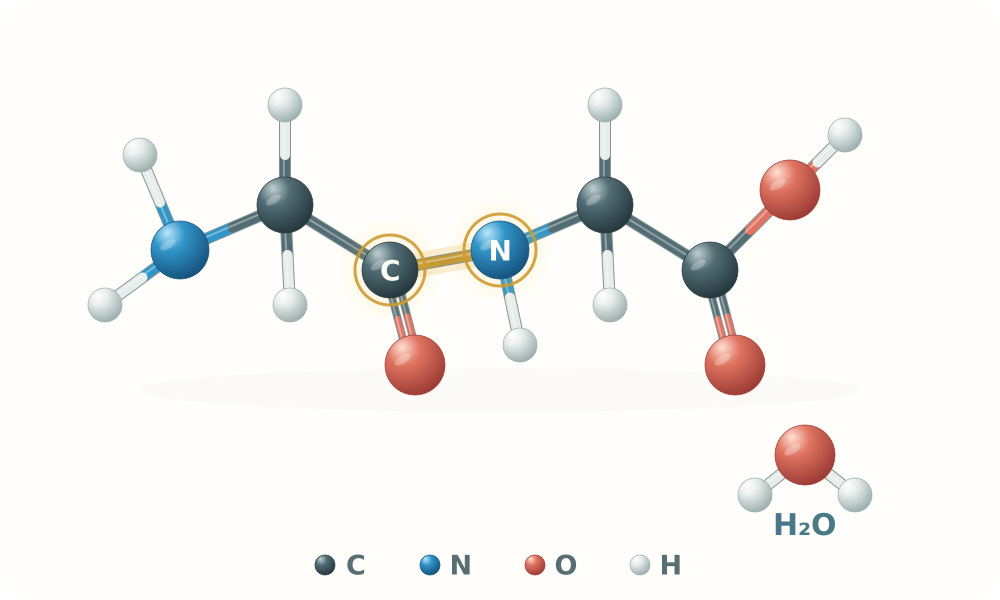
5. Check: There it is: the new –CO–NH– peptide bond. The carbonyl oxygen stays on the carbon. Count: two residues, one peptide bond, one water — every atom accounted for
| Item | Properties |
|---|---|
| Peptide link | Carboxyl C joins amino N |
| Water | Carboxyl –OH + amino –H → H₂O |
Extend and read a peptide chain
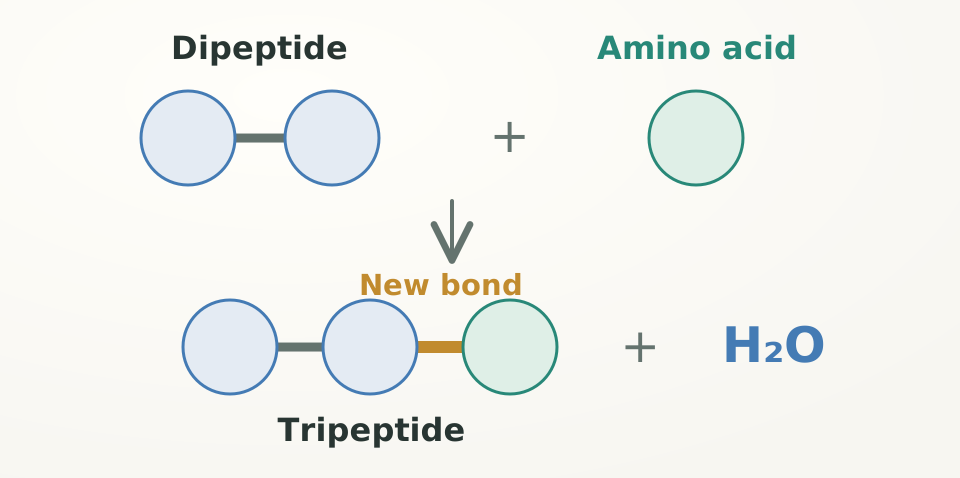
+1 residue → +1 link
You have two amino acids joined into a dipeptide. Real polypeptide chains in proteins are usually far longer — often hundreds of residues. In the net chemistry model, every added residue creates one more peptide bond and releases one more water molecule
Two free ends
Look at the dipeptide you have just built. One end still has a free amino group — by convention we call this the N-terminus. The other still has a free carboxyl group — the C-terminus. Peptide sequences are written N-terminus first, so these labels let us read a chain from one definite end to the other
| Read N → C | Free group / near pH 7 |
|---|---|
| N-terminus | –NH₂ / –NH₃⁺ |
| C-terminus | –COOH / –COO⁻ |
Glycylglycine · two residues
Glycylglycine · one peptide link
3D model of glycylglycine, a dipeptide formed from two glycine molecules
Find the N-terminus and C-terminus. The peptide bond that links the two residues lies in the middle
| Item | Properties |
|---|---|
| Chain direction | N-terminus → C-terminus |
| Central link | 2 residues · 1 link |
Chain → folded protein
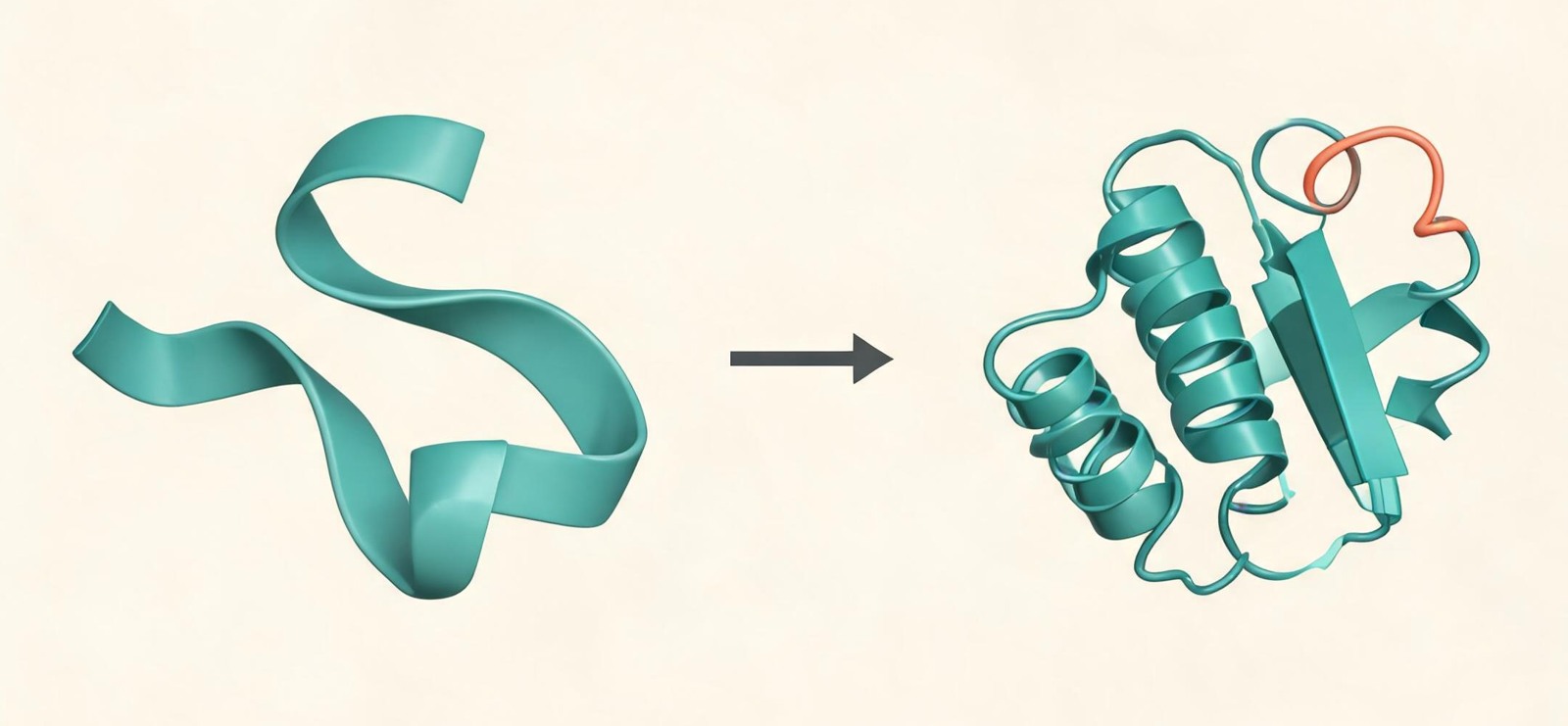
Repeat that net condensation pattern many times and you build a polypeptide. One folded polypeptide can already be a functional protein; some proteins pack several polypeptide chains together — for example, the four chains of haemoglobin
Peptide geometry and bond counting
Peptide-group geometry
One consequence of the new bond: the lone pair on the peptide nitrogen shares with the C=O, giving the C–N bond partial double-bond character. That makes the whole –C(=O)–N(H)– group nearly planar and restricts rotation around this bond. A polypeptide chain bends mainly around the neighbouring single bonds instead
| Item | Properties |
|---|---|
| C–N bond | Partial double-bond character |
| Peptide group | Nearly planar · restricted rotation |
| Chain bending | Neighbouring single bonds |