Trends Across Period 3
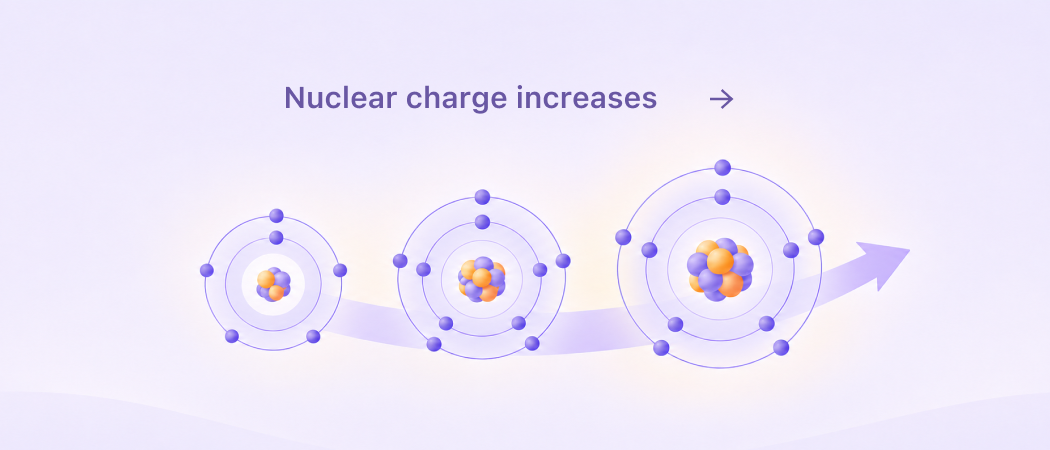
From sodium to magnesium to aluminium, proton number and outer electron count increase while the number of occupied shells stays at three. The increasing nuclear charge strengthens the net attraction to the electron cloud, so atomic radius decreases. Metallic character also decreases across these three elements, although all remain metals.
Start in Period 3
Sodium: 2, 8, 1
Start with a neutral sodium atom. Its eleven electrons are arranged two, eight, one. That means three occupied shells and one outer electron. Keep these two counts separate: three is the number of occupied shells; one is the outer electron count
Sodium Na
3D teaching model of a sodium atom with one outer electron
Shell electrons: 2 · 8 · 1
3 shells · 1 outer electron
A period is a row
A period is a horizontal row of the periodic table. Sodium, magnesium and aluminium are the first three elements in Period three. Moving from sodium to aluminium, atomic number rises from eleven to twelve to thirteen. Atomic number counts protons
Period 3: Na → Mg → Al
Atomic number: 11 → 12 → 13
Compare outer electrons
Magnesium: 2, 8, 2
Magnesium has twelve electrons in a neutral atom, arranged two, eight, two. Compared with sodium, one electron has been added to the outer shell. The number of occupied shells stays at three, while the outer electron count increases to two
Magnesium Mg
3D teaching model of a magnesium atom with two outer electrons
Shell electrons: 2 · 8 · 2
3 shells · 2 outer electrons
Aluminium: 2, 8, 3
Aluminium has thirteen electrons in a neutral atom, arranged two, eight, three. There are still three occupied shells, now with three outer electrons. Across sodium, magnesium and aluminium, the outer count rises from one to two to three without adding a new occupied shell
Aluminium Al
3D teaching model of an aluminium atom with three outer electrons
Shell electrons: 2 · 8 · 3
3 shells · 3 outer electrons
Explain the smaller radius
More protons, same inner shells
Compare the structural evidence. Proton count increases from eleven to twelve to thirteen. Each atom has ten inner electrons, arranged two and eight, and three occupied shells in total. Nuclear charge increases, but no new inner shell is added
| Atom | Protons | Inner e⁻ | Shells |
|---|---|---|---|
| Na | 11 | 10 | 3 |
| Mg | 12 | 10 | 3 |
| Al | 13 | 10 | 3 |
Stronger nuclear attraction
More protons increase the positive nuclear charge. The inner-shell arrangement remains two, eight. Electrons added to the same outer shell do not shield one another as effectively as inner electrons do. The increasing nuclear charge therefore produces a stronger net attraction across these atoms
More protons · same inner shells
Net nuclear attraction ↑
Atomic radius decreases
Atomic radius describes the size of an atom. With the same number of occupied shells, stronger nuclear attraction draws the electron cloud closer. The radius decreases from sodium to magnesium to aluminium. Sodium is largest and aluminium is smallest among these three
Stronger pull → smaller radius
Na > Mg > Al
Apply the trend
Metallic character decreases
These three elements also illustrate the broad decrease in metallic character across a period. Sodium is more metallic than magnesium, and magnesium is more metallic than aluminium. All three are still metals; the comparison describes a change in metallic character, not a switch to nonmetals
Na > Mg > Al
All three → metals
Takeaway
Across sodium, magnesium and aluminium, all three atoms keep three occupied shells. Increasing nuclear charge strengthens the net attraction to the electron cloud. The atomic radius therefore decreases from sodium to magnesium to aluminium: the same number of shells, but a stronger pull and a smaller radius