Periodic Law and Element Predictions
Recurring properties help organize the periodic table and support predictions. Follow Mendeleev's use of gaps and compare his prediction below aluminium with the later discovery of gallium.

Explain recurring properties
Lithium, sodium and potassium have similar chemistry. Their atomic numbers are three, eleven and nineteen. They are not next to one another in the table, yet each has one outer electron. As we pass other elements, that useful arrangement appears again. This is a repeating pattern
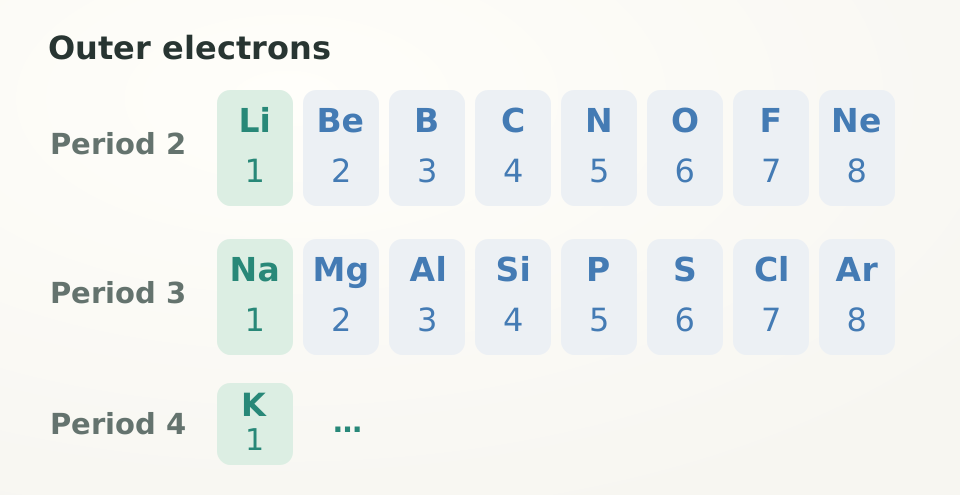
| Element | Atomic number | Outer e⁻ |
|---|---|---|
| Li · lithium | 3 | 1 |
| Na · sodium | 11 | 1 |
| K · potassium | 19 | 1 |
Periodic means recurring in a pattern. As atomic number increases, similar outer-electron arrangements recur, and related chemical properties recur too. That is the modern periodic law. It does not mean that every property is identical, or that every element repeats after exactly eight places
| Item | Properties |
|---|---|
| As Z increases | Outer-electron patterns recur |
| Chemical properties | Related properties recur |
How Mendeleev used gaps

What should he do when the pattern seemed to need an element that had not been found? He left a gap instead of forcing the next known element into the wrong place. Follow the steps: recognise the pattern, leave a gap, predict the missing element's properties. That prediction could be checked by a later discovery
Pattern
Gap
Prediction
Test a prediction: gallium
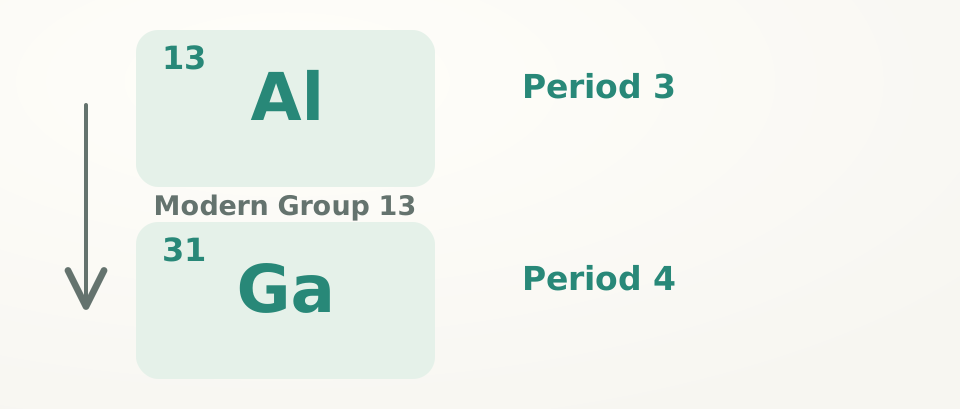
By eighteen seventy-one, Mendeleev had predicted an element below aluminium. He predicted an atomic weight of about sixty-eight and a density of about five point nine grams per cubic centimetre. In eighteen seventy-five, gallium was discovered. Notice the order: a specific prediction came first, and a discovery tested it later
1871 — Prediction below aluminium — Atomic weight ≈ 68; density ≈ 5.9 g/cm³
1875 — Gallium discovered — A new element to test the prediction
Gallium Ga · Z = 31
Gallium · a modern atomic model
3D teaching model of a gallium atom, atomic number 31
Here is our modern model of a gallium atom. It is not evidence Mendeleev had. For comparison, modern reference values are an atomic weight of about sixty-nine point seven and a density of five point nine one. They are close to his predictions, not identical. Those modern values are not measurements we are claiming were made in eighteen seventy-five
| Property | 1871 prediction | Modern reference |
|---|---|---|
| Atomic weight | ≈ 68 | 69.723 |
| Density (g/cm³) | ≈ 5.9 | 5.91 |
Keep the eras separate. Mendeleev found patterns in weights and chemical properties. Later science ordered the table by proton count and explained the repetition using electron arrangements. The pattern was discovered before its modern explanation
| Item | Properties |
|---|---|
| Then · Mendeleev | Weight + properties |
| Now · modern explanation | Z + electron arrangement |