Alkali Metal Trends Down a Group
Alkali metals share one outer electron. More occupied shells and greater shielding down the group help explain why that electron is easier to remove and why reactivity changes.
One outer electron
Lithium: 2, 1
Lithium Li · Z = 3
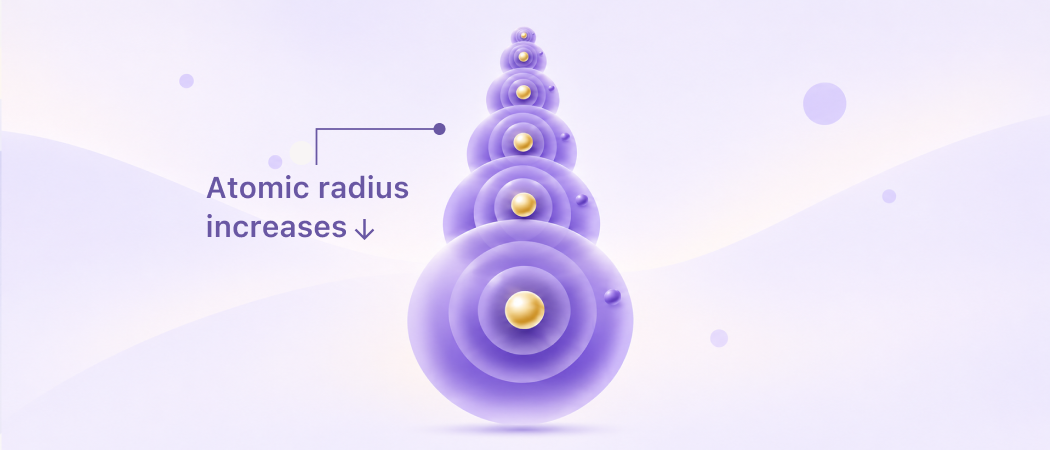
3D teaching model of a lithium atom with atomic number 3
Start with lithium. Its three electrons occupy two shells: two electrons in the first shell and one in the outer shell. The final one is important. Lithium has two occupied shells, but only one outer electron
| Item | Properties |
|---|---|
| Shells | 2 |
| Outer e⁻ | 1 |
Group 1 · Li, Na, K
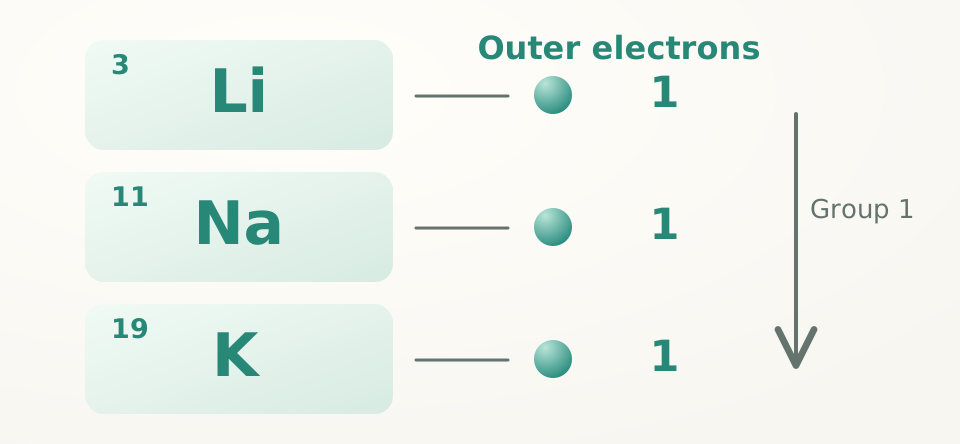
Lithium, sodium and potassium belong to Group one, the alkali metals. A group is a vertical column in the periodic table. Read down this part of the column: lithium, then sodium, then potassium. All three have one outer electron
More occupied shells
Sodium: 2, 8, 1
Sodium Na · Z = 11
3D teaching model of a sodium atom with atomic number 11
Sodium has the shell arrangement two, eight, one. Its eleven electrons occupy three shells. Compared with lithium, sodium has one more occupied shell. The outer count stays the same: one electron. More occupied shells do not mean more outer electrons
| Item | Properties |
|---|---|
| Shells | 3 |
| Outer e⁻ | 1 |
Potassium: 2, 8, 8, 1
Potassium K · Z = 19
3D teaching model of a potassium atom with atomic number 19
Potassium has the shell arrangement two, eight, eight, one. Its nineteen electrons occupy four shells. Compared with sodium, there is another occupied shell, yet the outer shell still contains one electron. The pattern is more occupied shells with the same outer count
| Item | Properties |
|---|---|
| Shells | 4 |
| Outer e⁻ | 1 |
Why the trend changes
Shells → electron loss
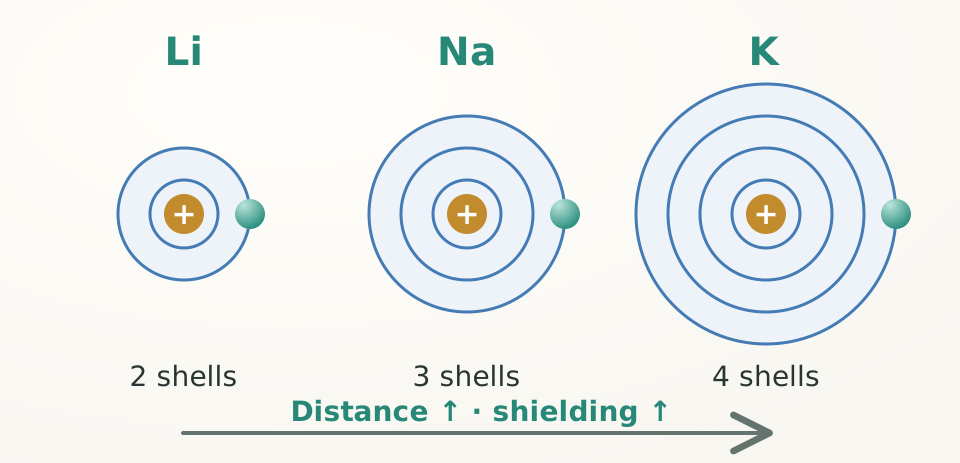
Compare the three elements together. Lithium has two occupied shells, sodium has three, and potassium has four. Down this sequence, the outer electron becomes easier to remove. Potassium loses its outer electron most easily of these three elements
| Element | Shells | Electron removal |
|---|---|---|
| Li | 2 | Hardest of three |
| Na | 3 | Easier than Li |
| K | 4 | Easiest of three |
Distance and shielding
Why does removal get easier? Down these Group one elements, the outer electron is farther from the nucleus and more inner electrons shield it. Although proton number increases, greater distance and shielding outweigh that increase. Attraction to the outer electron becomes weaker
Metallic character
Metallic character describes how readily an atom loses electrons. The outer electron is easier to remove from sodium than from lithium, and easier still from potassium. Therefore metallic character increases in the order lithium, sodium, potassium
| Item | Properties |
|---|---|
| Electron loss | Li → Na → K: easier |
| Metallic character | Li < Na < K |
Apply the pattern
Common +1 ions
All three elements commonly lose their single outer electron to form a positive one ion. Losing one negative electron leaves one more proton than electrons. Here M represents lithium, sodium or potassium. The products are lithium plus, sodium plus and potassium plus
| Item | Properties |
|---|---|
| Electron loss | M → M⁺ + e⁻ |
| Common +1 ions | Li⁺ · Na⁺ · K⁺ |