Valence Electrons and Sodium Ions
Neutral sodium has an outer electron that can be transferred in a reaction. Count protons and electrons before and after transfer to explain the positive ion without changing the element's identity.
Identify the valence electron
Neutral sodium Na
Neutral sodium Na
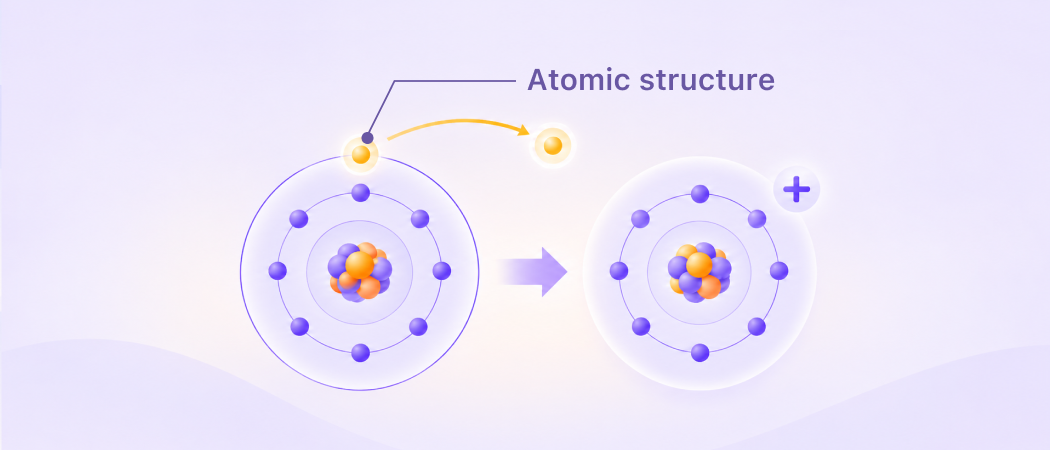
3D teaching model of a neutral sodium atom before it loses one outer electron
A sodium atom has eleven electrons, but when it reacts it usually loses only one. Why not lose all eleven? The electrons are not all in the same situation. To understand the reaction, look first at the outer region of this model
| Item | Properties |
|---|---|
| Neutral Na | 11 electrons |
| In reactions | Usually loses 1 |
Why the outer electron is easier to remove
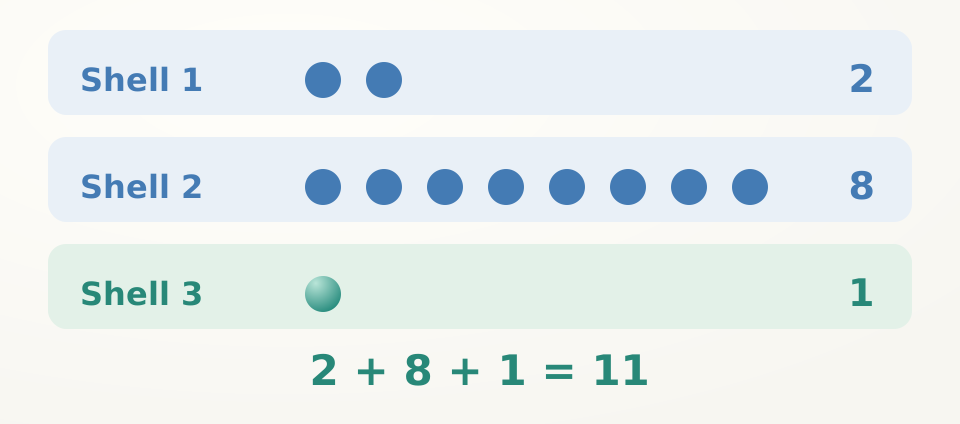
Read the table from the first shell to the outer shell. Sodium has two electrons in shell one, eight in shell two, and one in shell three. The counts add to eleven. These numbers count electrons; they are not drawings of electron paths. The final row, one, is the outermost electron
| Electron shell | Number of electrons |
|---|---|
| Shell 1 · nearest | 2 |
| Shell 2 | 8 |
| Shell 3 · outermost | 1 |
The positive nucleus attracts negative electrons. Compared with the inner electrons, the outer electron is farther away and partly screened by the electrons between it and the nucleus. That makes it the easiest one to remove. It still takes energy; sodium does not lose the electron for no reason
| Item | Properties |
|---|---|
| Distance | Outer electron is farther from the nucleus |
| Shielding | Inner electrons partly screen the nuclear pull |
| Removal | Easiest electron to remove · energy still needed |
Count the charges in Na⁺
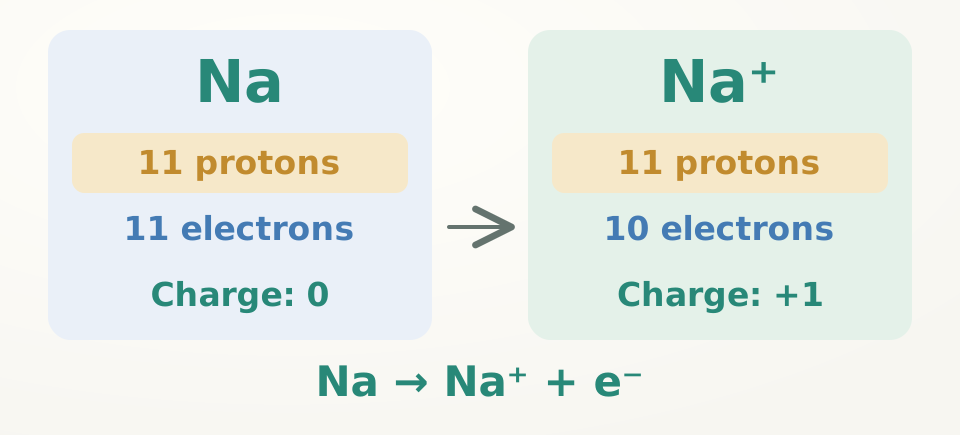
In a suitable reaction, another substance accepts that electron. Neutral sodium begins with two, eight, one. It loses one electron. The particle left behind is a sodium ion with two and eight. The nucleus has not changed
Na · 2, 8, 1
Transfer 1 e⁻
Na⁺ · 2, 8
Count the charges after the change. Eleven protons remain, but only ten electrons remain. Positive eleven plus negative ten equals positive one. That particle is the sodium ion, written Na plus. Removing another electron would break into the filled inner shell and requires much more energy
Keep identity and charge separate
Takeaway
Now we can ask a better question about the table. Is sodium alone in having one outer electron, or does it belong to a family? Next, compare it with lithium and potassium, one model at a time
Li · Na · K: 1 outer e⁻ each