Cell Membrane and Transport
The cell membrane keeps cell contents together while allowing materials to cross by different routes. Its phospholipid bilayer provides an oily barrier that oxygen can cross directly, while sodium ions need a suitable protein channel. Closing that channel changes sodium’s route without stopping oxygen from crossing the lipid layer.
How can a boundary let things through?
Why cells need a membrane
Think of a cell as a tiny living unit filled mostly with water. Chemical reactions happen inside it. Every cell has an outer boundary called the cell membrane. This membrane separates the inside of the cell from the outside
The cell membrane separates inside from outside
The cell needs to keep its contents together. They cannot simply drift away into the surroundings. The cell membrane helps hold them inside
It keeps cell contents from drifting away
But a cell also needs supplies from outside. Its boundary must allow needed materials to enter. So the interesting question is not just what keeps things out. It is how anything gets through
The cell can still take in needed supplies
Lipids and proteins
Membrane patch
3D model of the plasma membrane forming a boundary around a cell
We are looking at a tiny patch of the cell membrane. It would continue around the cell. Find the repeated little heads with two tails. These molecules are phospholipids, and they form the membrane's oily barrier
Phospholipids form the membrane's oily barrier
Now find the much larger protein shapes among the phospholipids. Specific proteins provide routes for materials to cross the membrane. These different ingredients have different jobs. The model is enlarged enormously, with colors to help us see the parts
Specific proteins provide routes for materials
The phospholipid bilayer
The phospholipids arrange themselves in two layers. These two layers together are called a bilayer. Let's look at how their heads and tails are arranged
Phospholipids form two layers — a bilayer
The phospholipid heads mix well with water. There is water both outside and inside the cell, so the heads point toward the water on either side of the membrane
Water-friendly heads face water on both sides
The tails are oily and do not mix well with water. They tuck together in the middle, away from the water on both sides. This oily middle forms the barrier
Oily tails face inward, forming the middle barrier
Same barrier. Different routes.
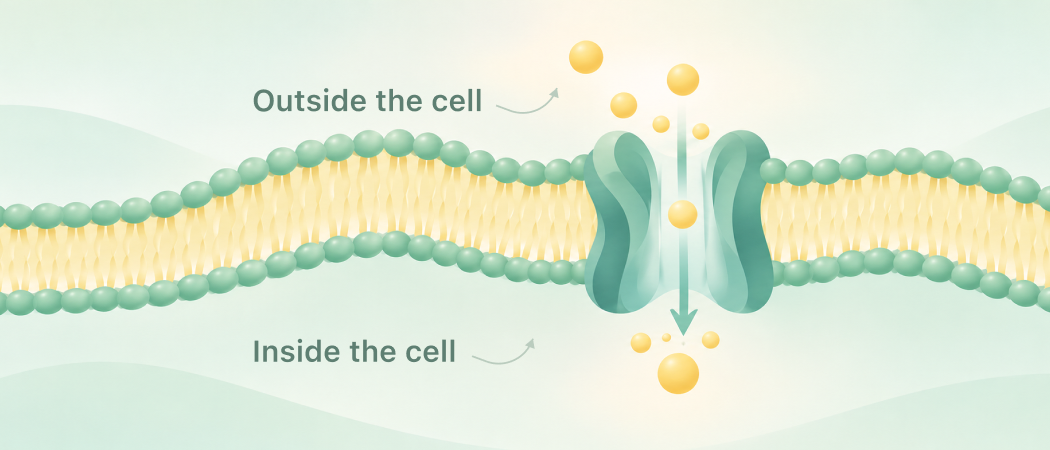
1. Boundary: This side view shows two layers of phospholipids. Water-friendly heads face the water on both sides; oily tails face inward. The larger purple structure is a protein channel

2. Oxygen: Oxygen is small and uncharged. Unlike a charged particle, it can dissolve in the oily middle of the membrane. Its chemical properties give it a direct route

3. Cross: Follow oxygen through the lipid layer. Molecules move randomly both ways, but a higher concentration outside means more move inward overall. This is diffusion, with no ATP spent on this crossing

4. Blocked: Sodium carries a positive charge. Even though it is small, it does not easily enter the oily middle. With this channel closed, the route shown here is blocked


5. Channel: Now the channel opens, giving sodium a water-friendly path. In this example, electrical and concentration forces favor inward movement. The channel allows downhill movement; it does not pump the ion uphill
One change. One clear explanation.
One route closes.
The membrane itself is still there. Only the sodium channel closes. Think about which substance depended on that path, rather than treating every substance as if it used the same door
Close the sodium channel. Leave the lipid layer unchanged