Chloroplasts and Photosynthesis
Photosynthesis connects light-energy capture in thylakoid membranes with carbon building in the stroma. A leaf contains many cells, and many leaf cells contain chloroplasts, where these two locations cooperate. Light supplies energy, while carbon dioxide supplies carbon; neither input can replace the other.
A leaf is not one giant cell.
Start with a leaf.
A plant can build sugars without eating a sandwich, but sunlight is not food matter magically poured into it. Light supplies energy. Carbon dioxide and water supply starting materials. First, let us find where this happens by travelling from a leaf into a cell and then into a chloroplast
Leaf → leaf cell → chloroplast
Leaf cross-section
Leaf cross-section
3D cross-section of a leaf showing its internal tissues
This three-dimensional model is a slice through a leaf. The upper and lower surfaces enclose layers of cells. Look for the tightly packed, upright cells near the top, and the looser cells with spaces below. Much photosynthesis occurs in these inner leaf tissues, called mesophyll. A leaf is many cells working together
A leaf is layered tissue made of many cooperating cells
Plant cell cutaway
Plant cell cutaway
3D plant cell model showing where chloroplasts are found
This generalized plant-cell model shows the next scale. The outside includes a stiff cell wall. Inside, look for small green oval structures: chloroplasts. They are only part of the cell, not the entire green cell itself. This model is not a literal cell extracted from the previous leaf, and the sizes have been independently enlarged for viewing
One plant cell can contain many chloroplasts
Chloroplast cutaway
Chloroplast cutaway
3D model of a chloroplast inside a plant cell
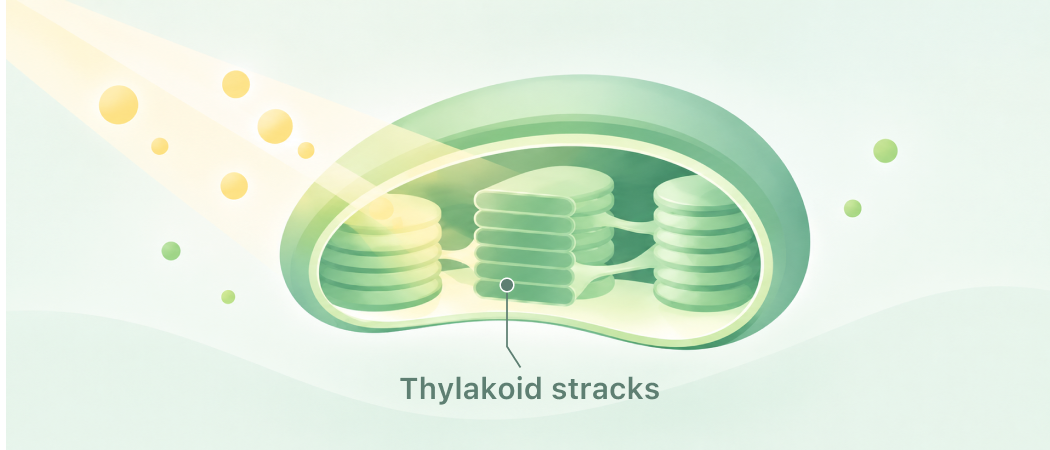
Here is one chloroplast. The cutaway reveals stacks of flattened membrane sacs called thylakoids. One stack is a granum. The fluid around the stacks is the stroma. We need just those two locations for today's idea: membranes capture energy, and reactions in the surrounding fluid use that support to build carbon compounds
Thylakoid stacks sit in the carbon-building stroma
Green means light-absorbing pigment.
Chlorophyll is a pigment that absorbs light. It works with proteins in the thylakoid membranes. The membranes are not shelves holding finished sugar. They are organized working surfaces that make the first stage of photosynthesis possible
Chlorophyll works in thylakoid membranes
Energy comes in. Carbon gets built.
1. Two places: Keep two places in view: thylakoid membranes and the stroma around them. Both are inside one chloroplast. The membranes capture light energy; reactions in the stroma use that support to build with carbon


2. Light: Chlorophyll-containing machinery captures light in thylakoid membranes. These light reactions use water and release oxygen. The oxygen comes from water; sunlight supplies energy, not carbon atoms
3. Carriers: The light reactions make ATP and NADPH, temporary resources for chemical building. They connect energy capture to reactions in the stroma, where carbon dioxide supplies carbon

4. Carbon: Reactions in the stroma use carbon dioxide, ATP, and NADPH to build small carbon compounds. These can become sugars and other materials. Carbon comes from carbon dioxide; energy came from light

5. Lights off: With the light off, fresh light capture stops. Carbon building cannot continue indefinitely without resources from the light reactions. Stored sugars remain, and mitochondria can still help supply energy for work

One change. One clear explanation.
Plenty of light. No fresh carbon.
Light is still available, but carbon dioxide is no longer supplied to the carbon-building reactions. Separate energy from material: can extra light replace missing carbon atoms?
Light stays on, but the CO₂ supply stops