Phospholipids Build a Membrane
Water-friendly heads and oily tails explain the membrane bilayer, its ability to reseal small disruptions and the selective routes used by different particles.
A boundary with two faces
Cell membrane
The plasma membrane forms a boundary around a cell

Your cells are watery inside, and fluid surrounds them outside. Yet each cell keeps a distinct boundary. What can make a barrier in all that water? A phospholipid has a water-friendly head and two oily tails. Heads meet the water; tails gather away from it. These opposite preferences organize the membrane
A flexible boundary
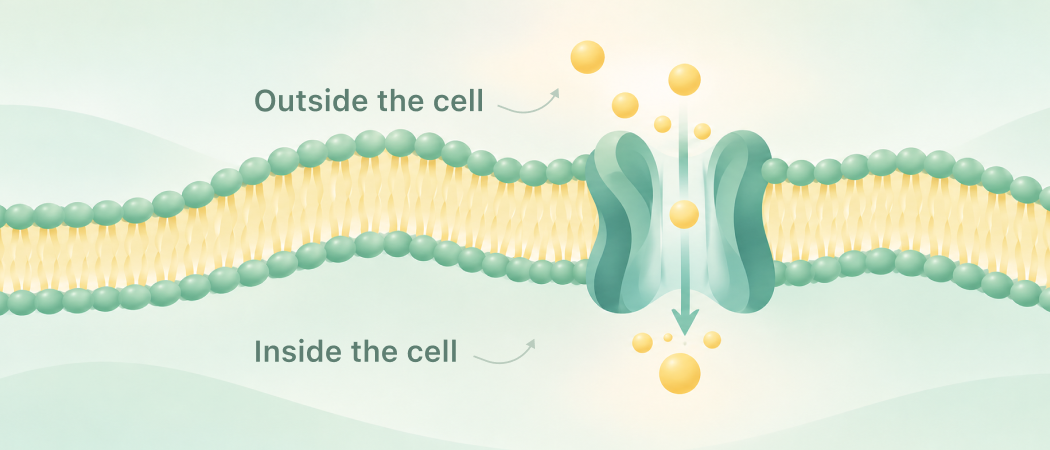
The membrane is a moving arrangement, not a solid shell. Lipids can slide sideways, while embedded proteins give particular substances routes across the boundary. The oily core stays continuous around those proteins, so adding a route does not leave an unprotected hole. Water on both sides · a sheltered lipid core Proteins provide selective routes
Why a bilayer closes
Build and reseal
1. Bilayer. Place two layers back to back. Heads face water on both sides, while tails meet in the middle. That sheltered core explains the bilayer's arrangement

2. Exposed edge. Now picture a small tear. Oily tails at the edge touch water, an unfavorable contact. Because lipids can move, the exposed edge need not stay open

3. Reseal. As the edges meet, tails become sheltered again. A small disruption can therefore reseal. Large tears need cellular repair; this simple rearrangement cannot mend every injury

The reason for closure
Follow the cause: exposed tails favor rearrangement, and rearrangement reduces their contact with water. Exposed tails → Lipids rearrange; Lipids rearrange → Water contact decreases
Predict what can cross
Read the oily core

Oxygen is small and nonpolar, so it can enter the oily core and cross. Sodium carries a charge and holds a watery shell. That makes the same route unfavorable for sodium
Size and chemistry matter
Water crosses the lipid core slowly, but aquaporin channels make its passage much faster. Ions and large polar solutes usually require suitable proteins. A thin boundary can therefore be selective without being a completely sealed wall. To predict passage, check the particle's chemistry as well as its size
| Particle | Across the lipid core |
|---|---|
| O₂ | Readily |
| Water | Slowly; aquaporins speed passage |
| Ions / large polar solutes | Need suitable transport routes |
Takeaway
The arrangement that makes the boundary also explains what can pass through it