Golgi Apparatus and Protein Sorting
Building a protein and delivering it are different jobs. Follow one protein from the rough ER through Golgi modification and sorting to release by exocytosis, and explain why blocked membrane fusion leaves the cargo enclosed.
Made is not the same as delivered.
Protein delivery
Imagine ordering a useful item, only for it to be delivered to the wrong place. Cells have that problem too. Building a protein is not the whole job. The Golgi apparatus helps modify and sort many proteins and lipids. We will follow just one protein that the cell will release outside, so the route stays manageable
A protein must reach the right destination
Golgi apparatus
Golgi apparatus
3D model of the Golgi apparatus, a stack of membrane sacs
The Golgi is a stack of flattened membrane sacs. They contain spaces where chemical processing can occur
Stacked sacs modify, sort, and package membrane-bound cargo
The small round bubbles nearby are vesicles: membrane-enclosed carriers containing cargo. A vesicle is not a solid ball of protein. Its membrane keeps the cargo separated from the surrounding cytoplasm
Vesicles carry cargo inside a membrane
The Golgi's two sides
Cargo generally arrives from the endoplasmic reticulum, shortened to ER. The receiving side is called cis, and the shipping side is trans. You can forget the Latin words for a moment and keep the direction. The Golgi receives material, works on it, and routes it onward
Cis receives. Trans ships
Receive. Refine. Route.
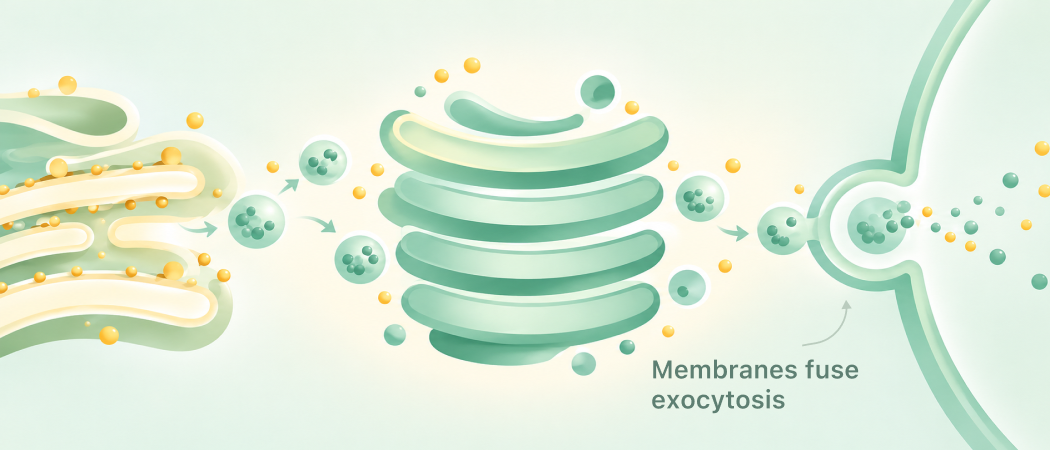
1. Make: Follow one protein destined for release outside the cell. It starts at the rough endoplasmic reticulum, or ER. Ribosomes build the chain, while the ER begins folding and processing it

2. Receive: A vesicle buds from the ER and carries enclosed cargo toward the Golgi. When its membrane merges with the receiving side, the cargo is delivered into the Golgi

3. Modify: The Golgi modifies and sorts this cargo. The small green branches represent adjusted sugars, not written address labels. Molecular features help direct the cargo to a suitable destination

4. Ship: An outgoing vesicle encloses our cargo and travels toward the cell membrane. This shipment is going outside; other Golgi shipments can have destinations inside the cell

5. Fuse: The vesicle membrane fuses with the cell membrane, opening the inside of the vesicle to the outside. Cargo is released by exocytosis, not pushed through the oily lipid layer

One change. One clear explanation.
The shipment is packed.
Our protein has already been built, modified, and packed. The problem happens at the final delivery step: the vesicle cannot fuse with the cell membrane
The outgoing vesicle cannot fuse with the cell membrane