Diaphragm Movement and Inhalation
The diaphragm contracts and moves downward to expand the chest and lungs. This briefly lowers pressure inside the lungs, allowing air to flow inward through open airways. During a quiet exhale, lung recoil reverses the pressure difference and air flows out. In either direction, net airflow stops when inside and outside pressures are equal.
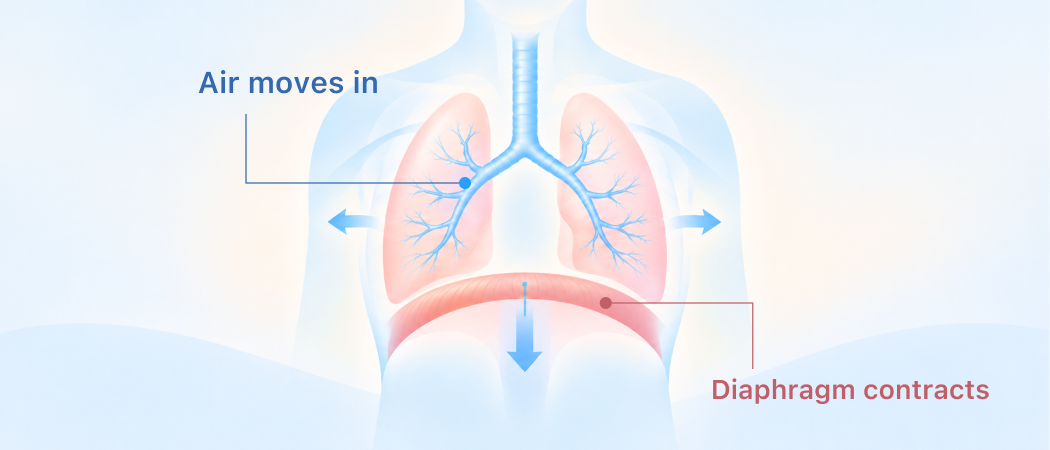
The muscle that makes room.
Diaphragm
Diaphragm
3D model of the thorax with the diaphragm below the lungs
Take a quiet breath and meet your diaphragm, the dome-shaped muscle below your lungs that helps make room inside your chest
This muscle makes room for a breath
Branching airways
Branching airways
3D model of the branching airways inside the lungs
Follow the branching airways: these open tubes carry air into the lungs, but the tubes themselves do not pull air inward
Open tubes connect outside air to the lungs
Alveoli
Alveoli
3D model of alveoli at the ends of the airways
At the ends of the smallest airways are alveoli, tiny air spaces where a breath brings oxygen close to the blood
Tiny air spaces receive the incoming air
Follow one quiet breath.
1. Rest: Before this quiet breath begins, air pressure inside the lungs matches outside pressure, so there is no overall airflow through the airways

2. Contract: The diaphragm contracts and moves downward, changing from a taller dome into a flatter shape beneath the lungs at the start of inhalation

3. Expand: The chest expands, and the lungs follow because their outer surfaces are normally coupled to the chest wall by thin, moist pleural layers

4. P ↓: As the air inside has more room to spread out, its pressure briefly drops below the pressure of the air outside your body

5. Air in: Now air moves through the open airways from higher pressure outside toward lower pressure inside, filling some of the extra space in the lungs

6. Equalize: As incoming air fills that extra space, pressure inside the lungs catches up with outside pressure near the end of a quiet inhale

7. Stops: With the pressures now equal, net airflow pauses even though the lungs remain expanded, so a bigger lung does not always mean moving air
